
Architect Alexis Dornier discusses his topography-driven approach to residential design at Tampah Hills, Lombok, where circular geometries and material restraint create a home that descends the hillside as naturally as the terrain itself.
There is a particular kind of architecture that emerges when a designer stops fighting the land and starts listening to it. Nyrenstone Estate, completed in 2024 on one of the steepest slopes of Tampah Hills in South Lombok, belongs firmly to this category. Designed by Alexis Dornier, the 1,117-square-meter residence doesn’t perch on the hillside so much as cascade down it, tracing a geometry of circles and tangents that feel less imposed than discovered.
LATEST ARCHISCENE INTERVIEWS
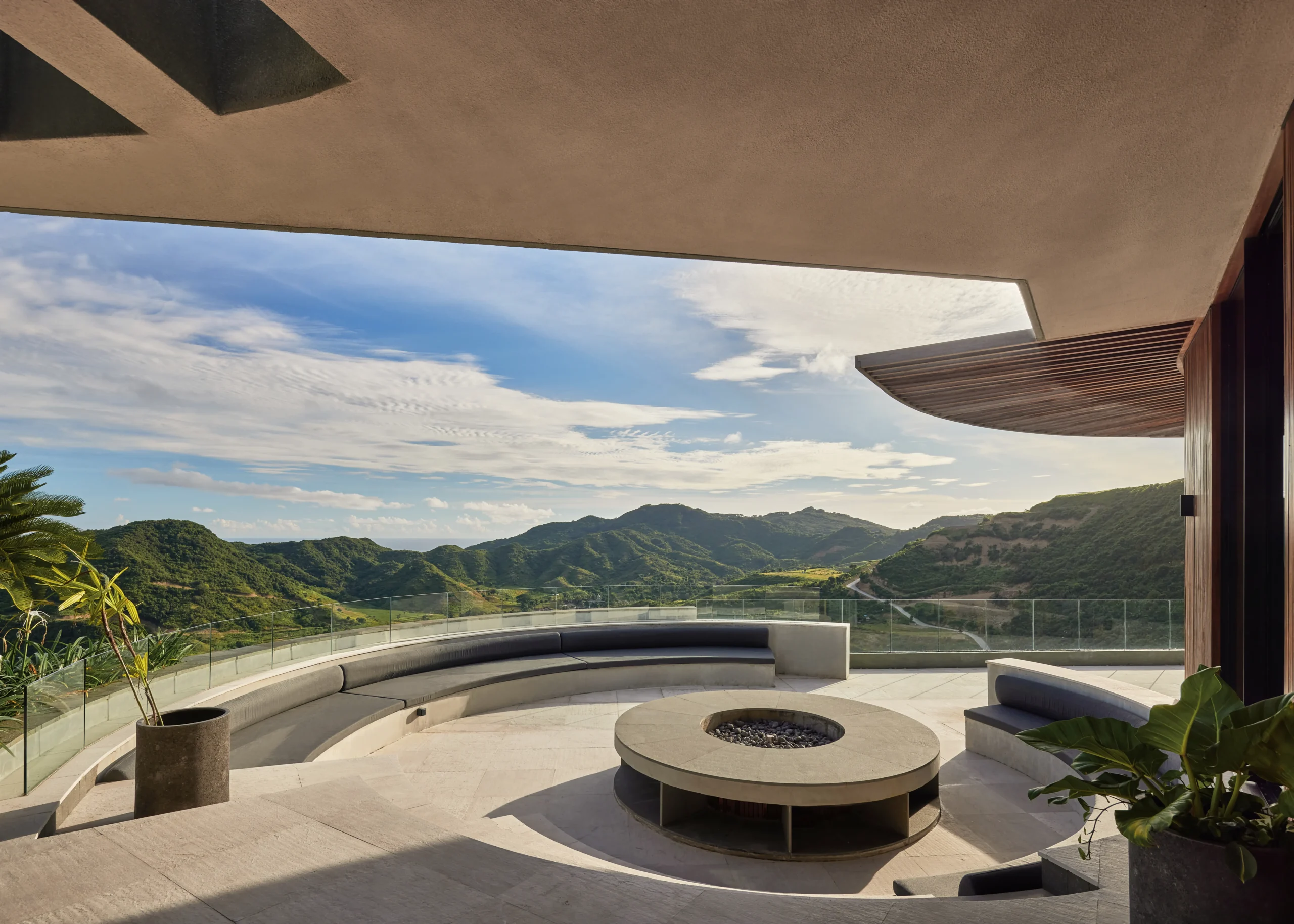
The project accommodates two families across multiple levels, with communal spaces anchored by circular forms: lounges, dining areas, fireplaces. Private wings branch outward along tangents. A circular yoga platform crowns the composition at the summit, offering unobstructed views across the bay. The descending sequence mirrors the curve of the coastline below, creating an architecture that frames rather than dominates its dramatic setting.
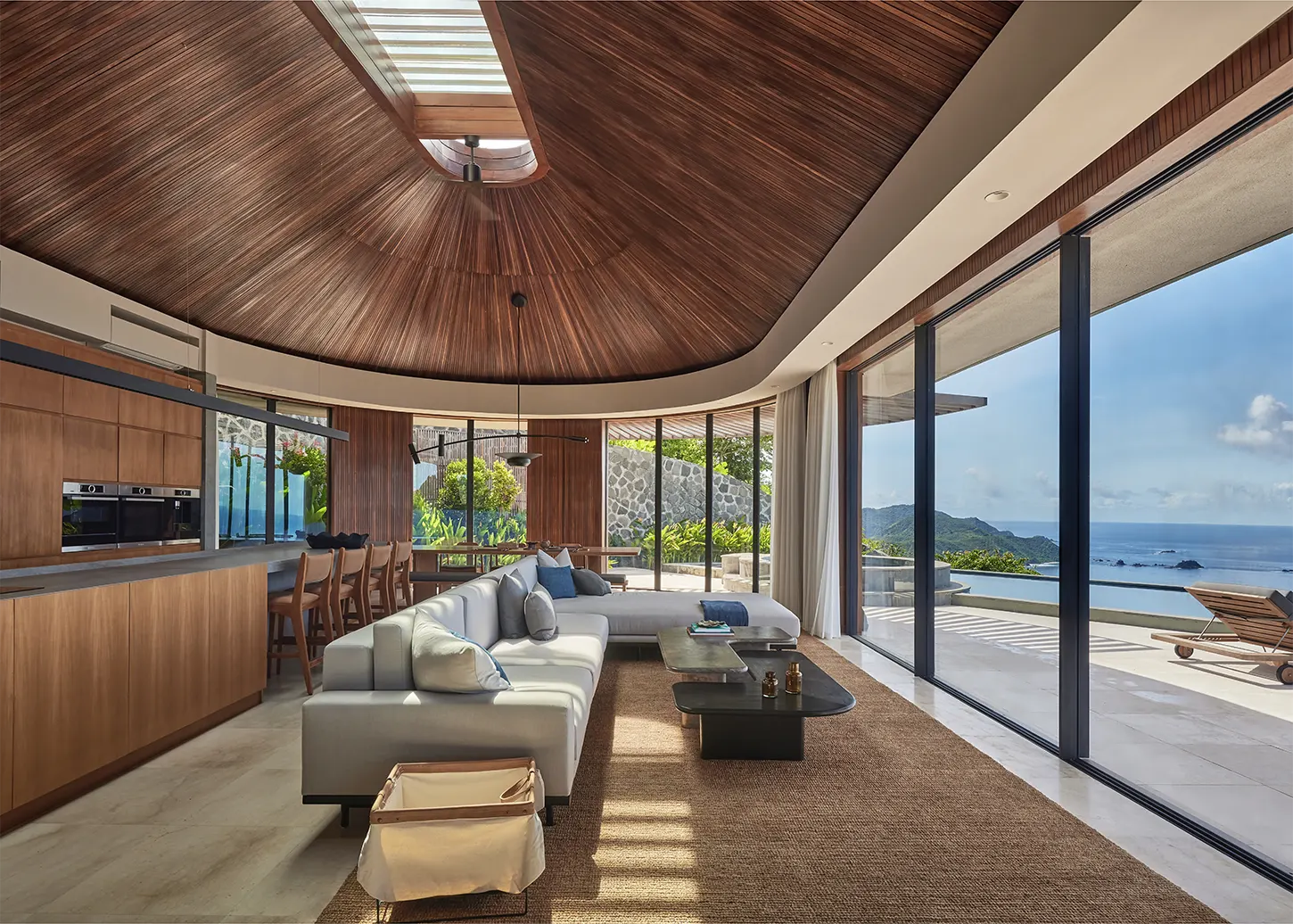
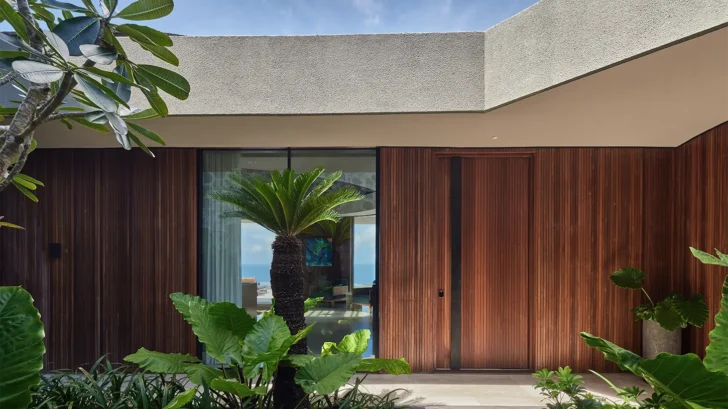
Dornier’s approach here recalls the spatial ambitions of John Lautner, particularly in how roofs extend to guide the eye and how space flows freely around strong geometric anchors. Yet the material palette, warm teak ceilings, off-white walls, pale Palimanan stone floors, remains deliberately subdued, allowing the landscape to carry the drama while the architecture recedes into quiet presence.
Working with construction partner Tunas Jaya Sanur, landscape architects WIND Landscape, interior specialists Somewhere Concept, and environmental consultants Eco Mantra, Dornier navigated the considerable challenges of building curved geometries on a steep gradient. The result is a residence that appears effortless despite its underlying complexity.
In this conversation with ARCHISCENE Editor-in-Chief Zarko Davinic, Dornier reflects on the design process behind Nyrenstone Estate: from early orthogonal studies that were ultimately abandoned, to the social logic governing each circle’s radius, to the disciplined restraint required when geometry already speaks loudly. He discusses the delicate balance between togetherness and privacy, the role of landscape as spatial completion rather than afterthought, and his ambition to create something “sculptural yet quiet, rooted in place yet open to the horizon.”
The project embraces one of Tampah Hills’ steepest gradients rather than fighting it. At what point in the design process did the circular geometry emerge as the solution, and were there earlier iterations that took a more conventional orthogonal approach before being abandoned? – The circular geometry emerged once we accepted that the steepness of the site should remain legible rather than corrected. Early studies did test more conventional orthogonal layouts, but they relied heavily on cut-and-fill and produced disconnected levels. The moment we began working with circles and tangents, circulation, structure, and the natural fall of the terrain aligned into one coherent system. The geometry allowed the house to step down the slope fluidly while maintaining continuity.
You’ve described the circular forms as corresponding to communal spaces, lounges, dining, fireplaces. How did you determine the specific radii and proportions of each circle, and what role did human scale and gathering dynamics play in those decisions? – Each circle was conceived as a social instrument before it was a formal gesture. Radii were tested against real patterns of gathering, how people sit, move, pause, and interact around dining tables, fireplaces, and lounges. Human scale was the governing factor, with the geometry simply making those relationships explicit. Tangents between circles create natural thresholds and transitions, guiding movement without rigid corridors.
The project has drawn comparisons to John Lautner’s residential work, particularly in its roof extensions and view framing. Was Lautner a conscious reference during design development, or do you see these similarities as coincidental outcomes of similar site conditions and spatial ambitions? – The comparison is understandable given the emphasis on roof lines, horizontality, and view framing, but John Lautner was not a literal reference during the design process. The similarities stem more from shared ambitions than direct influence: responding to dramatic terrain, using structure to frame the horizon, and allowing the roof to perform spatial and climatic work. The site itself was the primary driver.
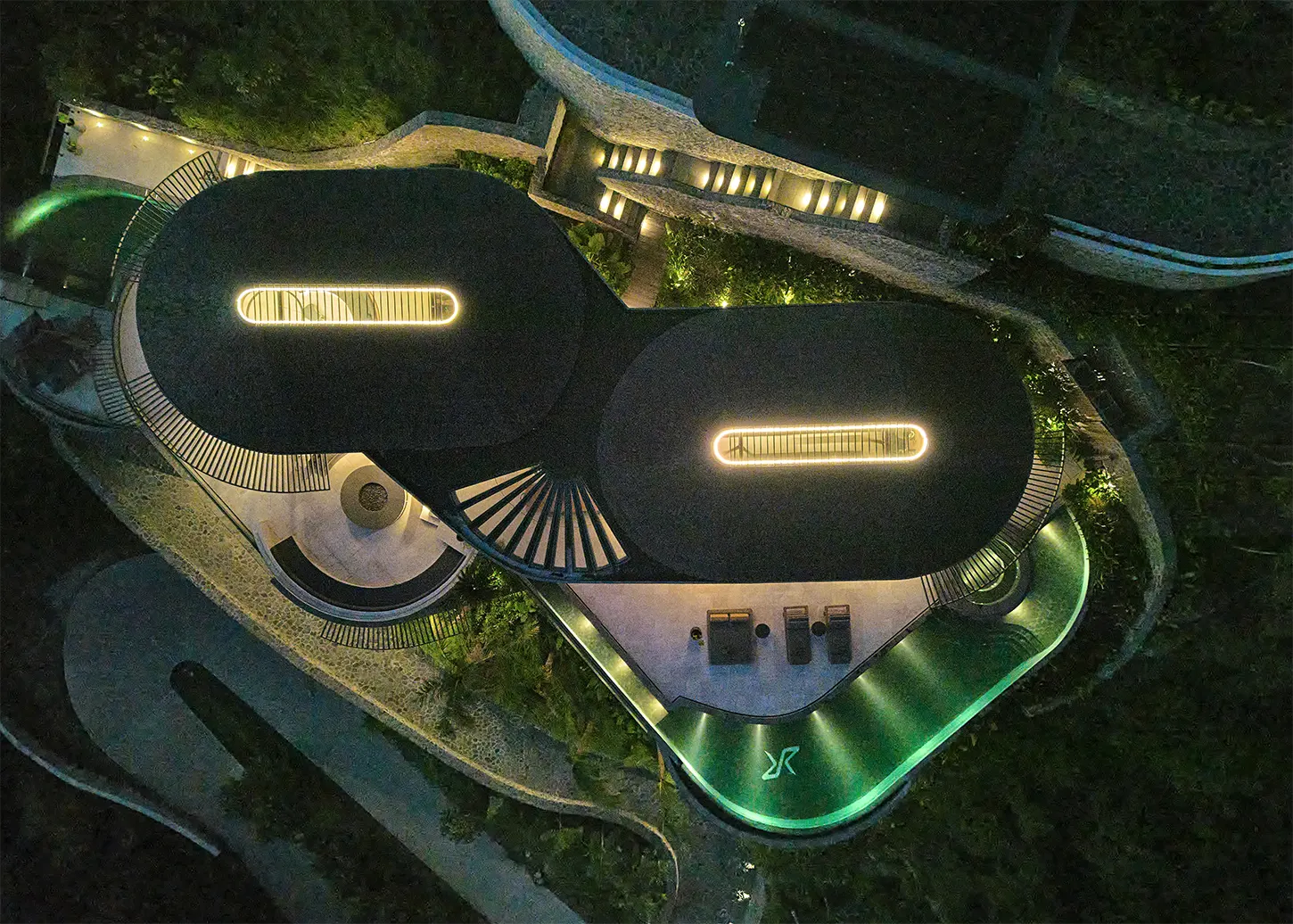
Nyrenstone accommodates two families with distinct private wings while sharing communal cores. How did you negotiate the balance between togetherness and privacy, and what architectural devices ensure both conditions are met without compromise? – The project balances togetherness and privacy through level changes, curvature, and sequencing rather than hard separations. Communal spaces are concentrated in shared circular cores, intentionally designed as places of encounter, while private bedrooms branch off along tangents and across different elevations. This allows two families to coexist comfortably, connected by shared experiences, yet able to retreat without compromise.
The palette, warm teak, off-white walls, Palimanan stone, is deliberately subdued. In a project with such strong formal gestures, was there ever pressure, internal or from clients, to introduce bolder material contrasts, and how did you resist or navigate that? – Because the geometry is already expressive, restraint in materials was essential. Teak, off-white walls, and Palimanan stone provide continuity and calm, allowing light, shadow, and landscape to carry the drama. There was always the temptation to introduce stronger contrasts, but discipline was key, the palette is meant to age quietly and let the architecture breathe rather than compete for attention.
The circular yoga deck crowns the composition with unobstructed bay views. Beyond its programmatic function, what role does this element play in the architectural narrative, is it a terminus, a punctuation mark, or something else entirely? – The circular yoga platform functions as a compositional full stop. It is less about program and more about presence, an elevated moment where the architecture releases itself to the horizon. In the sequence of the house stepping down the slope, this element acts as a punctuation mark, anchoring the project between ground and sky.
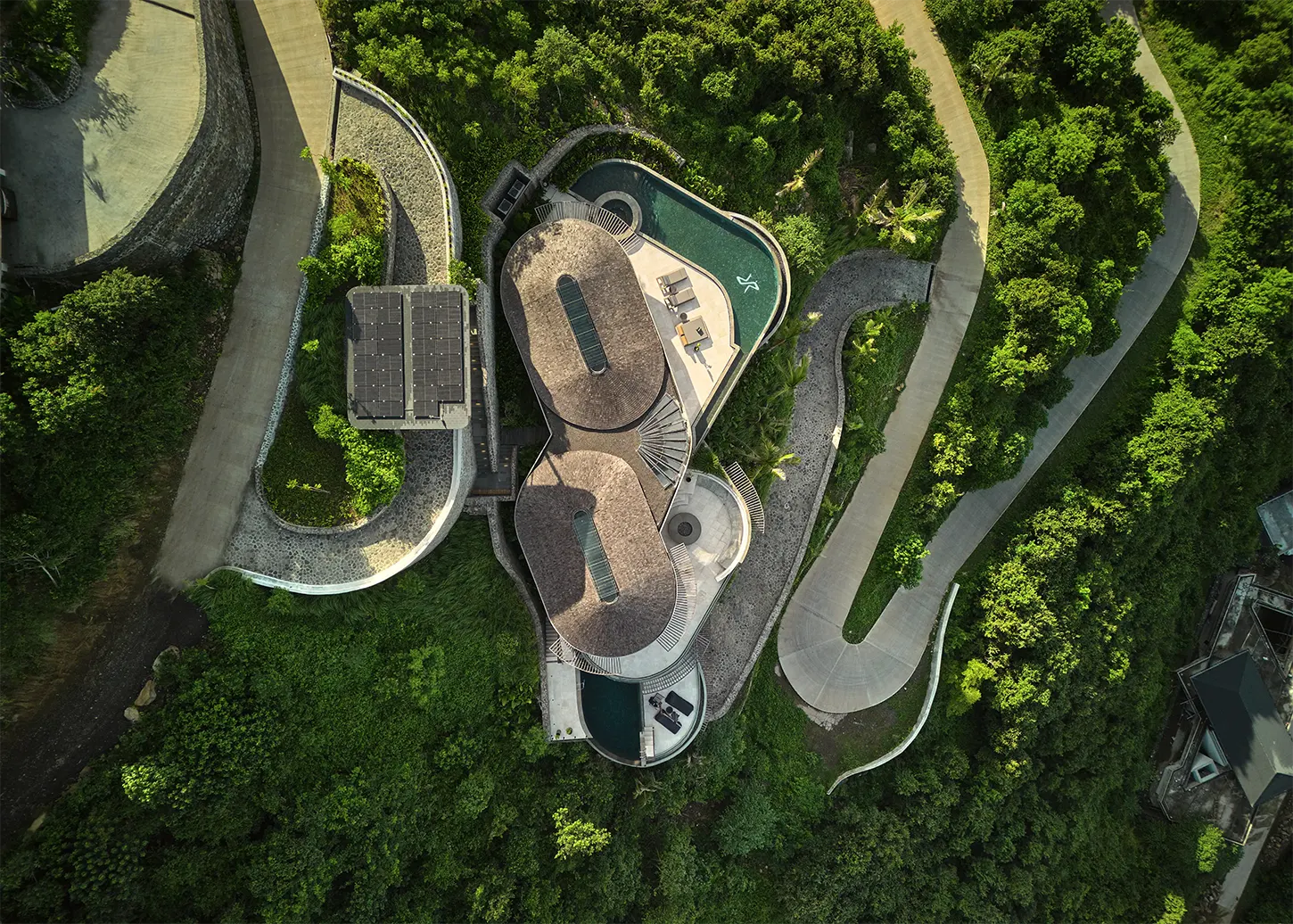
Working with Adi Jaya Utama on a steep slope with curved geometries presents significant structural and logistical challenges. What were the most demanding construction moments, and how did the build process influence or refine the final design? – The most demanding aspects were setting out true curves on a steep site and coordinating structure, retaining, and access simultaneously. Curved geometries require precision, especially where circles meet tangents and levels step down the hill. The construction process refined many details—joints, tolerances, drainage—ensuring the final result feels effortless despite the complexity behind it.
WIND Landscape handled the site work. How early were they brought into the process, and to what extent did landscape decisions, planting, grading, pathways, inform architectural choices rather than simply responding to them? – Landscape was integral from the outset. The architecture and terrain are inseparable, and planting, grading, and pathways complete the spatial sequence rather than simply surrounding it. The intention was for the house to feel grown into the hillside, with softened edges and circulation that follows natural desire lines rather than imposed routes.
This project sits within a broader masterplan context. How do you see Nyrenstone Estate in dialogue with its neighbors, does it set a precedent, respond to one, or deliberately stand apart? – Nyrenstone Estate responds first to topography and views rather than to stylistic cues from neighboring projects. In that sense, it both participates in and extends the masterplan’s ambitions. It demonstrates that steep terrain can be inhabited calmly and generously, without resorting to a singular object placed on a dominant platform.
You describe the ambition as “sculptural yet quiet, rooted in place yet open to the horizon.” That’s a delicate balance. Looking at the completed project now, where do you feel the design most successfully achieves that equilibrium, and where, if anywhere, would you push further? – The balance is most successful where the geometry is clear but the experience remains calm—where movement through the house feels inevitable rather than staged. The project is sculptural in silhouette, yet quiet in tactility and atmosphere. If pushed further, it would be through time: allowing landscape growth and material weathering to deepen the sense that the architecture belongs fully to its place.
Discover more of the project in our gallery:
Photography by KIE
Location: Tampah Hills, Lombok
Total Size: 1117.14 m²
Architectural Design: Alexis Dornier – alexisdornier.com
Construction: Tunas Jaya Sanur
Photography by KIE
Landscape by WIND Landscape
Interior Design by Somewhere Concept
Environmental Design Eco Mantra