
On the edge of Nový Bydžov, a quiet Czech town defined by orchards, brick walls, and open horizons, a new Senior Citizens’ Home introduces an architectural response grounded in dignity, landscape, and community. Commissioned by the Town of Nový Bydžov and built on the site of a former orchard near the local hospital, the project replaces conventional institutional models with a spatial concept rooted in domestic scale and autonomy. Designed by Architektura as a fully barrier-free, single-story complex for approximately sixty residents, the building reframes senior living through light, gardens, and the archetypal presence of brick.
RESIDENTIAL
The site carries strong symbolic weight. Across the street, a cemetery and church establish a quiet threshold at the town’s entrance, while the surrounding terrain opens into fields and forests typical of the Central Bohemian landscape. Rather than resisting these associations, the architecture engages them directly. The building stretches horizontally across the plot, low and grounded, echoing the scale of cemetery walls while maintaining visual continuity with the flat terrain. Its placement invites calm and contemplation, reinforcing the site’s identity as a place of reflection.
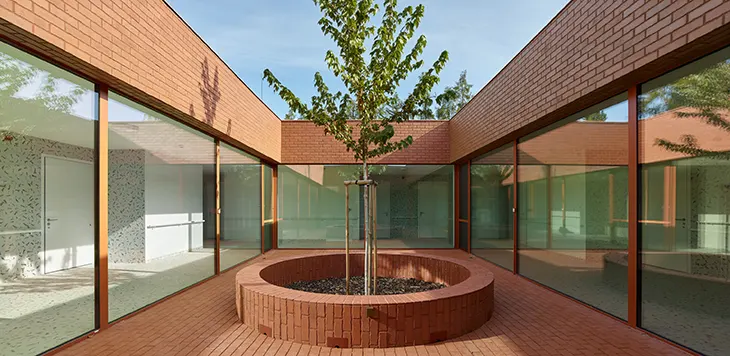
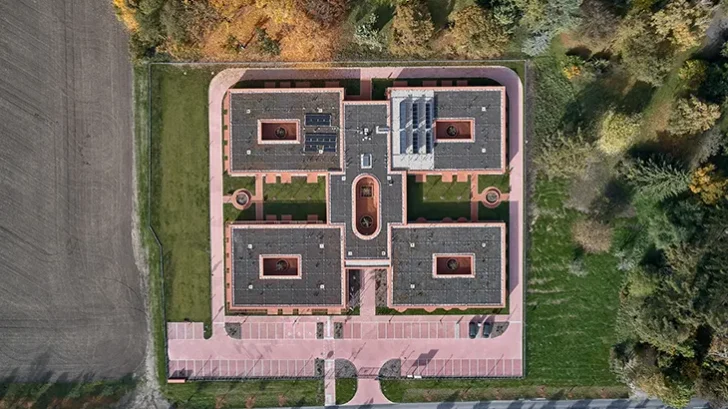
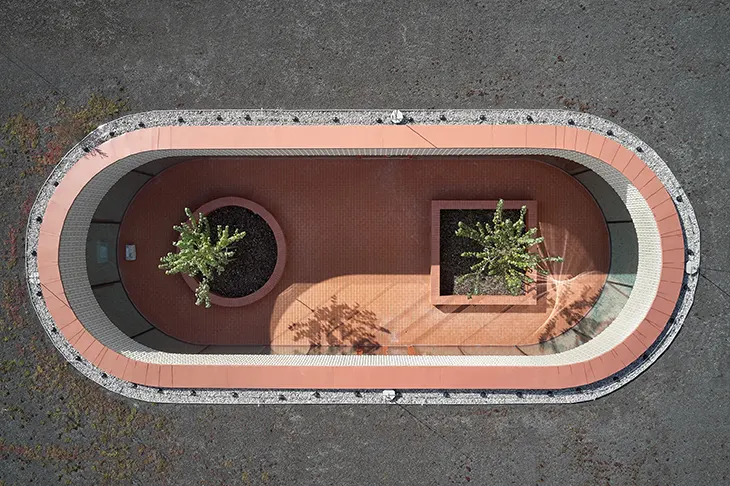
The plan organizes the residence into four independent households arranged around a central core, forming a composition reminiscent of a four-leaf structure oriented toward the cardinal directions. Each household accommodates approximately fifteen residents and staff, ensuring manageable scale and operational independence. This arrangement avoids long institutional corridors. Instead, rooms cluster around internal atriums, where circulation unfolds along light-filled pathways overlooking planted courtyards. These atriums establish visual continuity with nature and introduce daylight deep into the interior.
The central entrance on the south side leads into a reception hall connected to a large oval atrium, which functions as the spatial and social center of the building. From here, visitors and residents move toward individual households, each with shared living spaces, staff facilities, and direct access to both private courtyards and larger communal gardens. Every resident room includes its own terrace, extending living space outdoors and reinforcing personal autonomy.
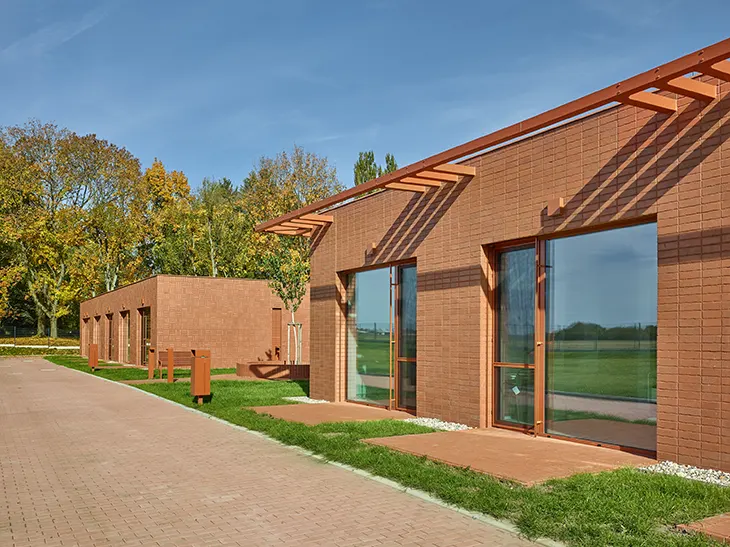
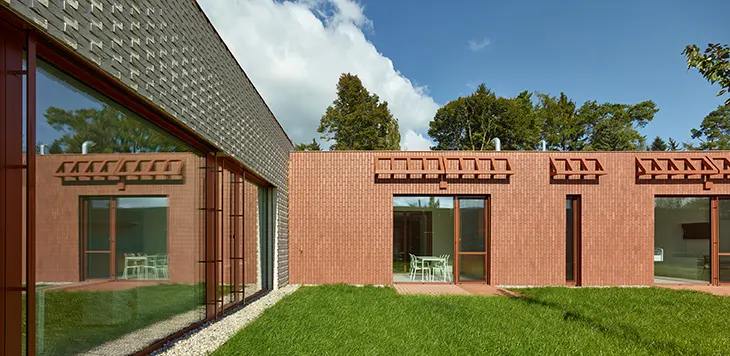
Material expression reinforces the building’s connection to place. Brick façades reference the historic masonry walls of the adjacent cemetery while establishing a durable and familiar exterior identity. French windows punctuate the façades at regular intervals, creating direct visual and physical links to terraces and gardens. Subtle variations in brick patterns and shading devices distinguish each household, introducing individuality within a unified architectural language. Steel structures and differing cornice treatments further articulate orientation and exposure to sunlight.
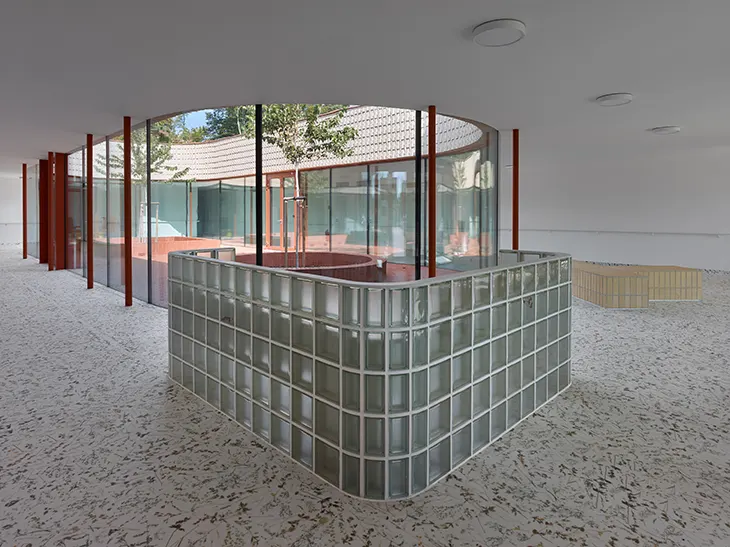
Inside, brick surfaces continue into shared areas, balanced by white finishes that amplify daylight and spatial clarity. Flooring introduces an unexpected layer of narrative: photographic imprints of local grasses and wildflowers appear across corridors and thresholds, grounding the building in its ecological context. Each household takes its name from regional plant species, Grass, Chamomile, Dandelion, and Bartsia, transforming botanical identity into spatial character.
The building prioritizes movement as a daily ritual. Its ground-level configuration allows residents to circulate freely through interior corridors, atriums, and gardens without encountering barriers. Walking becomes both functional and symbolic, reinforcing autonomy and physical engagement with space. Gardens serve as extensions of living areas, offering spaces for rest, reflection, and informal social interaction.
The Senior Citizens’ Home in Nový Bydžov presents architecture as a framework for aging with dignity. Through its courtyard organization, material continuity, and integration with landscape, the project replaces anonymity with belonging. It establishes an environment where care and independence coexist, and where architecture supports the emotional and physical realities of later life through spatial clarity, light, and connection to nature.