
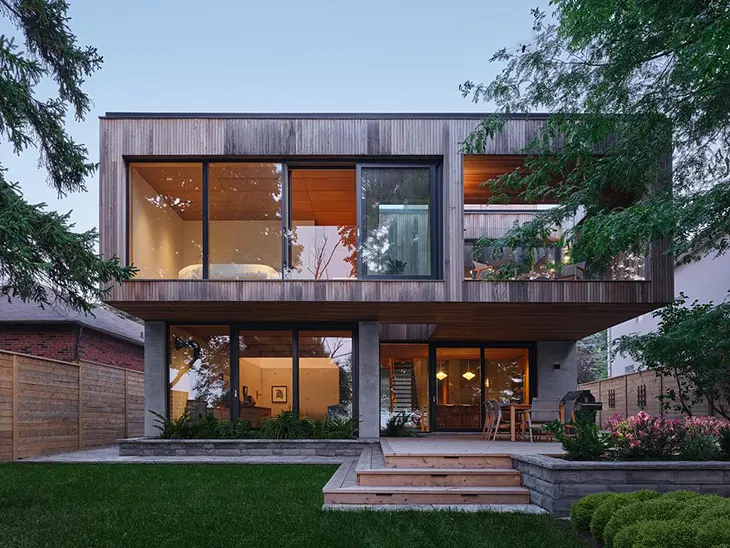
House of Monitors stands on a narrow suburban street above the Scarborough Bluffs, where land, structure, and domestic life meet under precise conditions. Designed by Williamson Williamson Inc., the residence approaches architecture as an instrument for measuring light, material, and construction. Developed in close collaboration with the homeowners, a resident scenic artist for the National Ballet of Canada, and a shoring engineer specializing in unstable ground, the project treats the house as an inhabitable section. Framed views, calibrated cuts, and layered spatial relationships allow occupants to read how the building stands, how it holds light, and how it meets the land.
HOUSING
The site’s sandy soils and fragile escarpment demanded an approach grounded in restraint. Concrete volumes rise from the bluff as inhabitable shoring, performing structural, spatial, and thermal roles at once. These volumes respond directly to the instability of the terrain while limiting disturbance to the edge condition. Above them, a wood-clad volume extends toward both the street and Lake Ontario, its cantilever creating tension between mass and void. Where concrete and wood intersect, the architecture opens itself through subtraction rather than excess, generating sectional depth, cross-views, and carefully modulated daylight throughout the house.
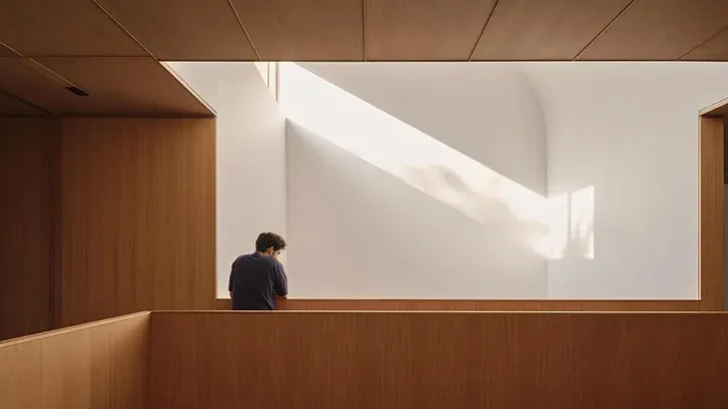
At the center of the plan sits a painting studio developed through iterative studies and virtual light simulations with the owner. The resulting space relies on a north-facing clerestory and a radiused ceiling that delivers even, controlled light across the working surface. Light here acts as material, shaped and directed rather than simply admitted. Throughout the house, white-painted light monitors pull daylight deep into the plan, reducing dependence on artificial lighting while giving spatial definition to volumes that rely on illumination instead of enclosure.
The broader context of the Scarborough Bluffs frames the project’s discipline. Once eroding at nearly a meter per year, the bluffs were stabilized in the 1960s through large-scale planting and engineering efforts that now read as natural terrain. House of Monitors acknowledges this constructed landscape by adopting a compact footprint and carefully positioned massing. The building respects neighboring houses and the fragile edge condition, favoring long-term stability and stewardship over visual assertion. The result is a house that sits with discretion, aware of both its geological limits and its suburban surroundings.
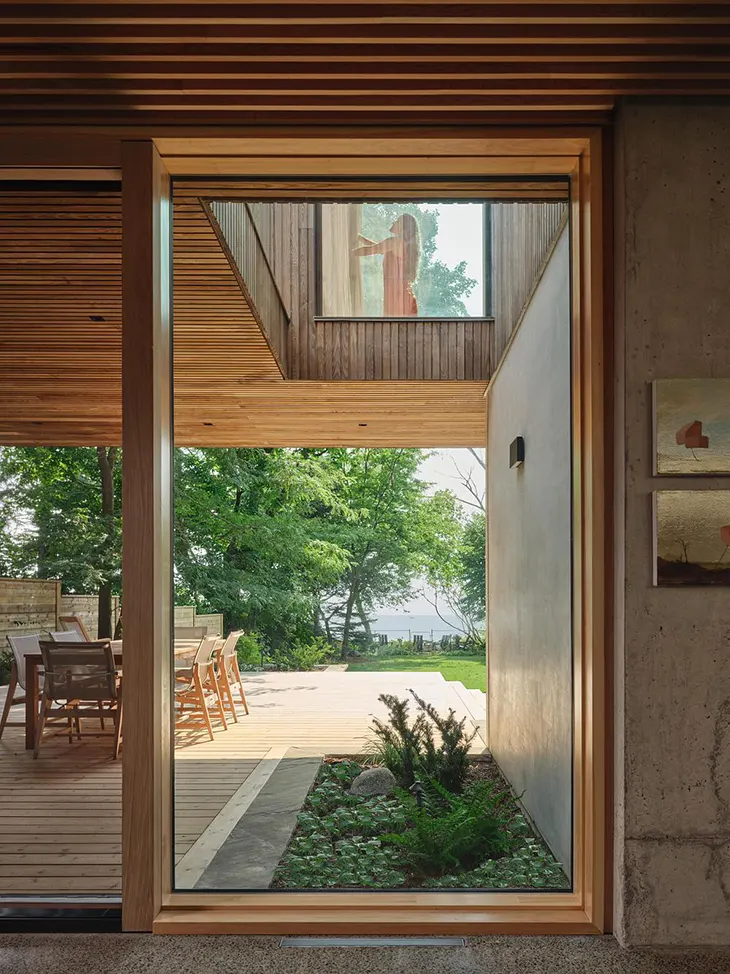
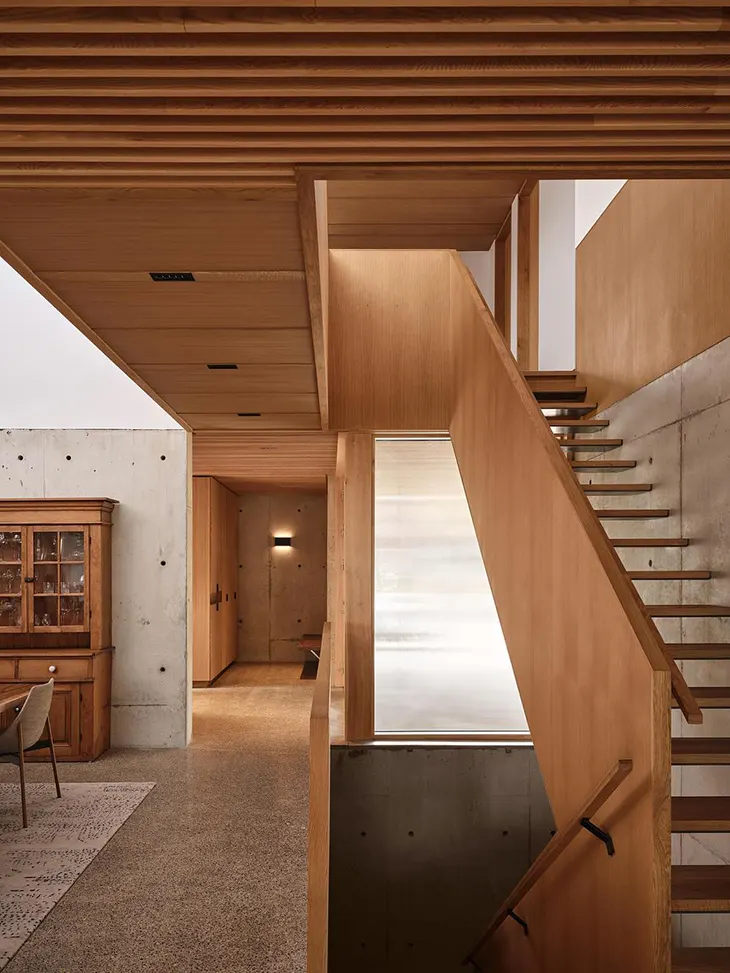
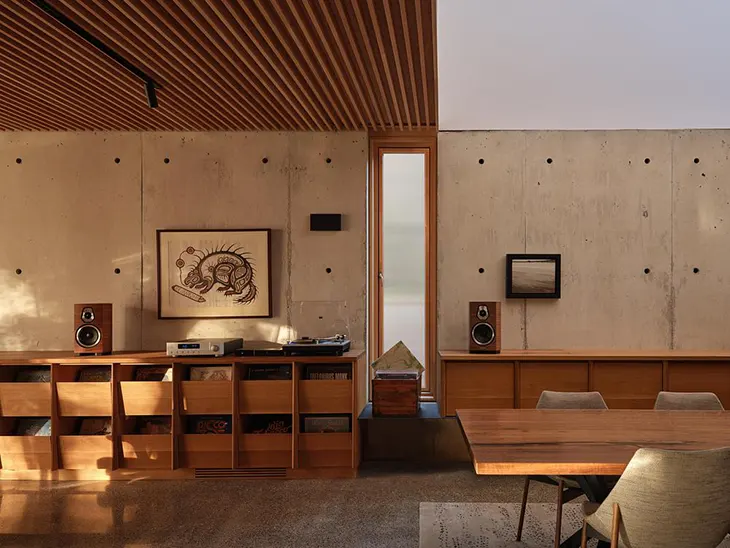
Arrival occurs beneath the front cantilever through a reeded glass door that admits daylight while preserving privacy along the tight street edge. Concrete forms the service core, anchoring the house to the bluff while acting simultaneously as structure, shoring, and thermal mass. Circulation and primary living spaces are lined with wood millwork, establishing a tactile counterpoint to the rawness of the concrete. The material palette prioritizes durability, repairability, and performance over time, allowing the building to age through use rather than concealment.
From the street, storage and pantry create a protective layer that supports daily routines before the plan opens toward the lake. Dining, kitchen, and living areas flank the stair, oriented toward expansive views. At the center, a 26-foot-tall light monitor defines a vertical room shaped by daylight alone, achieving generosity without increasing floor area. Above, bedrooms, office, and a secondary living space connect visually and spatially across levels, sharing light and views. The primary bedroom and deck face the lake, while secondary rooms rely on a slatted façade that moderates exposure to the street and allows spaces to adjust to changing needs.
As a private residence built on a sensitive site, House of Monitors offers a clear position on residential architecture today. Ambition here operates through clarity rather than scale, and environmental responsibility emerges from careful decisions about structure, material, and placement. The project demonstrates how architectural rigor, domestic comfort, and site stewardship can coexist through measured design rather than excess.
The 4,175-square-foot residence was led by partners Betsy Williamson and Shane Williamson, with Sonia Ramundi as part of the design team. Structural engineering was provided by Blackwell Engineering, with construction management by Ripple Projects. Craft and material execution involved BL Woodworking & Design for millwork, Woodbecker for wood ceilings and exterior siding, Torp for windows, TanTimber for exterior siding, and Berman Stairs for the stair. Lighting integrated vintage fixtures by the owner alongside systems from Lightline, WAC Lighting, and Titanium Technologie. Finishes and fixtures included Inax tile, Soprema roofing and barriers, Jenn-Air and Whirlpool appliances, Kohler bathtub, Benjamin Moore paint, Caesarstone kitchen counters, and Moncer wood flooring.