
UNS approaches Turin’s Metro Line 2 as a civic project that extends beyond transport. The proposal, selected by an international jury chaired by Dominique Perrault, positions infrastructure as an active part of the city rather than a hidden network beneath it. Developed with Settanta7, Mijksenaar, Frigorosso, 3BA, and WSP, the design translates Turin’s spatial logic into a contemporary system that prioritizes clarity, accessibility, and connection.
INFRASTRUCTURE
The project draws directly from the character of Turin, where movement has always defined urban life. From the Po and Dora rivers to the city’s long arcaded porticoes, circulation shapes how people experience space. UNS builds on this condition by framing the metro line as a new “urban river,” a continuous thread that links neighborhoods and reinforces daily movement patterns. This idea anchors the entire proposal, guiding both architectural form and user experience.
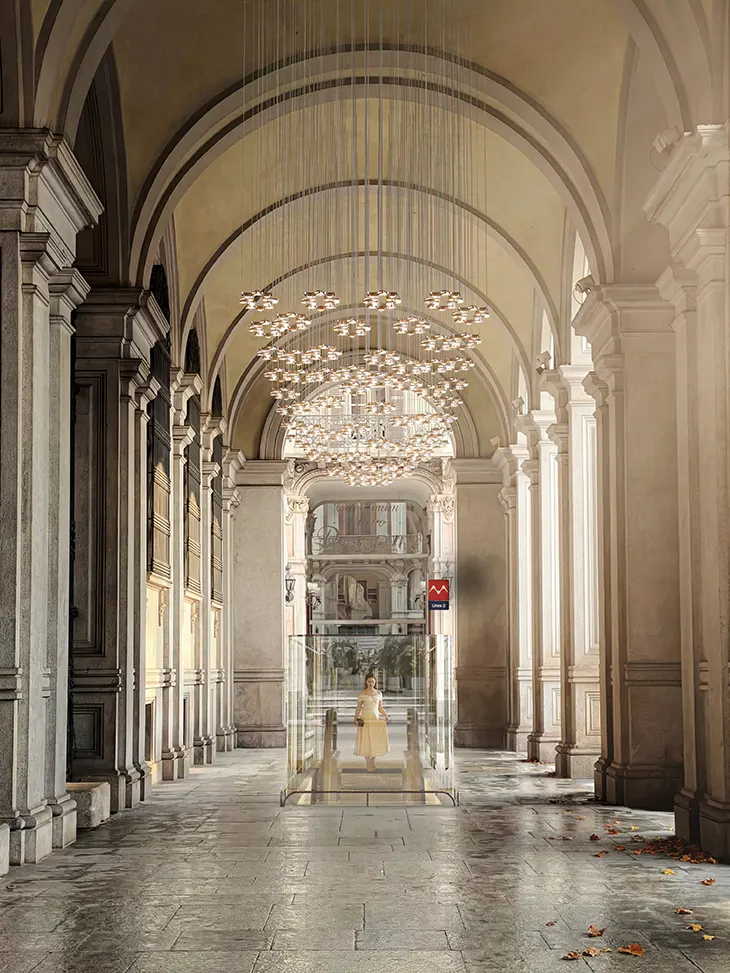
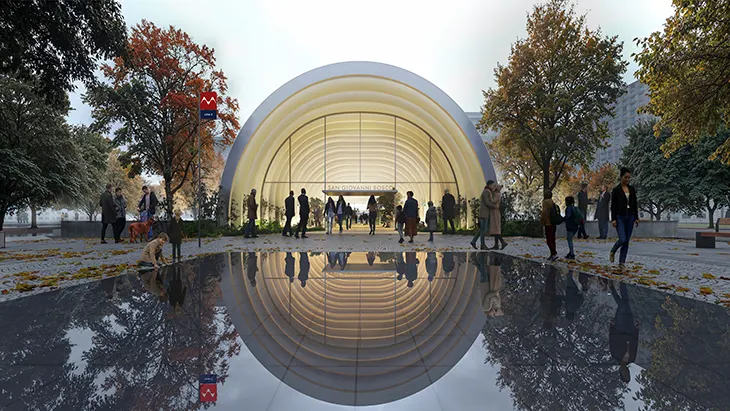
UNS grounds the design in Turin’s architectural contrasts. The city’s restrained exteriors and more layered interiors inform a sequence that moves from simplicity to richness. Station entrances adopt clear geometries that align with the city’s facades, while interior spaces introduce warmer materials and more expressive forms. This shift creates a legible transition between street and underground, reinforcing orientation while maintaining a sense of continuity.
The concept of transition also drives the formal language. The design moves from arches to porticoes, from curves to orthogonal shapes, reflecting both historical references and contemporary needs. This approach avoids visual excess and instead focuses on proportion, rhythm, and consistency across the network.
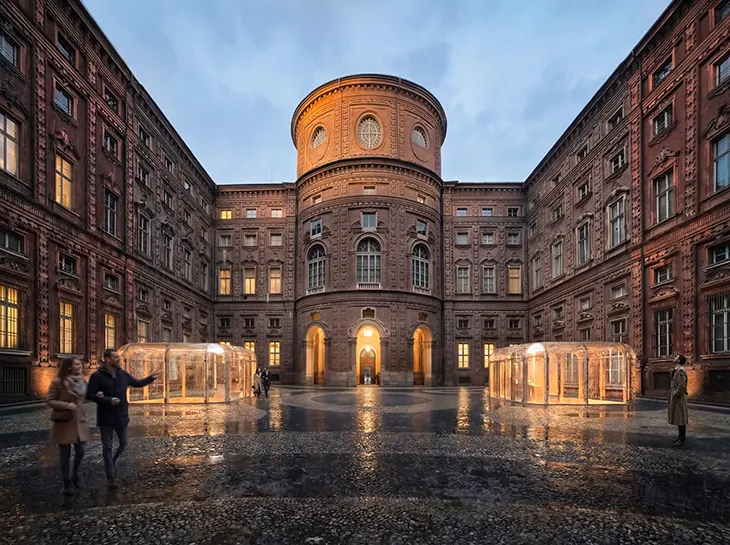
With 32 stations planned and an initial phase covering 10, flexibility becomes essential. UNS responds with a modular system that adapts to different urban conditions while maintaining a unified identity. Each station can adjust scale, layout, and program without losing coherence, allowing the network to evolve while preserving its core logic.
This modular approach proves particularly effective in key stations such as Mole Giardini, San Giovanni Bosco, and Carlo Alberto. Each location responds to its surroundings while remaining part of a larger system. The result avoids repetition while ensuring that users can recognize and navigate the network with ease.
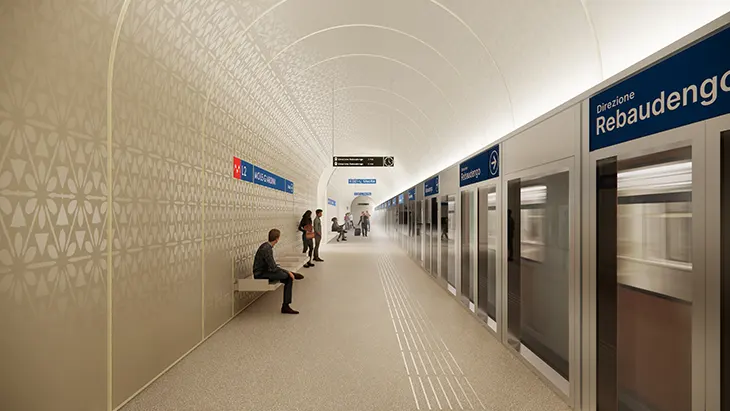
One of the project’s strongest aspects lies in its multi-layered identity strategy. UNS defines identity across three levels: network, system, and station. The network identity establishes a consistent visual language through signage, materials, and communication. The system identity extends this into the urban environment, ensuring that entrances and related elements remain visible and legible within the city. Station identity introduces local references through art, landscape, and thematic elements.
This structure supports both orientation and memory. Passengers can understand the system quickly while also forming associations with specific stations. The design avoids generic transit environments and instead creates distinct points of reference throughout the network.
UNS treats the metro as a continuous sequence rather than isolated spaces. The design considers every stage, from digital trip planning to movement through the station and onto the platform. This approach improves clarity and reduces friction, allowing users to move through the system with confidence.
Material choices reinforce this experience. Aluminum and porcelain stoneware provide durability, while terrazzo-inspired flooring references local history. Diffused lighting reduces glare and creates a calmer environment, supporting both comfort and visibility. These decisions focus on long-term use, ensuring that the system performs consistently under daily pressure.
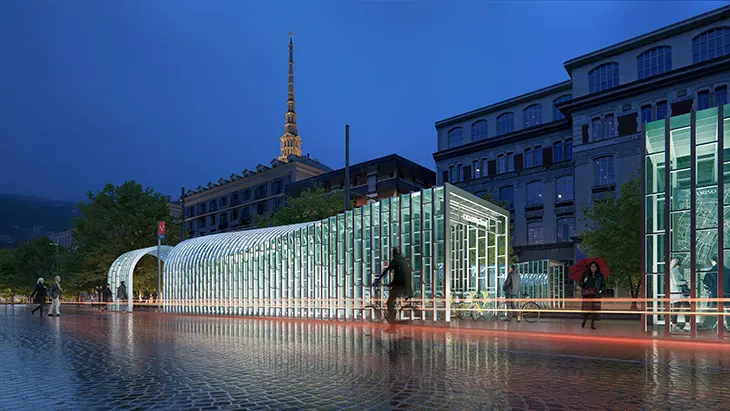
UNS positions Metro Line 2 as an extension of Turin’s public realm. Station entrances connect directly to surrounding parks and streets, allowing the boundary between infrastructure and city to dissolve. In some areas, the project integrates with green spaces, creating moments where transit and landscape intersect.
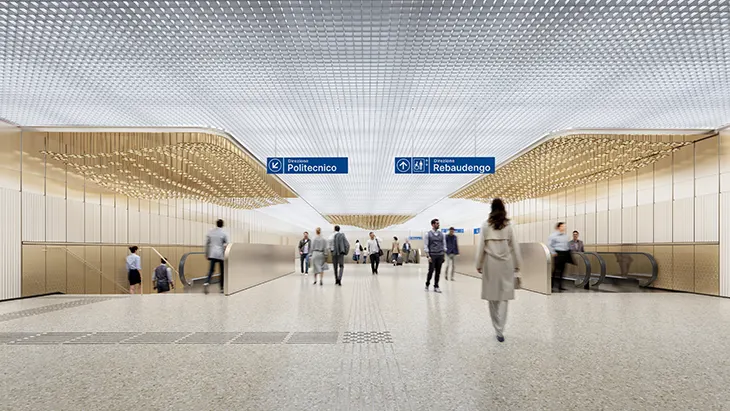
This approach reframes how infrastructure operates within the city. Instead of acting as a purely functional system, the metro contributes to urban life, offering spaces that support movement, interaction, and orientation. The design reinforces the idea that transport infrastructure can shape how people experience the city on a daily basis.
UNS delivers a proposal that prioritizes clarity, adaptability, and spatial continuity. By grounding the design in Turin’s existing logic while introducing a structured identity system, the project establishes a metro network that feels both connected and specific to its context.