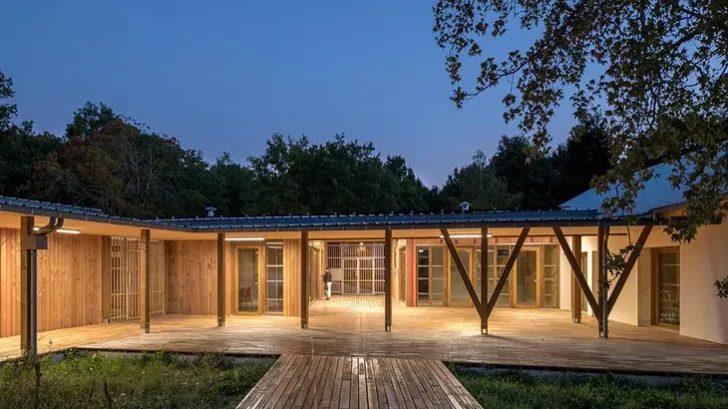

Set within a three-hectare former campsite near Limoges, the Leisure Centre with Dormitory represents a carefully calibrated response to landscape, childhood, and environmental responsibility. Designed by Atelier Quatre in collaboration with r2k architectes, the project transforms an underused site surrounded by remarkable trees into a year-round destination for leisure, learning, and overnight stays for up to 200 children. Project was photographed by Jean-François TREMEGE, continue for more:
INSTITUTIONAL ARCHITECTURE
The setting plays a defining role. Located near a lake and forested areas, the site had gradually returned to nature after years of disuse. Rather than clearing it, the project preserves mature trees and integrates four existing campsite buildings into the new programme. These renovated structures now house workshops, dining spaces, sanitary facilities, and support functions, extending the life of the site through reuse and continuity.
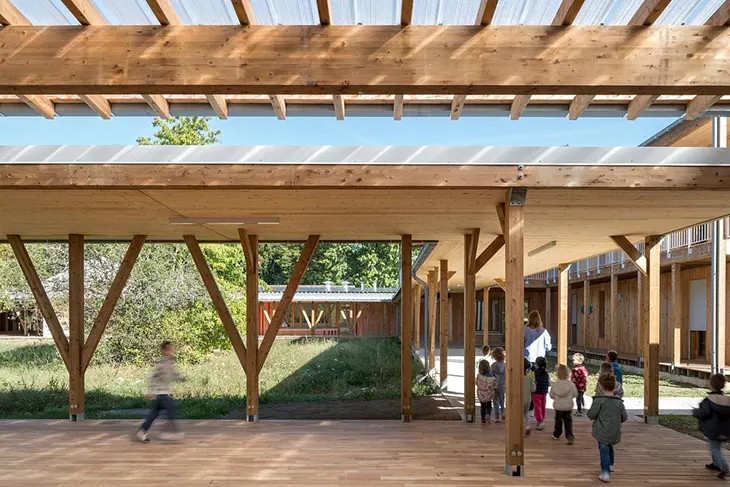
New construction follows the same logic of restraint and proximity. Buildings rely on local wood structures and straw bale insulation, with interior finishes favouring natural, healthy, and reused materials. The project achieved BDNA (New Aquitaine Sustainable Building) Silver certification, reflecting a holistic approach to carbon reduction, material sourcing, and long-term performance.
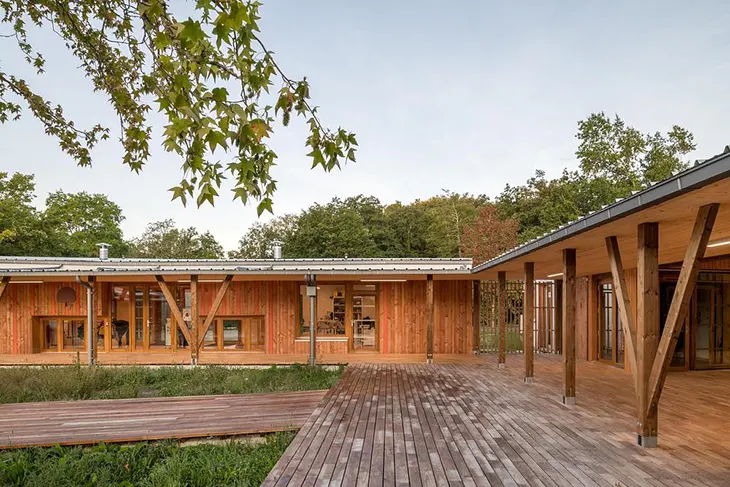
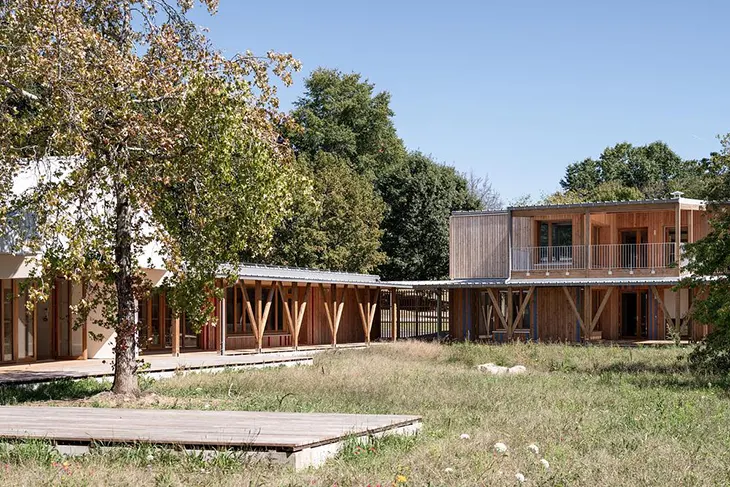
Arrival unfolds through a porch that opens onto a central lawn, the heart of the complex. A wooden gallery runs along this meadow, connecting all functions and establishing a clear, legible circulation system. This covered walkway becomes an architectural spine, guiding children from shared outdoor space toward reception, administration, activity rooms, accommodations, catering facilities, and kitchens. The experience remains reassuring and intuitive, reinforcing orientation through repetition and rhythm.
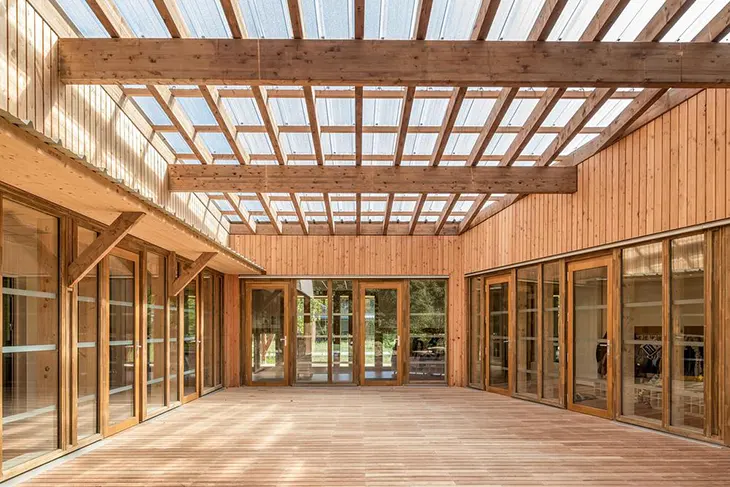
Each building maintains its own identity while sharing a common material palette. Natural wood cladding defines covered areas, while exposed façades use plaster for durability. Subtle colour accents distinguish the different houses, offering visual markers for children. Tree-like columns punctuate the gallery, reinforcing the sense of movement through a constructed landscape rather than a corridor.
Outdoor spaces extend the educational ambition of the architecture. Covered playgrounds allow year-round use, opening directly toward woodland edges. Excavated soil from the site was reused to shape hills, slides, tunnels, footbridges, and play landscapes that respond to the natural topography. A small outdoor theatre, sports fields, and archery zones are distributed throughout the wooded park, encouraging exploration and physical engagement with the terrain. Parts of the former campsite remain dedicated to outdoor immersion, moving from dense woodland to open meadows rich in biodiversity.
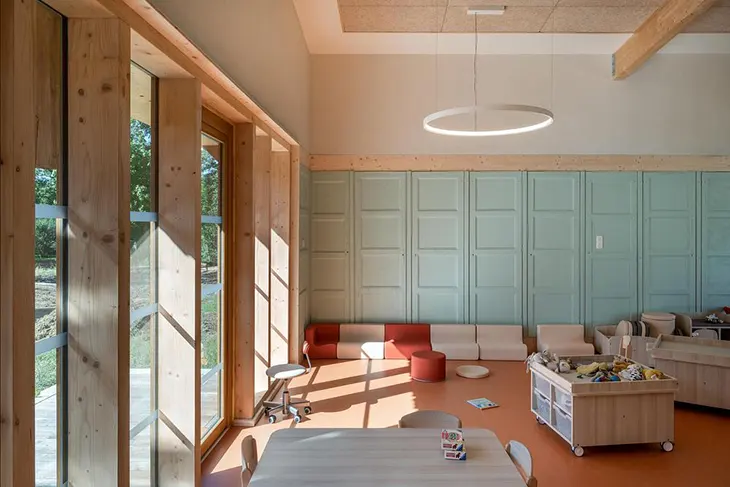
Interior spaces avoid classroom conventions. Activity rooms feature generous sloping ceilings and reused elements such as old doors repurposed as wall cladding, creating surfaces for expression and interaction. The architecture becomes educational in itself, exposing children to renewable materials and energy-conscious construction. Wood, straw, hemp, earth, and cellulose wadding contribute to acoustic comfort and stable indoor climates, supporting concentration and well-being.
The project places strong emphasis on collective process. Teaching staff, users, and the children’s municipal council participated from early design stages through to inauguration, reinforcing local ownership. Social inclusion remains central, with spaces designed to welcome children from all backgrounds and accommodate people with disabilities.
Energy performance supports this ambition. Buildings rely on bioclimatic design, careful insulation, and low-carbon systems. Air-to-water heat pumps supply underfloor heating, while photovoltaic panels on the reception and restaurant roof generate 78.4 kWp of solar energy. Rainwater management integrates drainage within the central courtyard and supports irrigation for the vegetable garden. Overall performance exceeds RE2020 requirements by nearly 40 percent, supported by dynamic thermal simulation to ensure summer comfort.
The Leisure Centre with Dormitory demonstrates how architecture can operate as a framework for care, learning, and environmental responsibility. Through reuse, bio-based construction, and close attention to landscape, the project offers a replicable model for public facilities rooted in place, material intelligence, and collective use.