
Republica rises in Amsterdam Noord as a considered response to the pressures shaping contemporary cities, where density, sustainability, and collective life must coexist without compromise. Designed by Marc Koehler Architects, the project occupies a former industrial plot in Buiksloterham, an area undergoing a long-term transition toward circular urban development. Rather than treating density as a purely numerical challenge, Republica proposes an urban village that organizes housing, work, leisure, and mobility into a connected spatial system, guided by the question of how people might live together well in a compact city.
URBAN DESIGN
The masterplan opens what was once a closed 80 by 80 meter factory site and reorganizes it into an ensemble of six buildings structured around squares, alleys, stairs, and terraces. Two pedestrian bridges and a monumental stair link the site to its surroundings, drawing the neighborhood inward rather than sealing the project off as an enclave. With a floor space index of 3.3, Republica achieves substantial density, yet the experience at ground level remains open, legible, and generous. Public space becomes the primary organizing device, allowing built form and social life to develop in parallel.
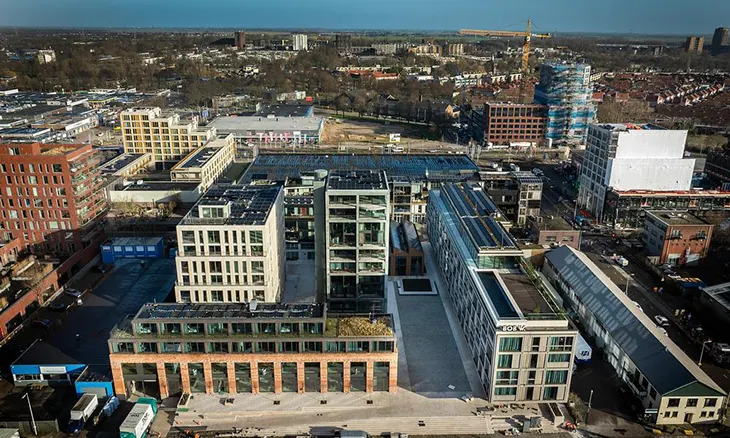
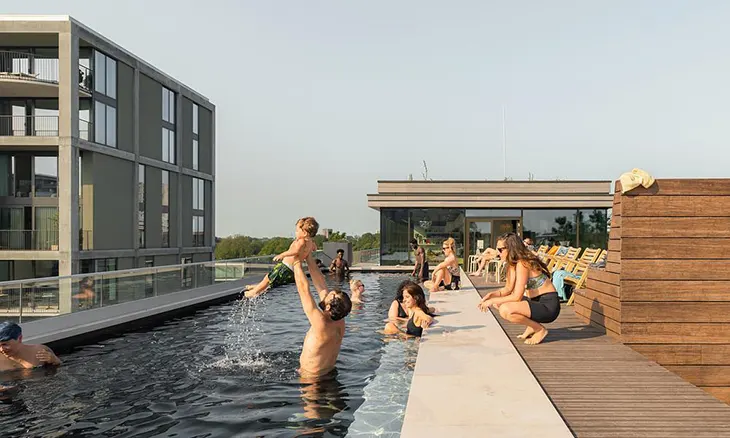
Housing forms the backbone of the project, combining homes for sale, rental apartments, and ten Superlofts within a varied architectural composition. These residential elements sit alongside co-work and office spaces, cafés, restaurants, a gym, and a mid- to long-stay apartment hotel. The mix extends to mobility, with shared electric cars and extensive bicycle facilities integrated into daily routines. The result is a hybrid environment where living, working, and leisure intersect without hierarchy, supporting different rhythms of use across the day and week.
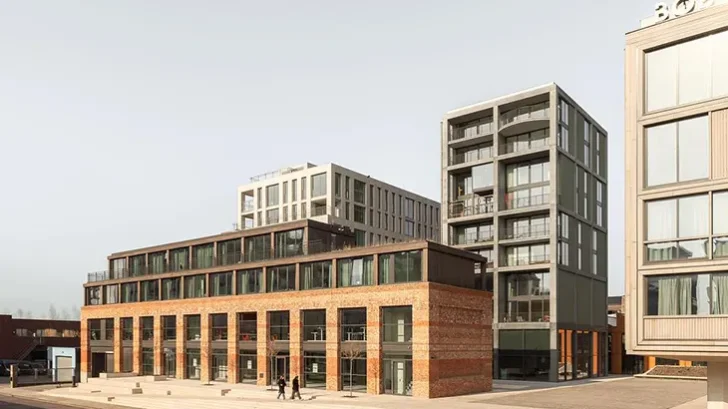
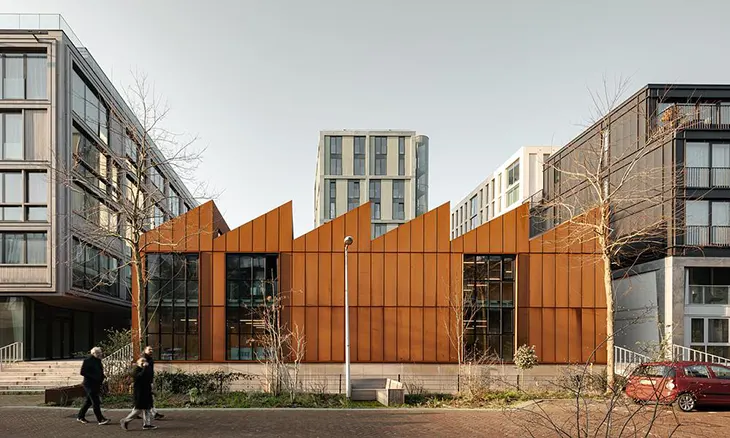
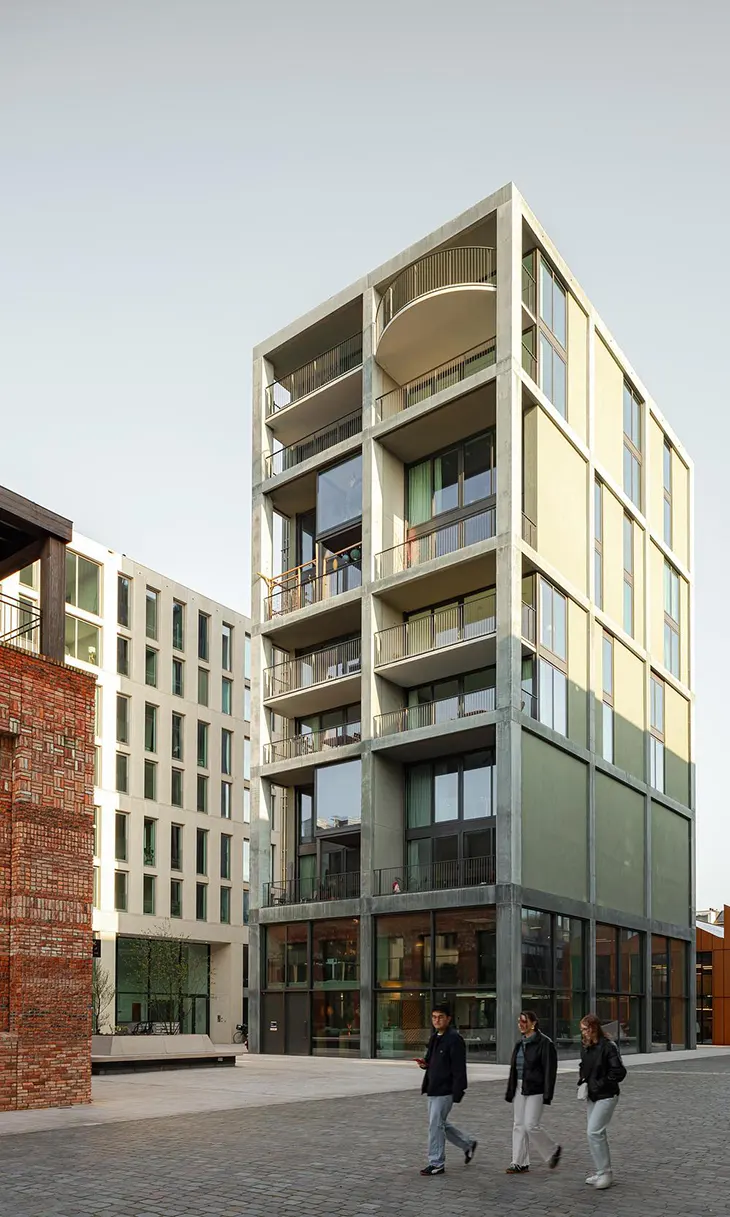
Architecturally, Republica draws from the industrial character of Amsterdam’s harbor districts through a loft-based approach defined by large windows, generous ceiling heights, wide spans, and robust construction. This language provides flexibility over time while maintaining clarity in structure. At the center, a green-toned concrete tower anchors the main square and houses adaptable Superlofts that allow residents to shape their interiors with significant freedom. Surrounding buildings each adopt a distinct material strategy, from profiled concrete and timber facades to brickwork and Corten steel, ensuring that each volume can evolve independently in response to future needs.
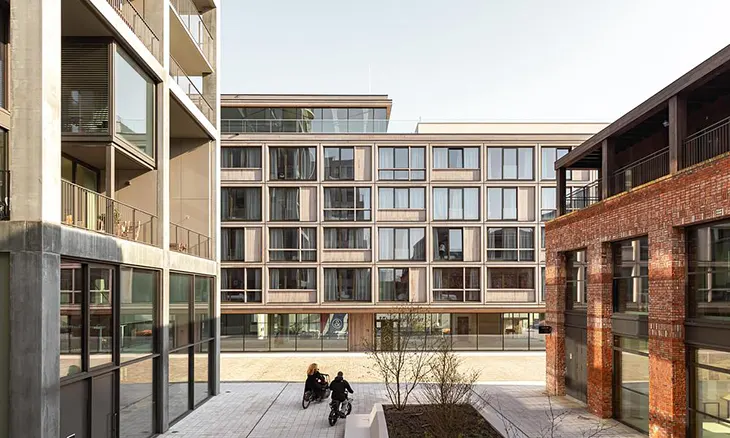
Public space is treated as an extension of the architecture rather than a residual condition. Intimate squares, narrow passages, and elevated terraces encourage movement and informal gathering, while integrated seating and planters contribute to rainwater retention. A natural stone plaza and broad exterior steps introduce a relaxed, almost Mediterranean atmosphere that contrasts with the site’s industrial past. The restaurant building steps back from the street line to create a south-facing social space that has quickly become a recognizable meeting point within Buiksloterham.
Beneath the entire ensemble, a half-submerged parking structure accommodates cars, bicycles, technical rooms, waste separation, and hotel logistics. By consolidating these functions below ground and ensuring ample daylight within the garage, the project frees the ground plane for active uses and open facades. This strategy increases liveliness, improves social safety, and supports a continuous relationship between interior programs and surrounding streets.
Republica also operates as a testing ground for sustainable construction and energy systems. Selected by the City of Amsterdam and supported by European funding, the project functions as an energy-positive site. Solar panels and a geothermal well generate more power than the development requires, while an on-site energy cooperative manages production, storage, and exchange through a micro-grid and neighborhood battery. Greywater reuse, heat recovery from air and sewage, and advanced waste systems further reduce environmental impact while remaining embedded within everyday use.
The concept of open building underpins the entire development. By separating support structures from interior fit-outs and using demountable systems, Republica allows spaces to change function, layout, and expression over time. This approach extends the life of the buildings and reduces the likelihood of demolition and material waste. Inspired by the ideas of John Habraken, the project treats architecture as a framework for change rather than a fixed outcome.
As Buiksloterham continues its transformation, Republica stands as an early and influential example of how dense urban living can remain social, adaptable, and grounded in environmental responsibility. It presents a model in which architecture, infrastructure, and community form a coherent whole, shaped by openness rather than excess and by long-term thinking rather than short-term solutions.