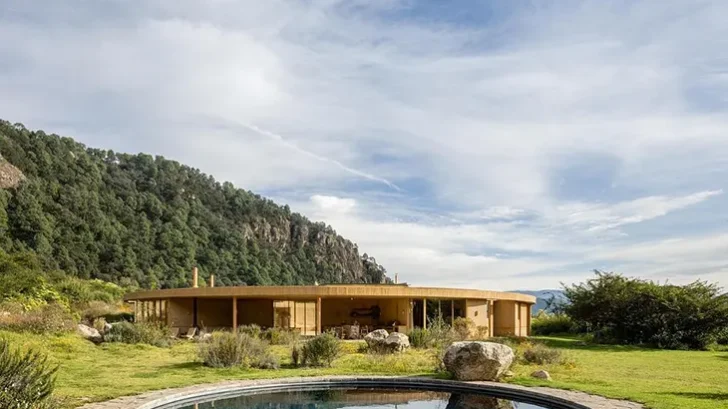

House 720 Degrees, designed by Fernanda Canales, sits quietly in the Valle de Bravo landscape, yet operates as a highly deliberate architectural instrument. More than a residence, the project functions as a spatial and optical device, extending the logic of 360-degree vision into a doubled experience. The house registers movement, light, and time, framing the environment while continuously recalibrating the relationship between interior life and the surrounding terrain.
HOUSING
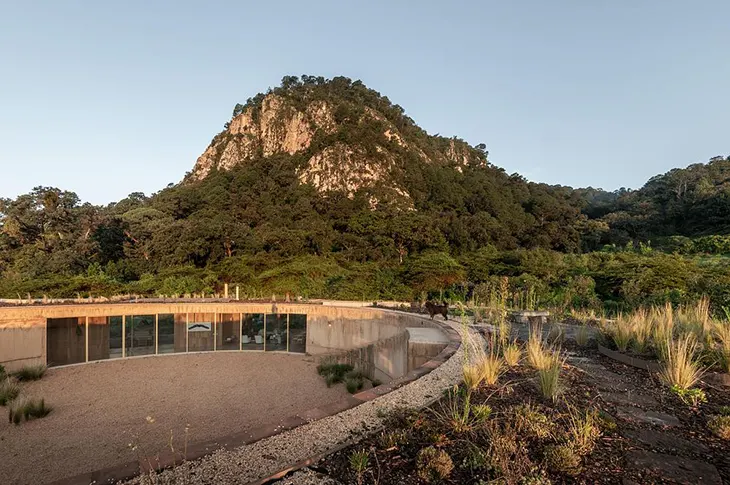
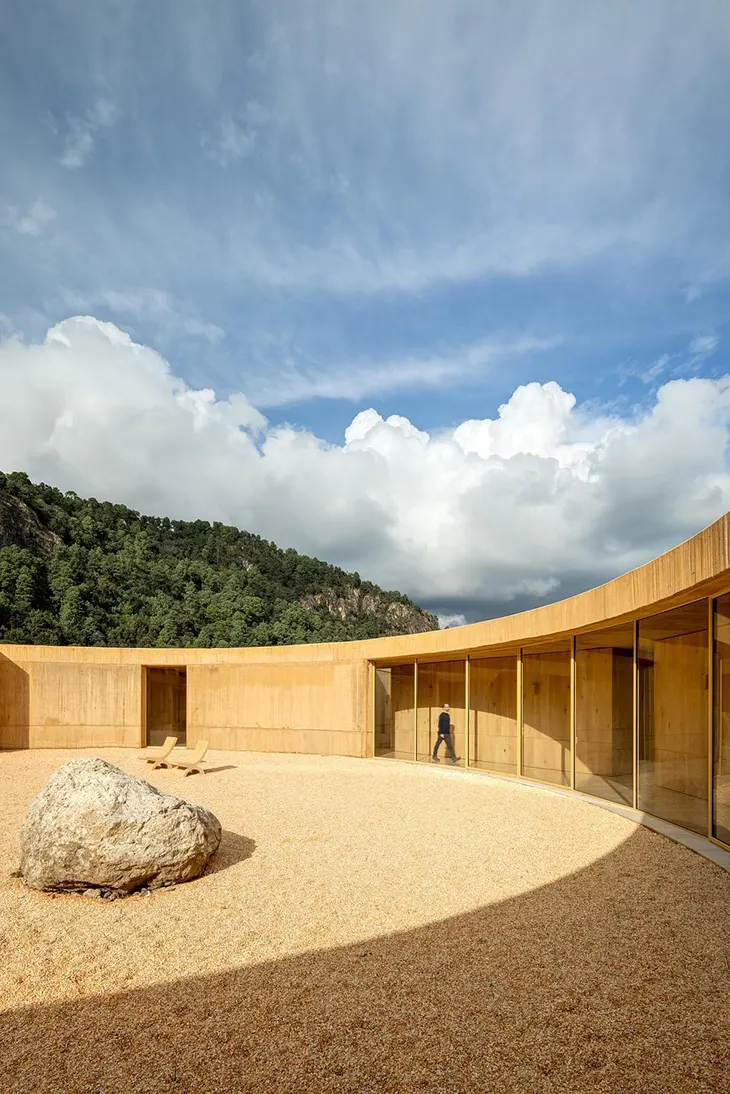
The concept begins with a circular plan anchored by a central patio. This courtyard acts as both origin and anchor, allowing the house to oscillate between outward and inward orientations. During the day, the structure opens toward distant mountains and a nearby volcano, using the circular perimeter to capture shifting views. At night, the house contracts inward, centering domestic life around the protected void of the courtyard. This daily rhythm turns the building into a solar clock, where time becomes spatial rather than abstract.
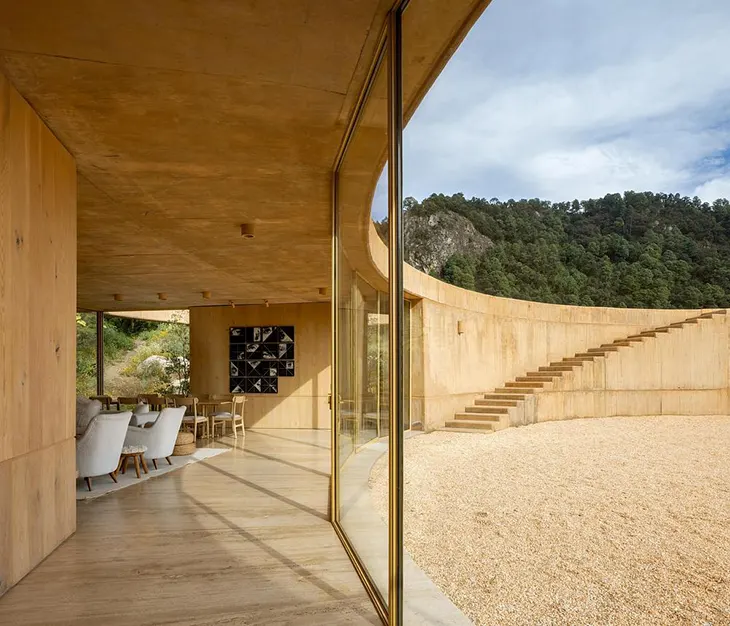
Rather than presenting itself as a single object, House 720 Degrees unfolds as a constellation of three volumes. The main circular house holds the primary living spaces. A detached studio or guest room provides separation and autonomy, while a rectangular volume organized around its own patio accommodates additional bedrooms, storage, and service areas. This fragmentation responds directly to the steep topography and allows the existing vegetation to remain largely undisturbed. Designed for two families, the layout accommodates extended relatives and guests without collapsing privacy into uniformity.
Inside the main volume, the plan balances geometry and adaptability. Rectangular bedrooms, bathrooms, closets, and the kitchen sit within the circular envelope, while the curved walls become zones of movement and transition. These circulation spaces extend outward as terraces toward the courtyard and as gardens toward the exterior. Flexible openings, including privacy screens, fold-away windows, and carefully framed views, allow rooms to shift in character, adjusting to climate, time of day, and use.
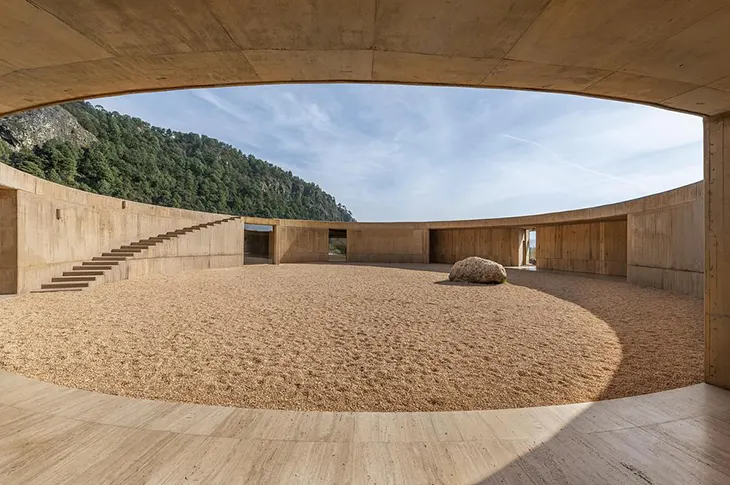
The house occupies a secluded valley roughly three hours from Mexico City, where extreme weather conditions shape daily life. Temperatures can fluctuate by as much as 30 degrees Celsius in a single day, and rain dominates nearly half the year. The architecture addresses this volatility through mediation rather than resistance. Walls function as membranes between forest and prairie, dry and wet seasons, and three spatial conditions: center, inside, and outside. The result is a house that shelters without isolating.
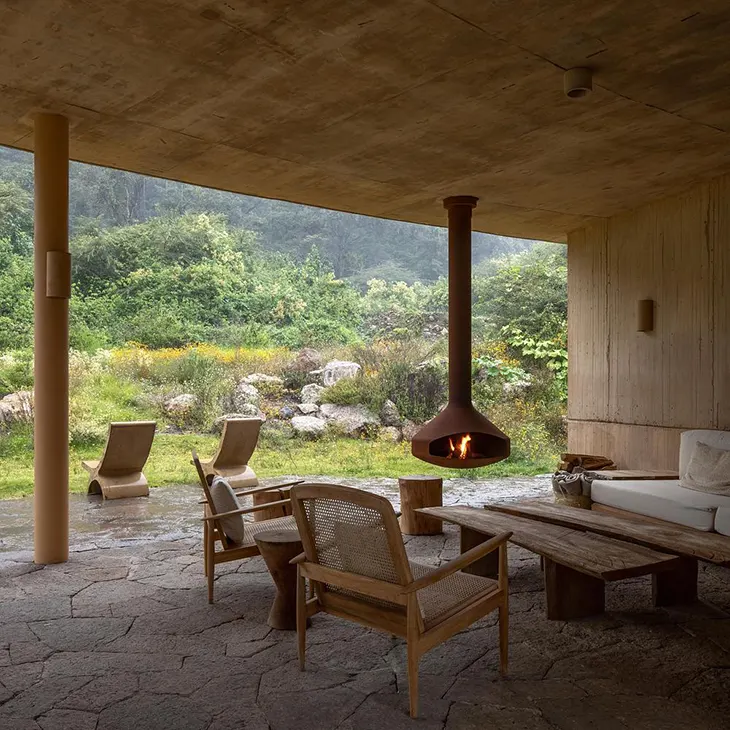
Material choices reinforce this grounded approach. The building nestles into the earth, using local soil mixed with concrete to achieve a finish that mirrors the surrounding land. The low, single-level profile helps the structure recede visually into the landscape, avoiding dominance or contrast. Much of the furniture and lighting was produced on site, relying on local materials and craftsmanship, extending the architectural logic into the interior environment.
Sustainability is embedded at a systemic level rather than treated as an add-on. The house harvests rainwater, generates electricity through solar panels, and uses the same system to heat water. Hydronic radiant floors provide thermal comfort in the bedrooms, while cross-ventilation ensures that every space opens to two or three orientations. These strategies allow the house to operate off the grid while remaining responsive to its climate.
Maintenance considerations guided many design decisions. Durable materials withstand weather without paint or cladding, allowing surfaces to age naturally. Built with the soil and color of its site, House 720 Degrees shifts subtly with the seasons. The structure does not aim for permanence through stasis, but through adaptation.
In House 720 Degrees, Fernanda Canales proposes a form of domestic architecture that measures time, climate, and inhabitation as interconnected forces. The project resists spectacle, instead offering a disciplined exploration of how geometry, landscape, and daily life can align into a living system that observes, responds, and quietly evolves.