

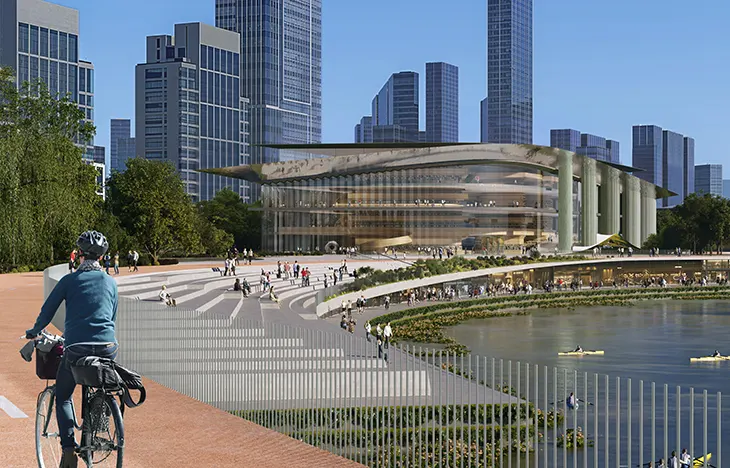
Zaha Hadid Architects has been commissioned to design the Qiantang Bay Cultural District in Hangzhou, China, a large-scale civic and cultural development anchored by a new Central Water Axis along the Zhedong Canal. The project transforms former industrial areas within Hangzhou’s Xiaoshan district into a continuous green corridor, positioning landscape, culture, and public life as central drivers of urban renewal.
CULTURAL PROJECTS
Conceived as a linear sequence of parklands, terraces, and gardens, the Central Water Axis reshapes the canal basin into a connective civic spine that cuts through the city. Rather than treating the waterfront as a backdrop, the masterplan integrates it as an active public realm, where movement, gathering, and performance unfold alongside water. Plazas, promenades, and open-air venues line the canal, offering spaces for recreation, relaxation, and communal events throughout the year.
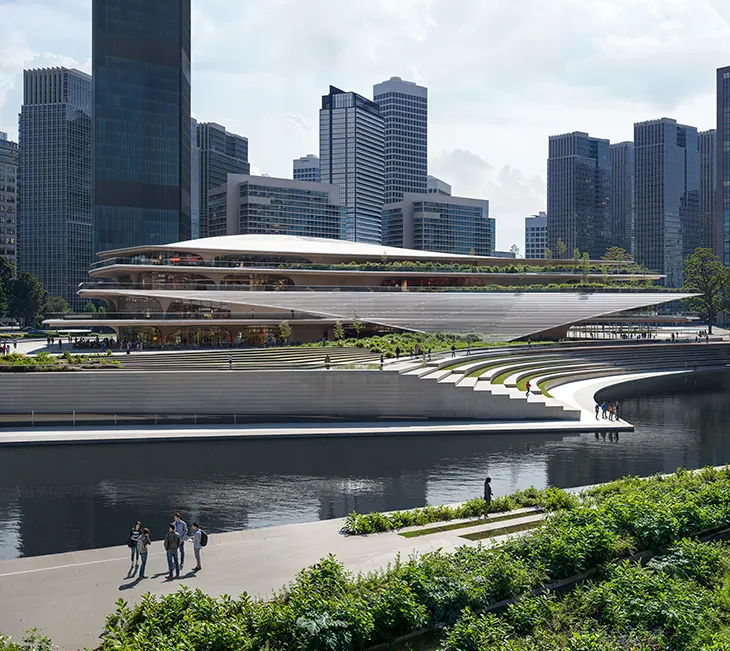
Cultural and educational buildings are distributed along the canal’s edge, each designed to engage directly with the surrounding public spaces. A network of bridges and pedestrian paths links both sides of the waterway, stitching the new district into the existing urban fabric while encouraging continuous circulation between city, landscape, and waterfront. The positioning and form of each building respond to local topography, panoramic views, solar exposure, and the flow of people through the district.
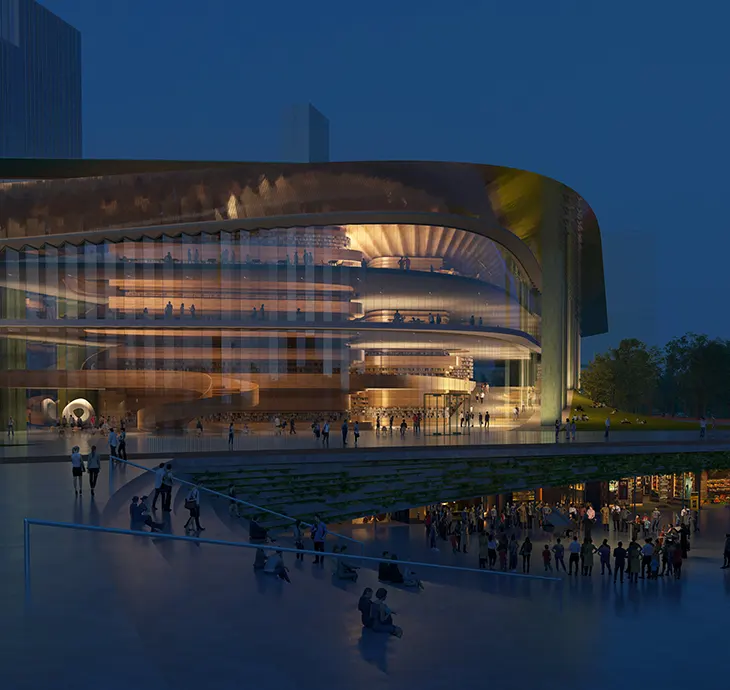
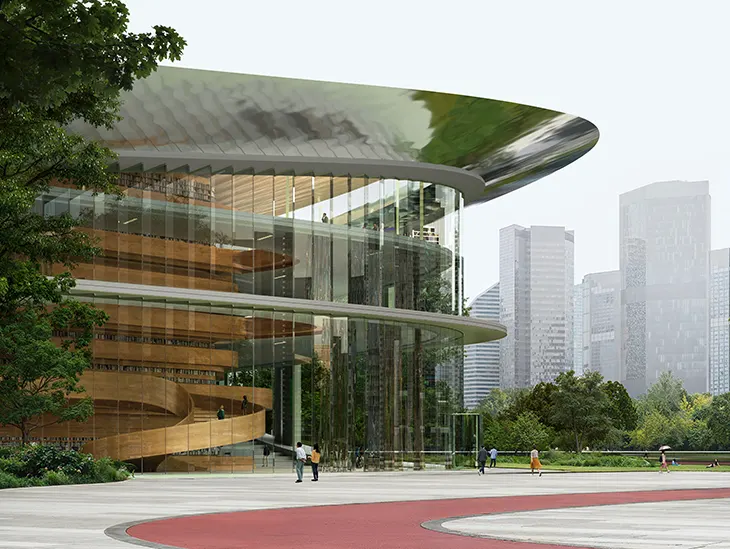
Within this canal-side framework, Zaha Hadid Architects introduces a library conceived as a landmark civic institution. Its architecture is structured around a series of inhabitable columns that act simultaneously as load-bearing elements and spatial organizers. Described as assembled “stones of knowledge,” these columns house the library’s collections, archives, reading rooms, and community spaces, creating a vertical and immersive environment for learning and reflection.
The library’s material expression draws from Hangzhou’s 5,000-year history of jade craftsmanship. Precision-crafted masonry tiles reference the tonal depth and subtle variations of the region’s prized stone, giving the façade a tactile and cultural resonance. Folded glass elements are embedded within this surface, diffusing daylight deep into the interior and creating a soft, luminous atmosphere tailored to reading and study. The result is an architectural language that balances monumentality with intimacy.
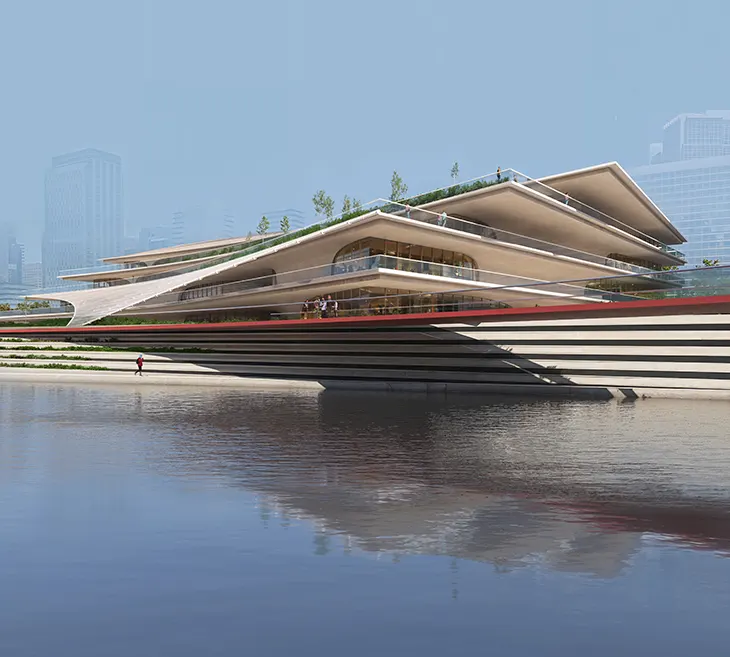
Complementing the library is the International Youth Centre, designed as a flexible hub for students, visitors, and emerging communities. Its geometry is shaped by its waterfront setting, with forms that extend inward to carve a sequence of interconnected auditoriums, studios, and gathering spaces. Areas for seminars, exhibitions, conferences, and performances are interwoven with circulation, encouraging overlap and exchange between different uses. Terraces overlooking the canal expand the centre’s activity outdoors, supporting public events and informal social encounters.
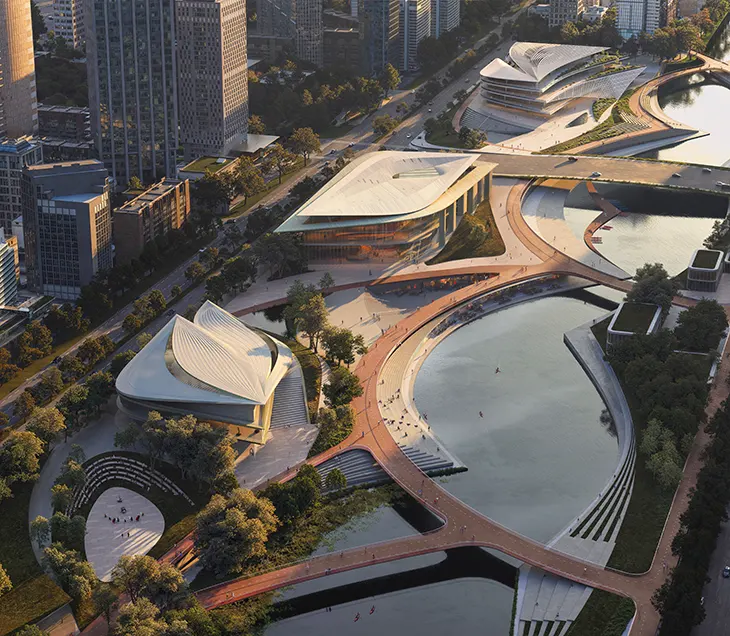
Environmental performance is embedded across the district through strategies informed by local ecology and climate. Energy-efficient systems and on-site power generation contribute to reduced operational impact, while landscape design plays a critical infrastructural role. As part of Hangzhou’s established sponge-city framework, the Central Water Axis integrates permeable surfaces, planted swales, and water-retention features that support stormwater management and flood resilience.
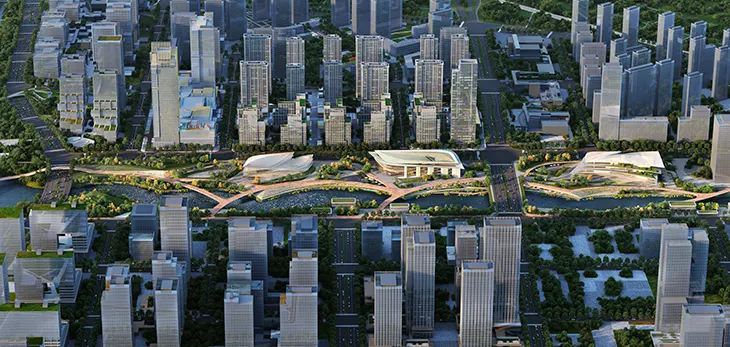
Rather than treating sustainability as an add-on, the project positions it as an integral aspect of civic design. The result is a low-impact yet high-performance urban environment that supports long-term ecological health while accommodating cultural growth. By transforming an industrial canal basin into a connected landscape of knowledge, culture, and public life, the Qiantang Bay Cultural District signals a new chapter in Hangzhou’s urban evolution.