
de l’Épée Residence is a full residential renovation in Montreal by Michael Godmer Studio, conceived as a lived narrative rather than a stylistic exercise. Located in Outremont, within an early 20th-century house of strong architectural character, the project unfolds through memory, use, and transformation, allowing domestic life to become both structure and guide.
RESIDENTIAL
The project began as a conversation. The clients had lived in the house for several years before reaching out, initially seeking ideas rather than solutions. Their backgrounds shaped the direction from the outset. She is an art therapist, working through the body, emotion, and gesture. He manages social programs, focused on building sustainable systems grounded in balance and long-term use. Together, their international life had left traces of color, material, and spatial references that resisted standard domestic templates. Returning to Montreal marked a conscious decision to anchor their family life while preserving the openness shaped by travel.
What was first imagined as a limited reflection gradually evolved into a complete renovation. Over nearly a year, Michael Godmer Studio worked closely with the clients, supporting decision-making, assembling a network of artisans and collaborators, and allowing the project to mature through time rather than acceleration. Even before construction began, the house became a testing ground: drawings on walls, family-made artworks, spontaneous gestures that embedded identity directly into the space. Architecture here does not precede life; it absorbs it.
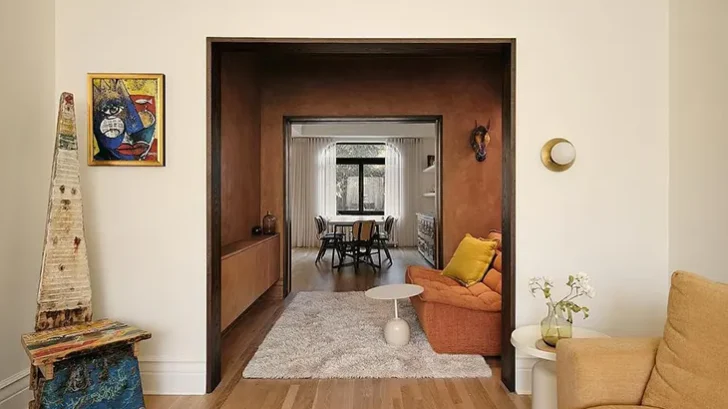
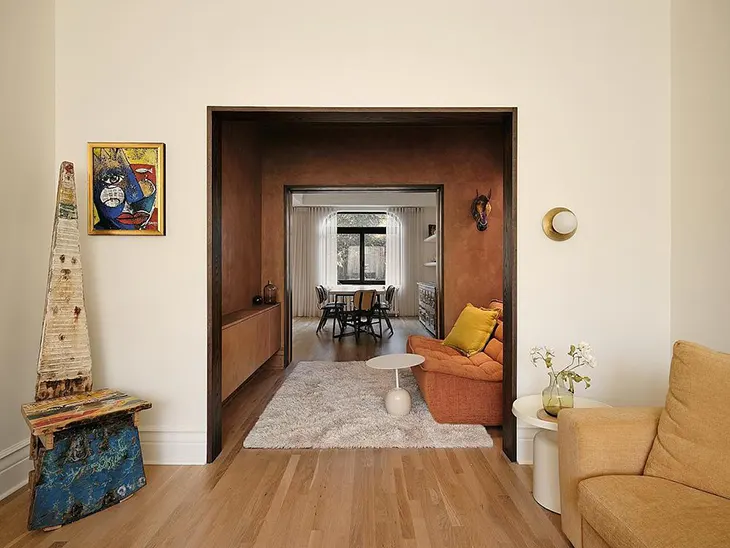
The existing house carried its own weight. Defined by warm woodwork, generous proportions, and a central staircase, the Outremont residence demanded continuity rather than erasure. The design approach favored dialogue with what was already present. The staircase was preserved entirely, acting as a hinge between eras and a stabilizing element throughout the project. New architectural interventions extend the original structure without competing with it. Rounded door frames, redesigned windows, and newly carved openings soften circulation and introduce fluid transitions, allowing spaces to flow without losing definition. The house reads as a palimpsest, where layers accumulate instead of replacing one another.
Programmatically, the renovation responds directly to contemporary family rhythms. Working from home becomes a spatial driver rather than an afterthought. A dedicated art therapy space integrates seamlessly into the domestic layout, while an upstairs office offers retreat and concentration. Each room is designed around its occupants, with integrated cabinetry replacing traditional partitions to reclaim space, organize functions, and support daily life with precision. Doors play a central role. Custom wood-framed glazed doors, solid bespoke panels, and louvered wardrobes were developed in close collaboration with local artisans, reinforcing the studio’s commitment to craft as a tool for personalization.
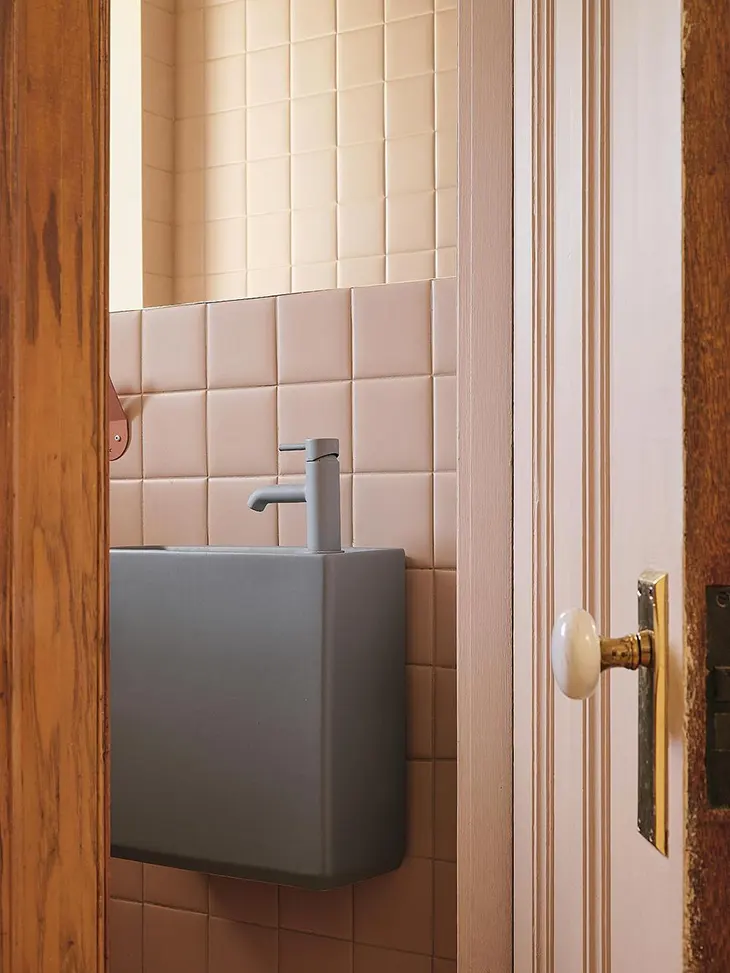
Despite technical challenges, the project maintains clarity and coherence. The house shifts in tone from one zone to another. A deliberately theatrical powder room, bathed in pink and subtly referencing the universe of Wes Anderson, contrasts with the energetic, color-driven spaces designed for the children. The parents’ wing adopts a calmer, more sensual register, where bedroom and bathroom enter into a quiet spatial dialogue defined by light, material, and proportion.
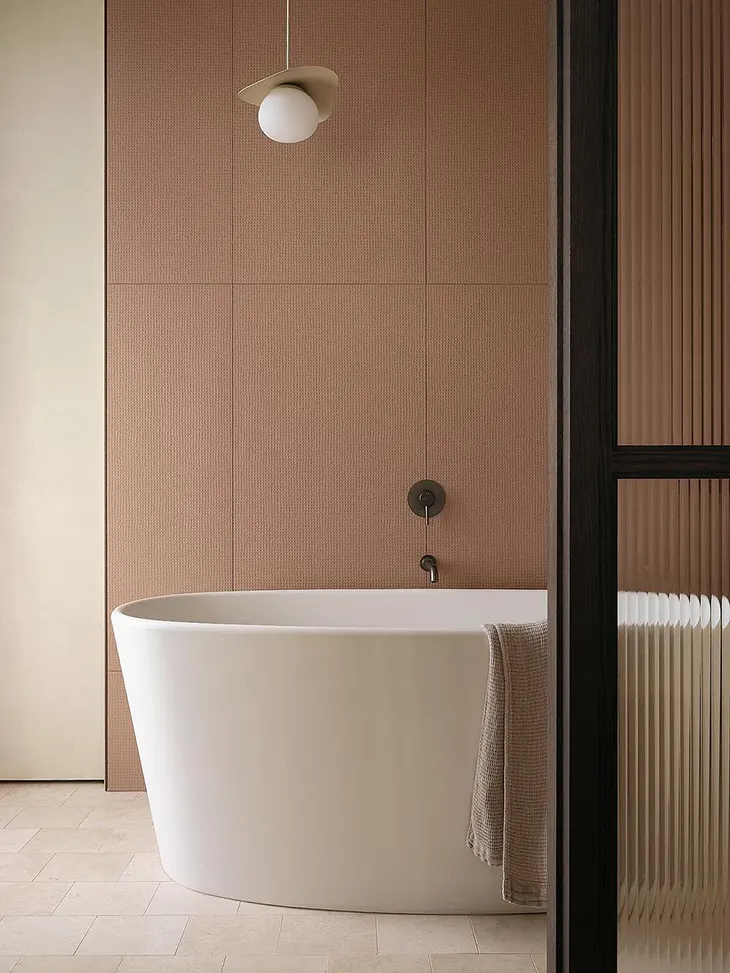
Materiality is layered with restraint. A warm, mayonnaise-toned base color creates a continuous backdrop throughout the house, allowing textures and objects to emerge without visual noise. Existing woodwork remains visible and celebrated, paired with brushed lacquered woods, uniform lacquer finishes, Botticino Fiorito marble, and travertine flooring. Limewash paint introduces sandy textures that shift with light, sometimes deep, sometimes muted, reinforcing the tactile quality of the interiors and echoing the clients’ eclectic references.
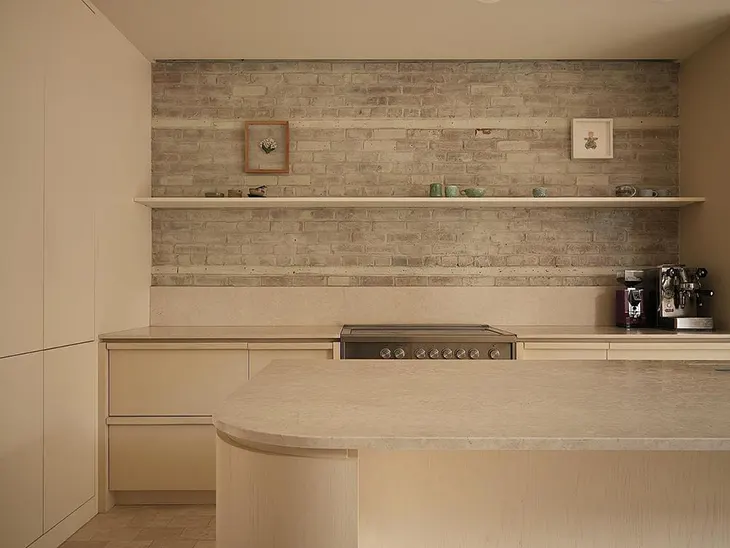
Curves appear as a recurring motif. Softened lines define the kitchen island, door frames, and bathrooms, establishing a fluid architectural language that moves through the house without fixing it in a specific era. The kitchen avoids literal references, particularly to the French bistro, opting instead for abstraction. Tile lines repeat subtly between floor and island, creating continuity through repetition rather than symbolism. A narrow-plank white oak floor, recalling the home’s origins, is framed by a tiled border that echoes the kitchen surfaces. A small tile marks transitions between wood and ceramic, a detail repeated throughout the house and quietly threading the narrative together.
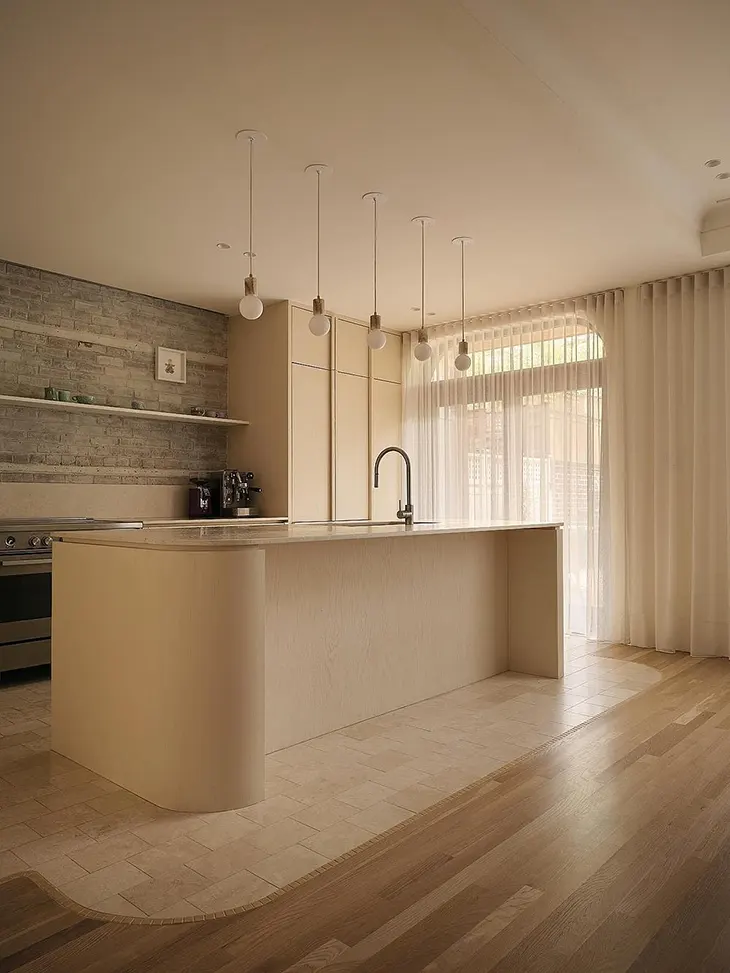
Lighting remains discreet, conceived as points rather than statements, revealing textures and supporting material depth. Fixtures and finishes were largely sourced through local collaborators, reinforcing the project’s rootedness in place.
At its core, de l’Épée Residence is a project about relationships: between a family and their home, between past and present, between architecture and craftsmanship. It resists finality, allowing the house to evolve through use while remaining grounded in its history. Rather than imposing a signature, the renovation constructs a framework capable of growing richer over time, preserving the house’s soul while opening it to new chapters.