
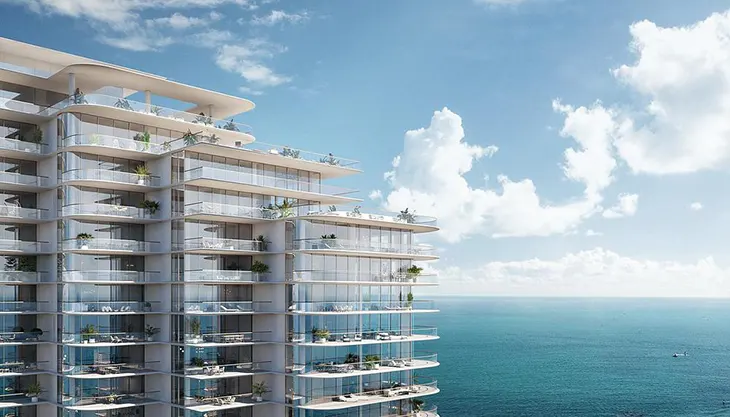
Rising along Collins Avenue in Miami Beach’s Mid-Beach neighborhood, The Perigon introduces a carefully calibrated residential tower shaped by its rare dual-waterfront site. Designed by OMA under the leadership of Jason Long, the 17-story project occupies a narrow stretch of land between Indian Creek and the Atlantic Ocean. Rather than treating this condition as a backdrop, the design actively organizes itself around it, using orientation, elevation, and form to redefine how residential architecture meets the ground in Miami Beach.
RESIDENTIAL ARCHITECTURE
The building is conceived as a series of interlocked “towers,” rotated and bundled to direct views away from neighboring buildings and toward open water on both sides of the site. This compositional strategy produces a singular sculptural volume while maintaining legibility of its constituent parts. A subtle contrast between organic and orthogonal geometries runs through the project, reinforcing the idea of multiple forms working together rather than a monolithic slab. The entire structure is lifted 45 feet above the flood line, a decisive move that responds to climate realities while freeing the ground plane below.
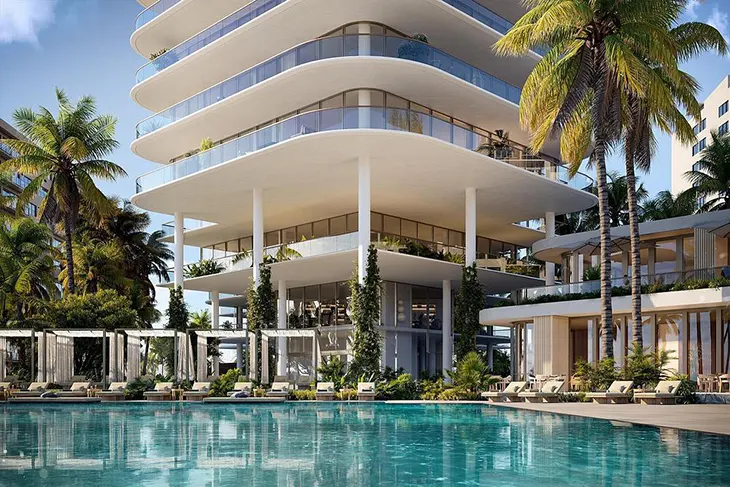
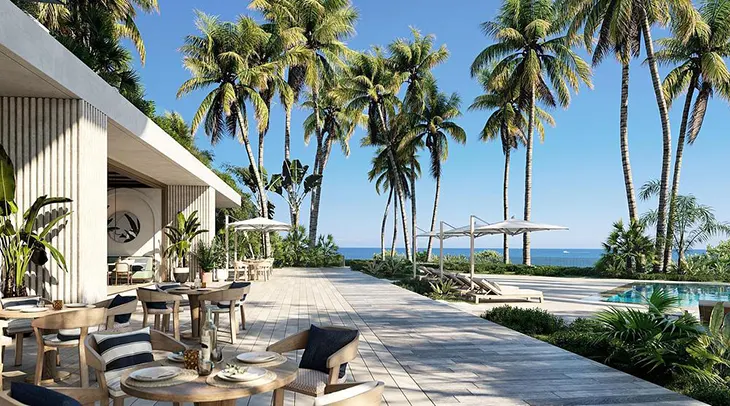
This elevation fundamentally alters the building’s relationship to Collins Avenue. Residential developments along this corridor often present solid, defensive bases that block sightlines and disengage from the public realm. At The Perigon, the lifted mass creates a porous site condition, opening visual and physical connections from the city toward the ocean. The carved base forms a shaded entry sequence and exterior amenity areas that face the beachfront, while allowing the landscape to flow beneath the building rather than stopping at its edges.
The top of the tower mirrors this strategy in reverse. As the base opens and recedes, the upper levels terrace downward, responding to both the city and the ocean. This stepped profile softens the building’s presence against the skyline and reinforces its relationship to horizon and water. Across the façade, alternating curved and straight terraces emphasize the rhythm of the bundled towers, making the scale of the residential units legible from multiple vantage points.
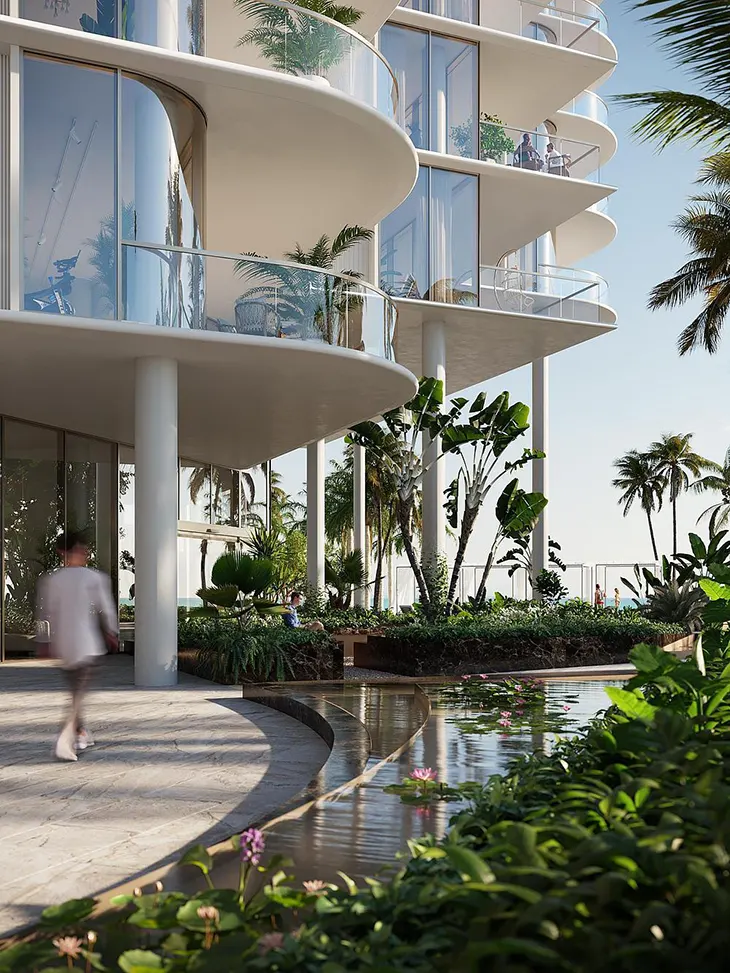
Circulation and landscape design extend this formal logic at ground level. Pathways echo the geometries of the tower above, weaving through gardens and water features that define a sequence of outdoor spaces. Rather than a single grand plaza, the landscape is organized as a series of moments, ranging from quiet gardens to more open communal areas. These spaces establish a gradient between public and private while reinforcing the lifted structure’s light touch on the site.
Within the tower, 82 condominium units are arranged across zig-zagging floorplates generated by the bundled form. This configuration allows for elongated residences with multiple corners, increasing exposure to light and views. Floor-to-ceiling windows and broad terraces blur the boundary between interior and exterior, while the variety of unit sizes, from studios to large four- and five-bedroom residences, reflects a diverse residential program. The planning balances expansive panoramic living areas with more secluded zones, supporting both openness and retreat within the same dwelling.
The Perigon is being developed by Mast Capital in partnership with Starwood Capital Group, with construction currently underway and completion expected in 2027. The 408,000-square-foot project includes residential units, amenities, restaurant and bar spaces, parking, and back-of-house functions, and is targeting LEED Gold certification. Supporting OMA are ODP Architects as executive architect, Gustafson Porter+Bowman on landscape design, and Tara Bernerd & Partners for interiors, among a broad consultant team.
Through its lifted form, bundled massing, and recalibrated relationship to Collins Avenue, The Perigon offers a measured architectural response to Miami Beach’s density, climate, and urban condition. It proposes a residential model that privileges access, permeability, and long-range views while reconsidering how a luxury tower can coexist with its city and coastline.