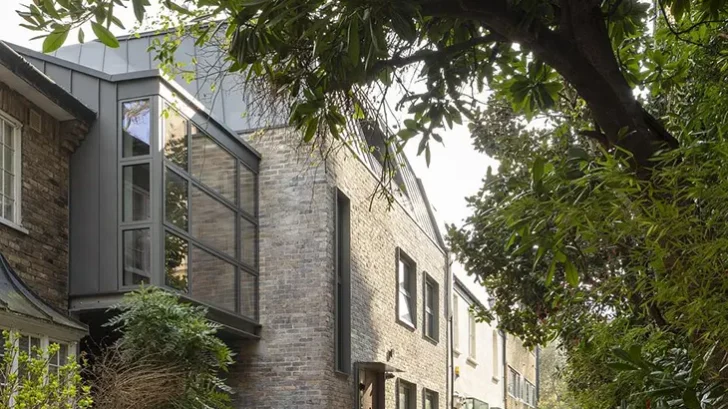

Archi-Tectonics completed the London Solar House in Primrose Hill as a residential renovation and extension that doubles the footprint of a century-old brick townhouse while preserving its structural core. Designed for a family of four, the 2,250-square-foot project reinterprets the compact typology of London’s masonry row houses through volumetric expansion and integrated renewable energy systems. The New York-based firm, led by founding partner Winka Dubbeldam, approached the intervention as an exploration of density and spatial richness, extending the original two-story structure into a vertically layered home that links historic fabric with contemporary construction.
HOUSING
The existing brick shell remains intact and functions as the foundation for the new addition. Archi-Tectonics treated the original masonry volume as an anchoring mass from which a folded zinc-and-glass envelope rises. This extension introduces an additional story and a series of projecting volumes that establish a visible contrast between old and new. Rather than flattening the distinction, the design emphasizes the transition between eras through material and geometry. The faceted roof form produces distinct apertures that frame views and direct daylight deep into the interior, including a pyramidal skylight positioned above the kitchen and a narrow glass slit that reveals the former rear yard. A fully glazed opening toward the street captures views of the surrounding neighborhood and a mature tree that anchors the streetscape.
The roof terrace extends the upper-level kitchen and dining areas outward, creating a transitional zone between interior living and the urban environment. Integrated photovoltaic panels line the roof surface and generate baseline electricity for the house, supporting heat pumps, lighting, and hot water systems. The installation also connects to a 13kW Tesla battery that enables on-site energy storage and electric vehicle charging. These systems position the building close to off-grid operation while embedding renewable infrastructure directly into the architectural form rather than treating it as an external layer.
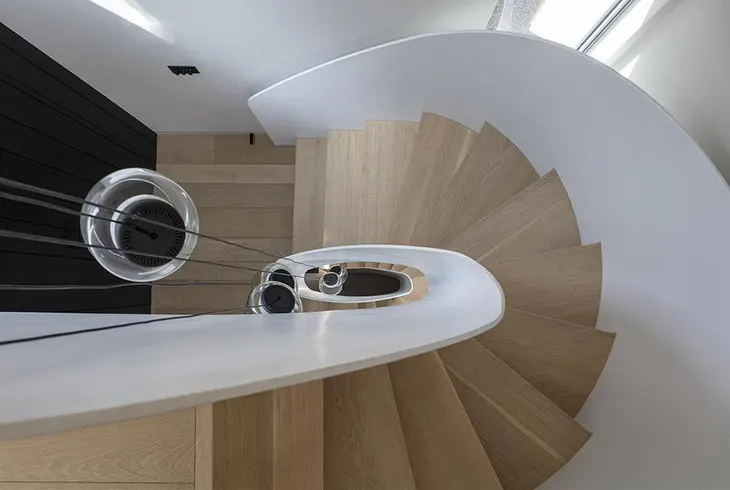
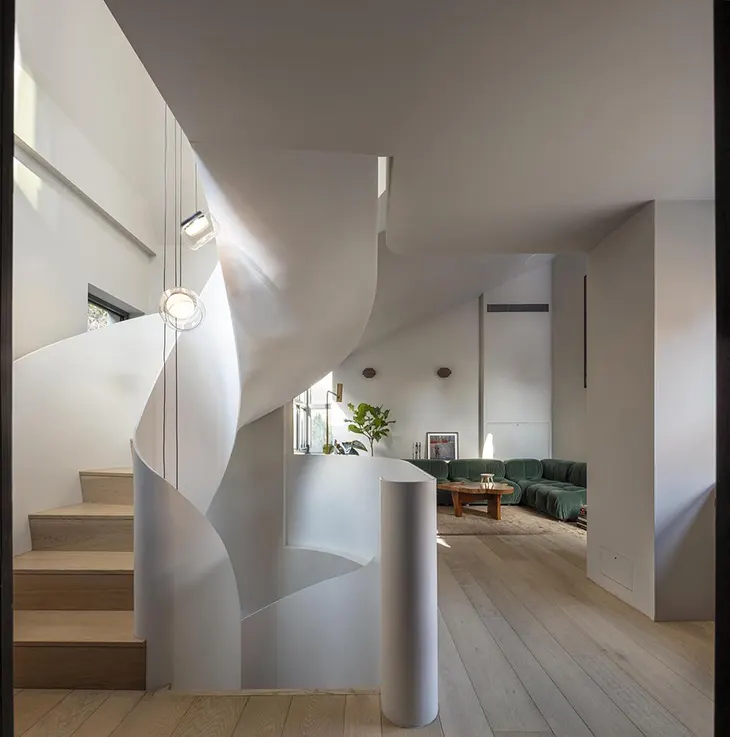
Circulation organizes the interior experience. At the center of the house, a custom steel staircase forms a continuous helix that connects the entrance level, the double-height living space, and the upper kitchen and dining floor. Its curved geometry creates a vertical axis that visually and physically unifies the house. Rather than functioning solely as a connector, the stair operates as a sculptural element that defines spatial relationships across levels. Daylight travels along its surface, reinforcing its role as both structural and spatial anchor.
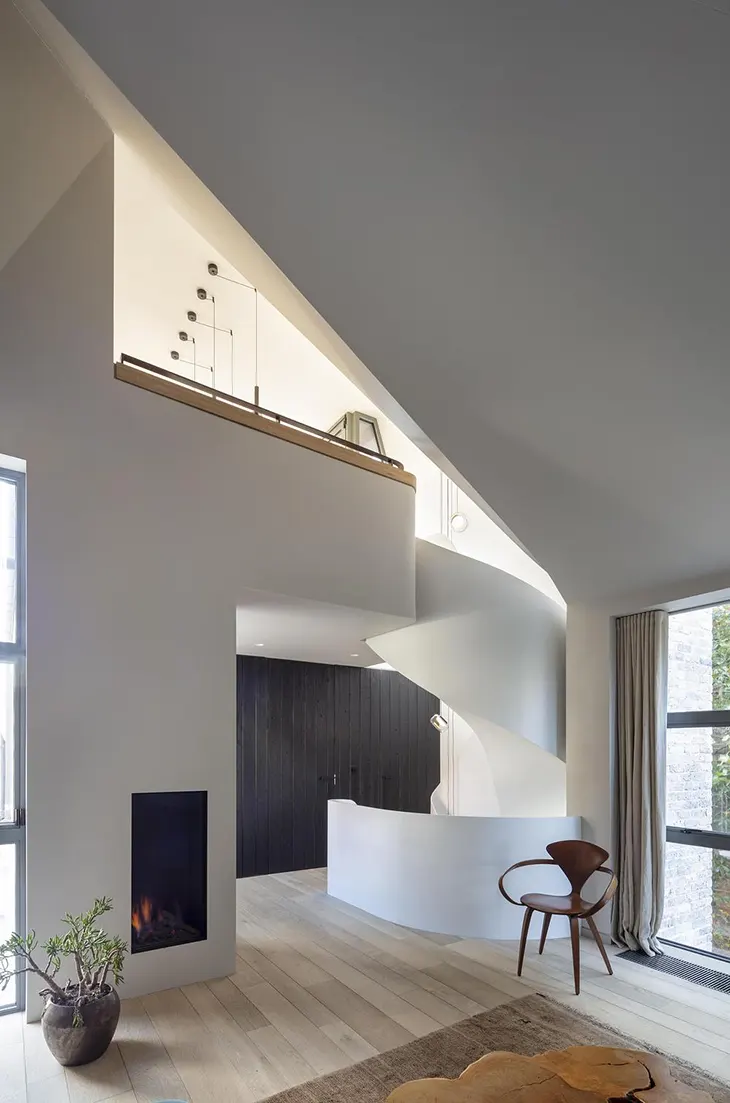
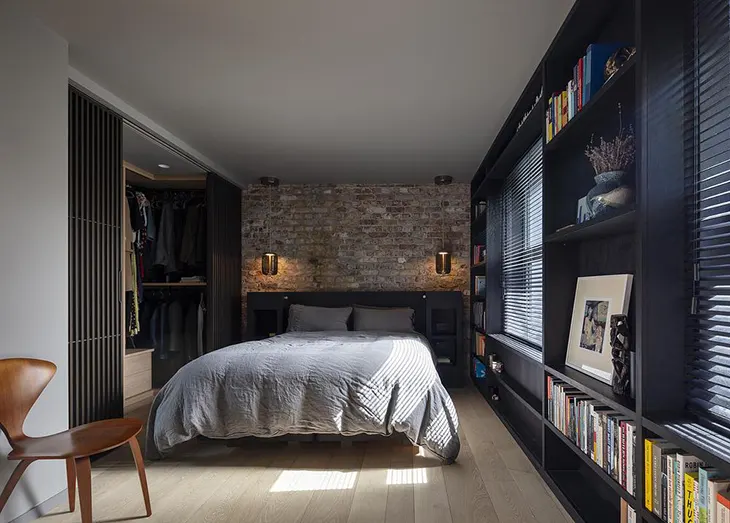
Interior material selection departs from the minimal restraint typically associated with compact housing. Black-stained wood cladding, textured stone, and brass mosaic surfaces establish a layered tactile environment. Light coves introduce controlled illumination that emphasizes depth and surface variation, while glass pendant fixtures contribute to the vertical continuity of the interior volume. Custom wood furnishings and wool rugs soften the spatial composition and reinforce the connection between architectural structure and inhabitation.
Archi-Tectonics positions the London Solar House within its broader research into sustainable urban housing models. Previous residential projects such as 512 GW Townhouse and the 497 Greenwich building explore similar questions of density, energy performance, and adaptive reuse. In London, these investigations converge within a single residence that integrates renewable systems, volumetric expansion, and material contrast. The project demonstrates how compact urban housing can incorporate energy production, spatial complexity, and architectural identity without expanding its footprint horizontally.
Completed in 2024 with Anthony Boulanger of AY Architects as Architect of Record and engineering by AKTII and WSP London, the London Solar House represents a focused application of Archi-Tectonics’ design methodology. The project transforms an existing masonry structure into a multi-layered residential environment defined by structural continuity, renewable energy integration, and spatial density.