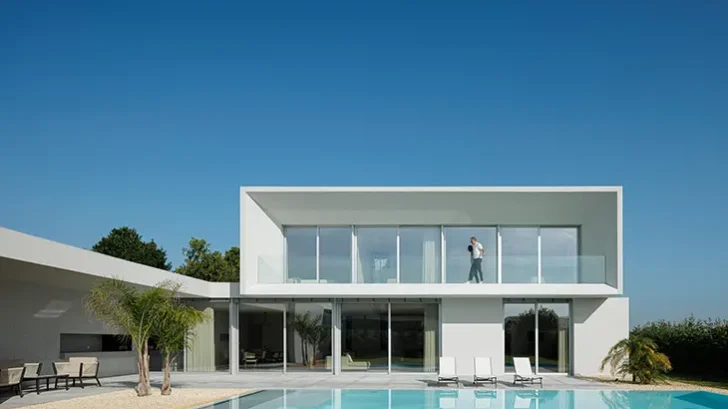

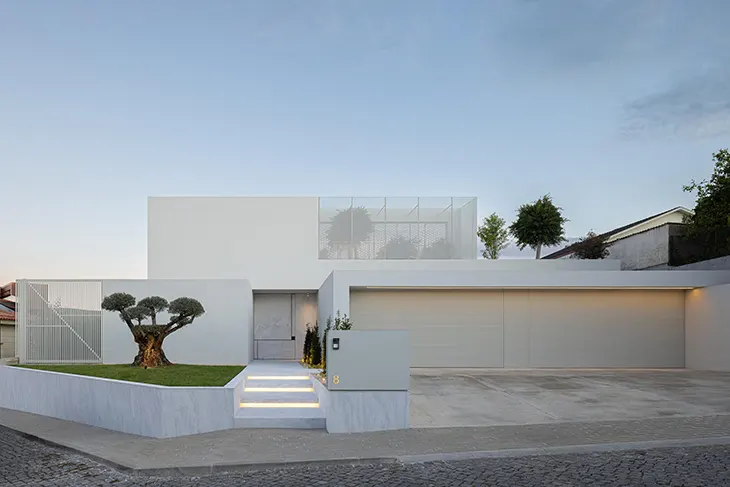
Minimalist White House is a single-family residence in Braga by Arquitetura501, conceived as a precise response to site orientation, context, and light. Set on a 980-square-meter plot within the city, the project balances openness and protection, using architectural clarity to negotiate views, privacy, and environmental comfort.
HOUSING
The plot’s conditions strongly informed the design strategy. While the east and south sides offer open views and favorable solar exposure, the western edge is constrained by a roughly five-meter-high party wall created by neighboring buildings. Rather than treating this limitation as a drawback, the project turns it into a defining element. The house closes itself toward the west and opens generously to the east and south, ensuring controlled daylight, thermal performance, and a high level of spatial quality.
The residence is organized across two levels with a clear programmatic hierarchy. The upper floor is dedicated to private functions, housing three bedrooms. A continuous balcony runs along the east–south façade, fully glazed to frame uninterrupted views toward Mount Sameiro. This linear element strengthens the relationship with the surrounding landscape while drawing daylight deep into the interior throughout the day. On the opposite side, an intimate garden faces the street, screened by a perforated metal panel that filters light and protects privacy while softly illuminating the circulation areas.
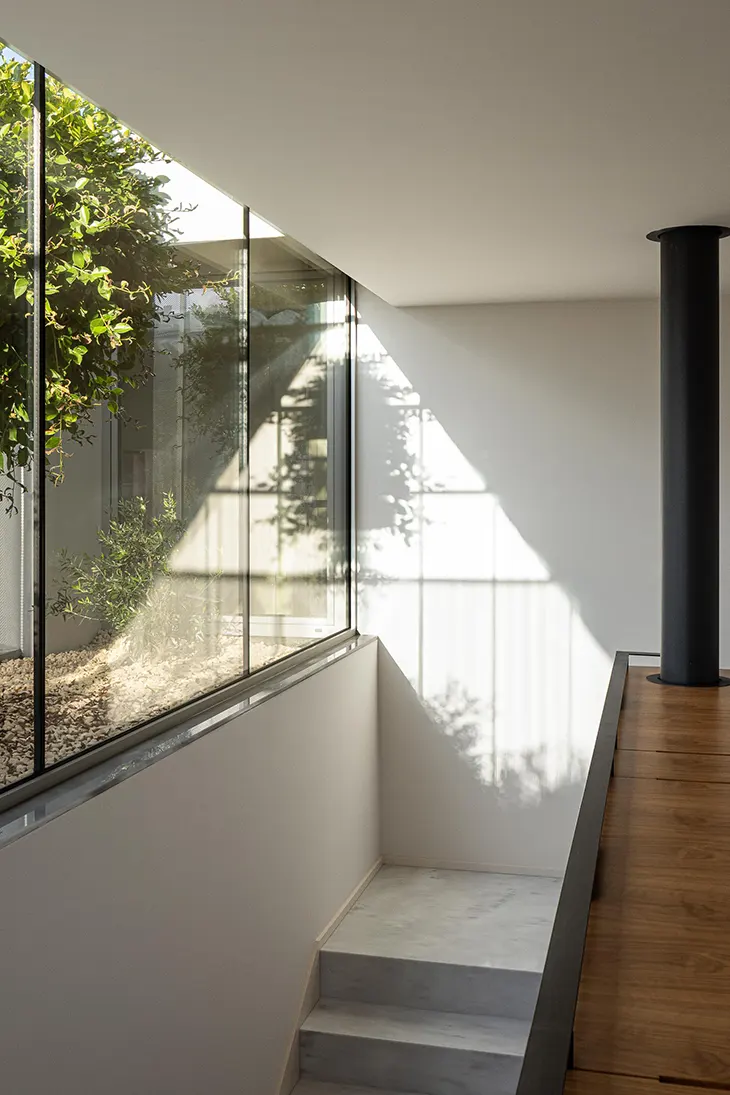
On the ground floor, the project is structured around a central architectural nucleus. An entrance hall incorporating an interior garden and a double-height void forms the heart of the house. This space acts as a distributive core, organizing circulation while offering a moment of pause upon entry. Light enters from above through an opening on the upper floor, creating a vertical spatial experience where zenithal light and vegetation introduce calm and depth.
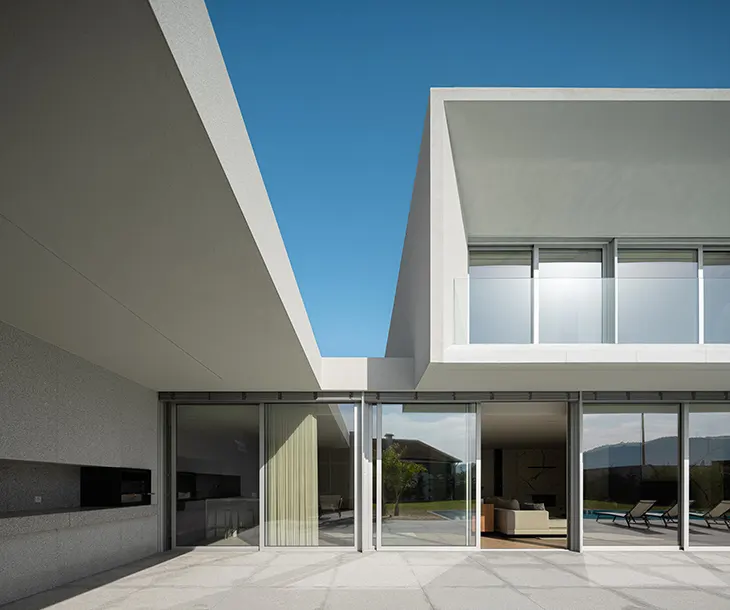
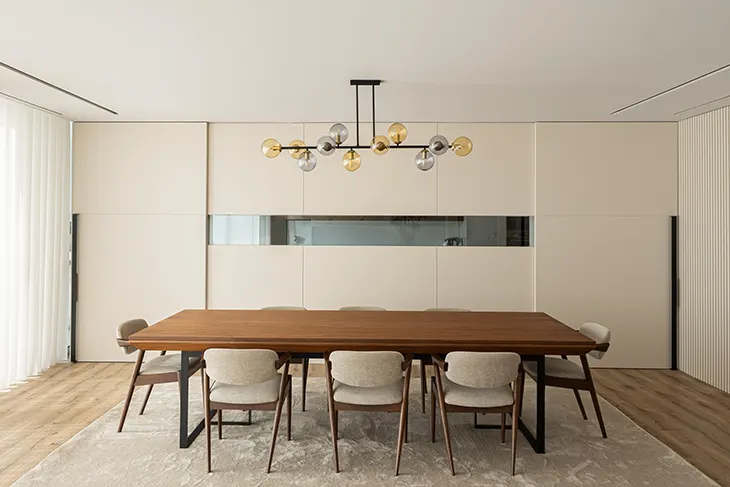
From this central space, the program unfolds into three distinct zones. A private area includes a full suite and a study, offering flexibility for working from home. The social zone combines living and dining areas with a semi-open kitchen, designed to function as a continuous, fluid space. Large openings connect these interiors to the covered veranda and swimming pool, reinforcing a seamless relationship between inside and outside and supporting a lifestyle oriented toward outdoor living.
The service areas are strategically placed along the western boundary of the plot, forming what the architects describe as an “inhabited wall.” This zone accommodates the garage with direct street access, as well as the laundry, changing room, and mechanical spaces. By concentrating these functions along the less favorable orientation, the design resolves the presence of the party wall while freeing the east–south frontage for living spaces and views.
Nordic influences are evident in both the architectural language and the relationship with the street. The house opens directly onto the public realm, avoiding perimeter fencing. This decision promotes volumetric simplicity and transparency, allowing the building itself to define boundaries in a subtle and integrated manner. The front of the site is left open, hosting a minimalist garden and private outdoor parking, reinforcing the sense of lightness and restraint that characterizes the project.
At the rear, the architecture becomes more expansive. Generous glazed surfaces dissolve the boundary between the interior living spaces, the veranda, and the pool area. This continuity emphasizes natural light as a central design tool and frames daily life around outdoor space, climate, and seasonal change.