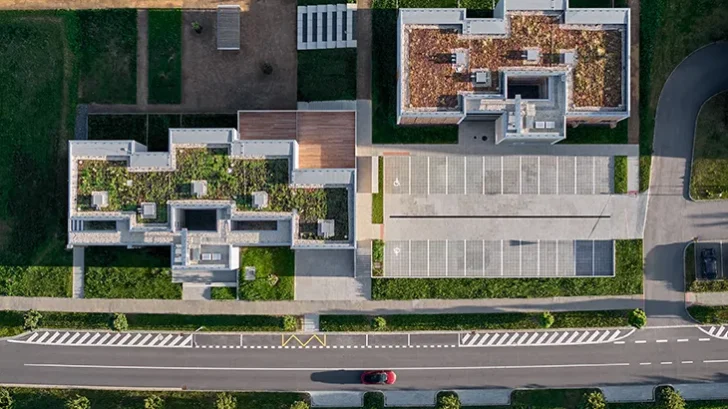

Kuba & Pilař architekti approach Zdar Wooden Housing through a clear urban framework that reintroduces the logic of the traditional city block into a contemporary residential setting. Positioned within the Klafar area, the project establishes a defined spatial hierarchy, moving from public streets to semi-private courtyards and into private front gardens. The block anchors the corner of Sázavská and K Milířům streets, shaping the site through a precise arrangement of volumes that open toward a south-facing courtyard while reserving the western edge for landscaped leisure spaces.
RESIDENTIAL
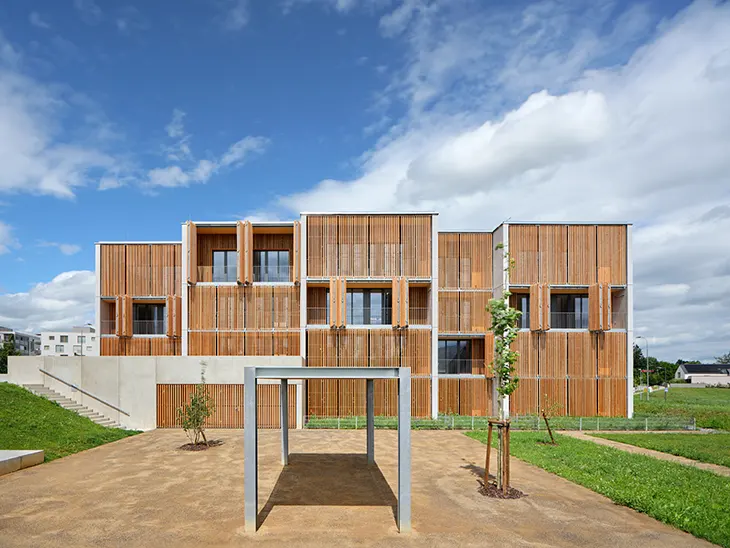
The composition relies on a system of simple vertical sections, each rising four levels and structured through transverse load-bearing walls. Between these structural planes, recessed loggias introduce depth and variation, fitted with wooden shutters that regulate light and privacy. This layered façade system produces a controlled interplay between openness and enclosure, where transparency shifts depending on orientation. Toward the courtyard, the architecture becomes more permeable, while the street-facing elevations remain flatter, defined by strip windows and a more contained expression.
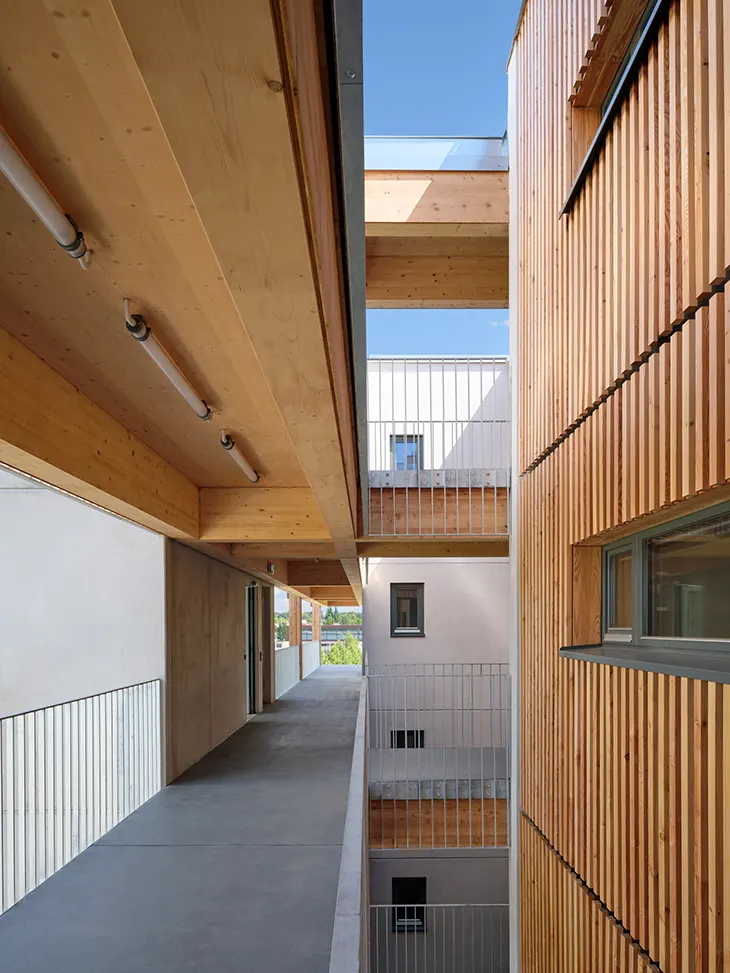
Circulation elements play a central role in shaping the spatial experience. Along the northern façade, wooden access galleries run parallel to the apartments, paired with reinforced concrete cores that house elevators and staircases. The residential units step inward toward the courtyard, creating vertical atria between the galleries and living spaces. These voids introduce greenery into the section, extending the landscape vertically and ensuring that circulation routes remain connected to planted spaces rather than isolated corridors.
The courtyard operates as the central social and environmental core of the project. Elevated to the level of the first floor, it accommodates a series of informal gathering areas, with gravel surfaces, benches, and clusters of trees. A pergola structures parts of the space, while stepped seating on the sloped terrain forms an amphitheater-like zone that connects different levels. Paths extend toward the western public areas, allowing the courtyard to function as both a shared internal space and a link to the broader site.
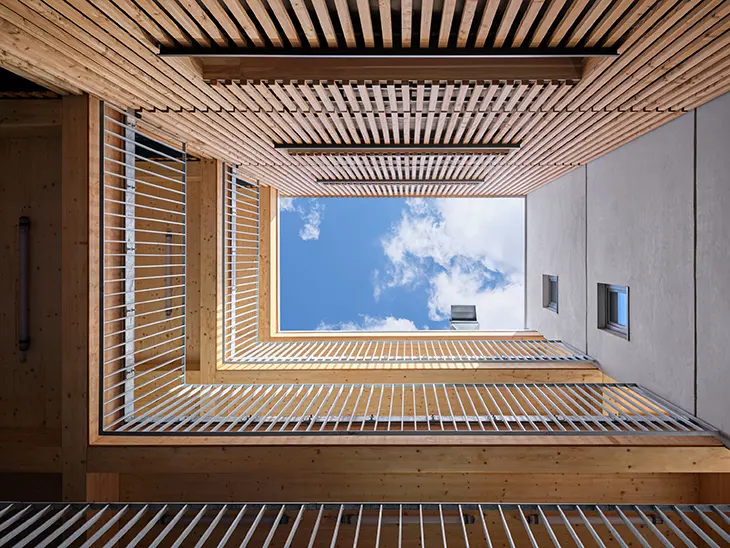
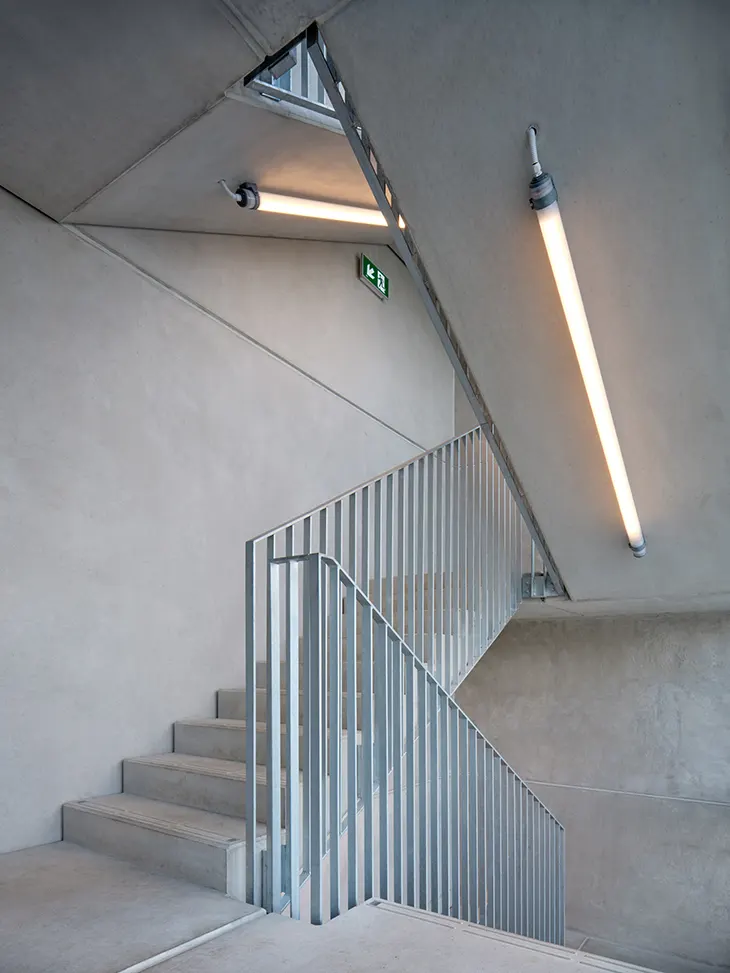
Construction follows a modular prefabricated system that combines timber and concrete. Walls and floor slabs are formed from CLT panels, assembled on-site to ensure precision and efficiency. The gallery structures use glued laminated timber, while concrete cores and external elements provide structural stability. This hybrid system supports both the architectural clarity of the project and its practical demands, maintaining a consistent material logic throughout.
Environmental performance is embedded in the design through passive strategies. The compact mass reduces energy demand, while wooden shutters provide shading across the façades. Apartments achieve cross-ventilation through dual orientation, improving indoor conditions without reliance on mechanical systems. Vegetation appears across multiple levels, from roof surfaces to internal atria, reinforcing the integration of landscape into the residential fabric.
Zdar Wooden Housing positions itself within a growing shift toward multi-storey timber construction in the Czech Republic. Developed as affordable rental housing through collaboration between the city of Žďár nad Sázavou and Česká spořitelna, the project demonstrates how prefabrication, material efficiency, and spatial clarity can align within a housing model that addresses both environmental and urban demands.