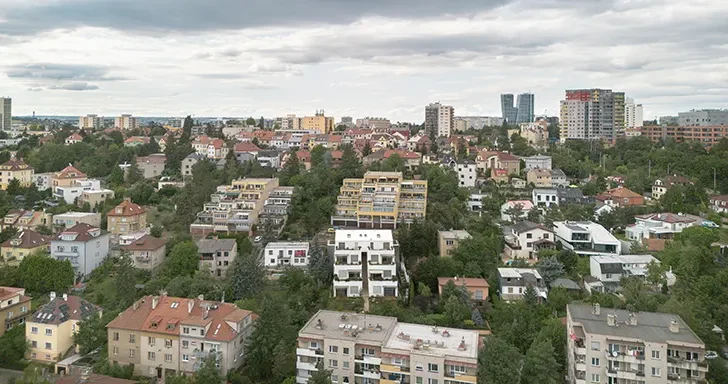

Krč Terraced Twins sits on a steep, topographically complex plot in Prague’s Krč district, an area shaped by successive layers of rural land use, early suburban housing, and postwar apartment construction. Designed by martin cenek architecture, the project responds to a site defined by constraint. A deep plot with a height difference exceeding ten meters, cut off from its original southern access, demanded a precise architectural response that could negotiate terrain, access, and context without visual or spatial overload.
RESIDENTIAL
The site’s history plays a quiet but important role. Once vineyards belonging to Lower Krč, the slopes gradually filled with family houses and villas in the early twentieth century, followed later by apartment buildings from the 1960s onward. The plot eventually lost its lower access, leaving it reachable only from the north. The previous house, located in the upper part of the site, had become functionally obsolete, lacking vehicular access after street level changes left the sidewalk well below the road. Part of the project therefore involved recalibrating the public edge, adjusting sidewalk levels to restore continuity between street, plot, and building.
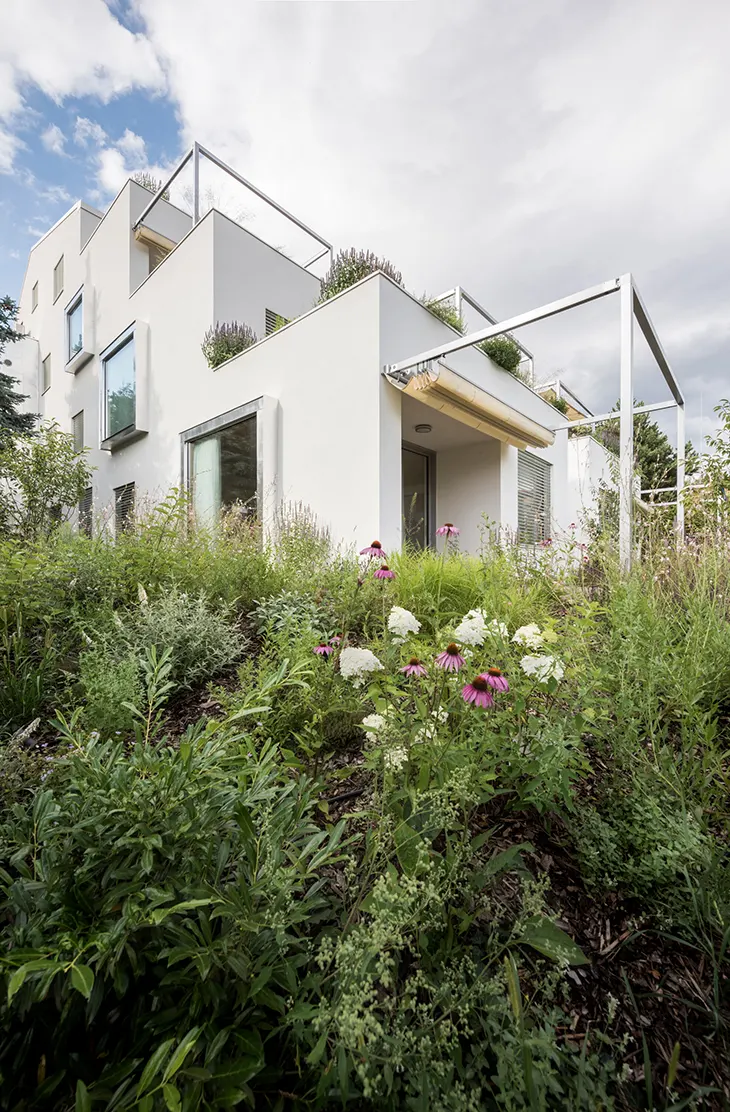
The new semi-detached house addresses this layered context through form and section. At street level, the building appears as a restrained, single-storey white volume with a sloped roof that aligns with neighboring family houses. This compact presence minimizes impact along the street. Cutting through it horizontally is a garage volume clad in natural aluminum sheet metal with standing seams, marking the interface between infrastructure and living space. Moving downhill toward the south, the building expands into a terraced composition that follows the slope and references the apartment buildings positioned across and below the site.
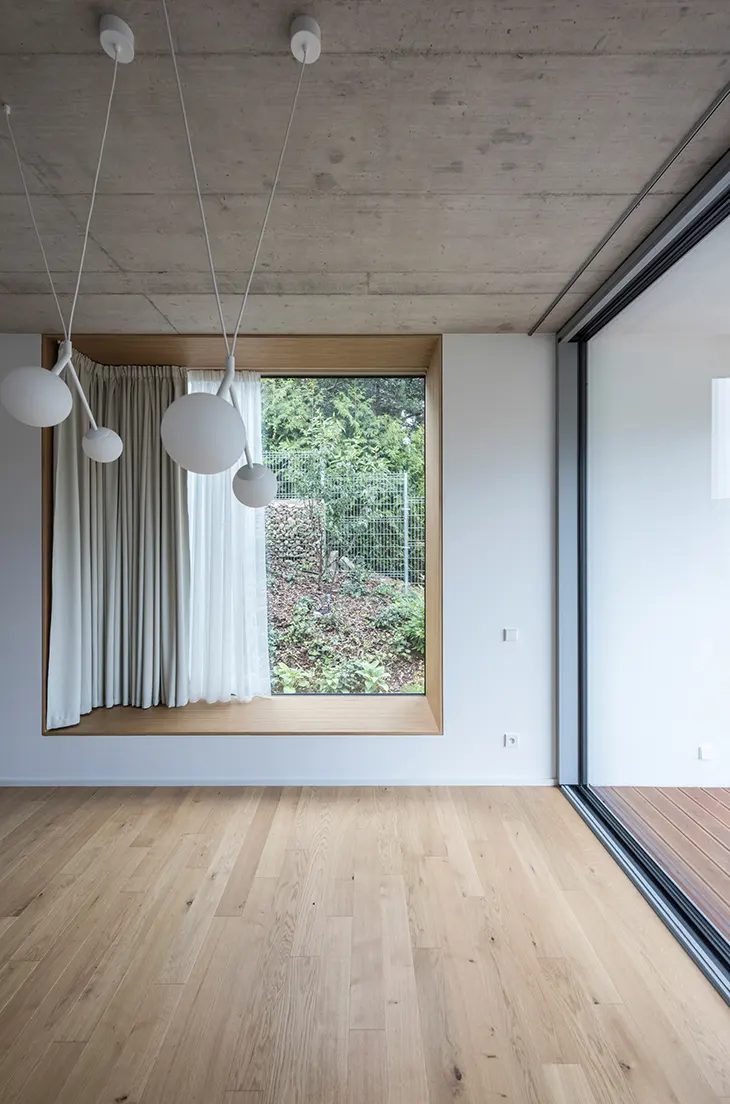
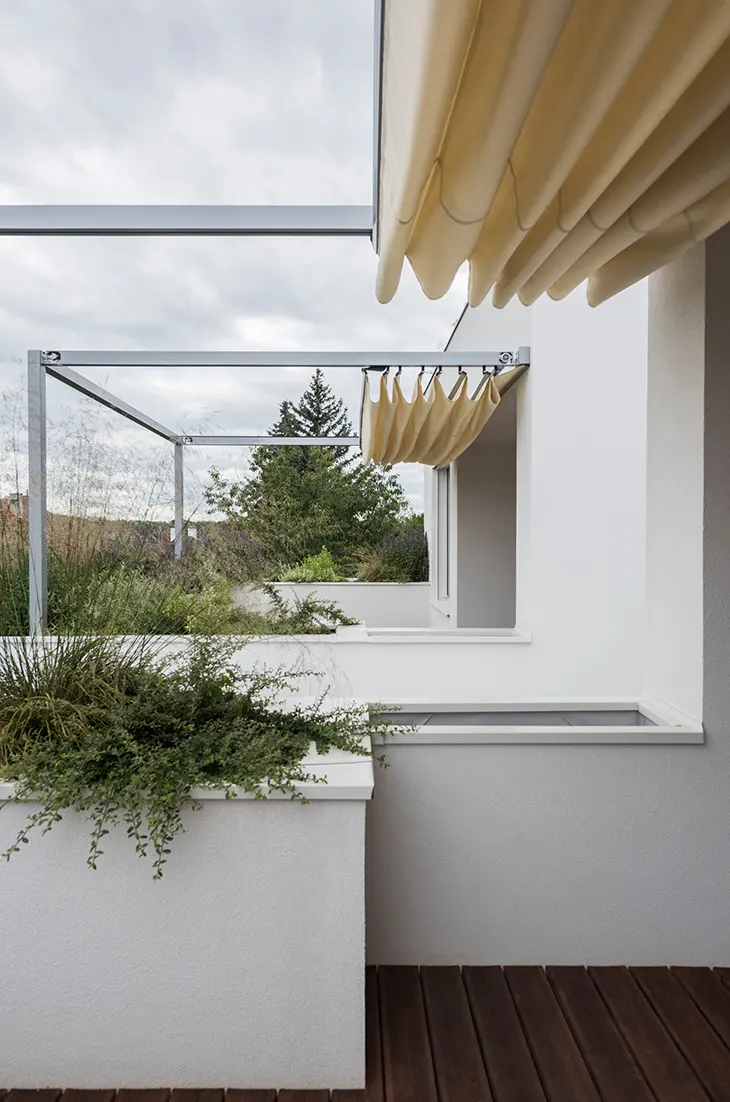
This dual condition gives the house two distinct orientations. Toward the city, it reads as controlled and compact. Toward the landscape, it opens through south-facing terraces designed to accommodate taller planting. These terraces wrap the building and support the architects’ intention to surround each apartment with greenery. Square windows puncture the side façades, positioned according to interior views rather than exterior symmetry, while large openings toward the south frame the forested slope opposite.
Circulation forms a defining spatial element. An external staircase cuts through the building along the central axis between the two mirrored halves. Partially sheltered by the attic volume, this vertical slice connects the street level with the shared garden almost eight meters below, reinforcing the relationship between city and landscape. The layout draws from the typology of classic apartment villas. Each half contains three larger units, including a three-bedroom apartment, a two-bedroom apartment, and a duplex three-bedroom unit. Entrances remain independent, while amenities such as garages, cellars, bicycle storage, and the garden are shared.
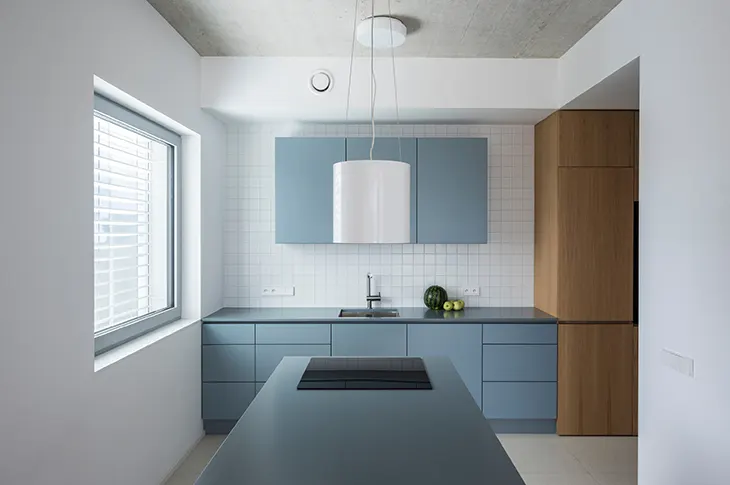
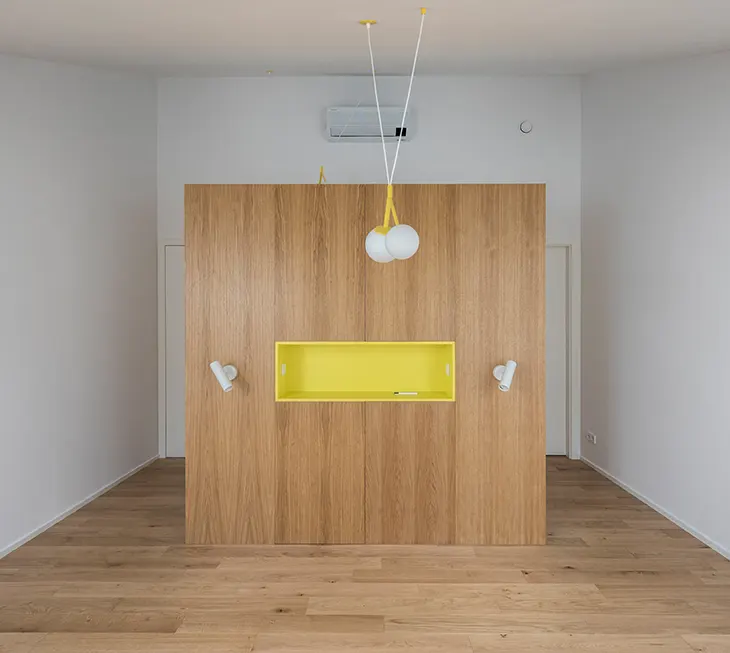
Material choices remain restrained on the exterior, allowing vegetation to dominate. Inside, the atmosphere shifts. Built-in furniture introduces color through lacquered surfaces paired with oak veneers, creating contrast against the neutral envelope. Pergolas with yellow canopies shade the terraces, while frameless windows with deep sills become both spatial and façade-defining elements. In living areas, exposed reinforced concrete ceiling slabs assert the building’s structural logic and add tactile weight.
Environmental performance supports the architectural concept. The building operates as a near zero-energy structure, incorporating heat pumps, forced ventilation, and rainwater recycling. These systems align with the project’s broader ambition: to shape housing that responds intelligently to terrain, history, and climate while offering generous outdoor space and long-term residential quality within a difficult urban condition.