
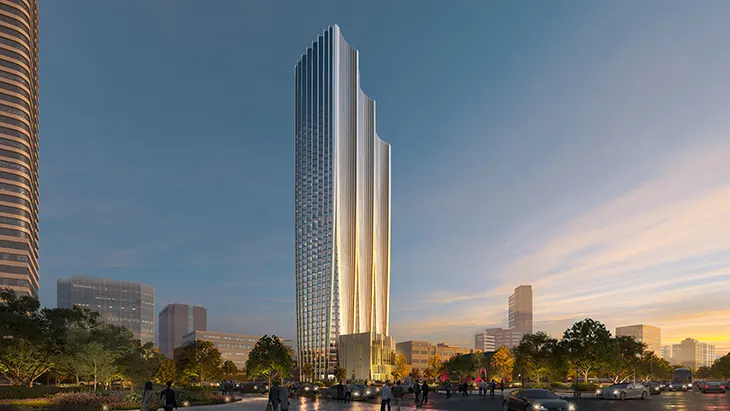
Following an international design competition, Zaha Hadid Architects (ZHA), in collaboration with C.Y. Lee & Partners, has been selected to design the National Innovation, Creativity and Finance Center (NICFC) in Taipei. Positioned in the Beimen district, the city’s historic financial hub, the 175,000-square-metre project consolidates four institutions under Taiwan’s Financial Supervisory Commission, including the stock exchange, futures exchange, and depository and clearing corporation.
TOWERS
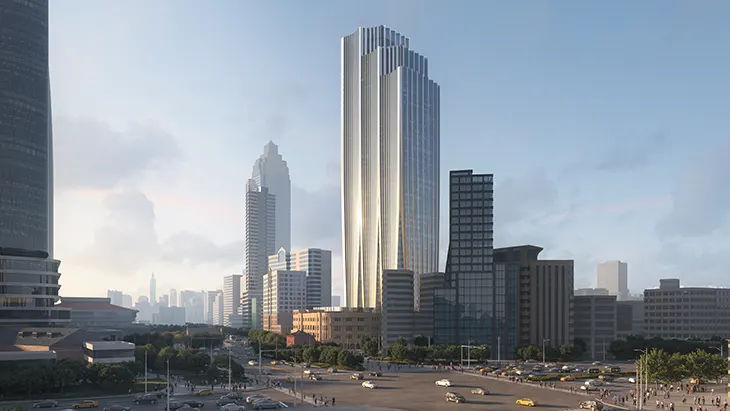
The site occupies a critical urban intersection at Zhongxiao West Road and Bo’ai Road, within walking distance of Taipei Main Station, Beimen Gate, MRT connections, Zhongshan Hall, and several cultural landmarks. The project aligns with the city’s Western Gateway initiative, which seeks to upgrade public space, strengthen pedestrian networks, and reinforce heritage continuity across downtown Taipei.
Heritage as Civic Anchor
Adjacent to the restored Taipei Beimen Post Office, originally completed in 1930, NICFC retains the ornate historic structure while removing its later extensions. The preserved building will transition into a museum and cultural venue, with its original interiors restored as a postal communications museum featuring archives, artefacts, and immersive displays. A community hub will activate the restored portico, positioning the former post office as a renewed civic landmark.
Postal services and administrative operations will relocate to a new facility equipped for contemporary infrastructure needs. This shift enables the historic building to operate as a cultural focal point, embedding institutional memory within the district’s evolving identity.
Podium and Tower
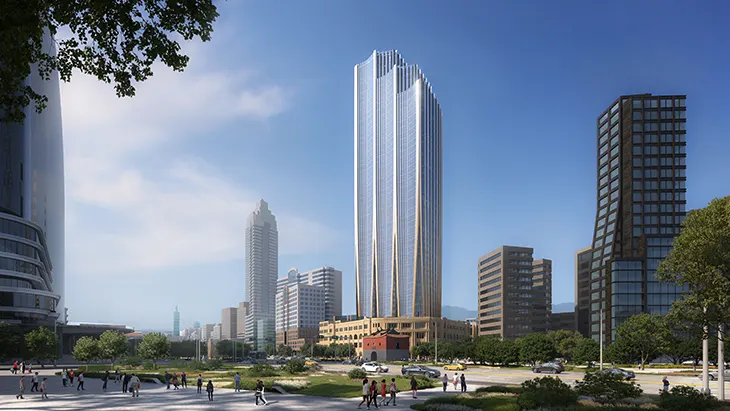
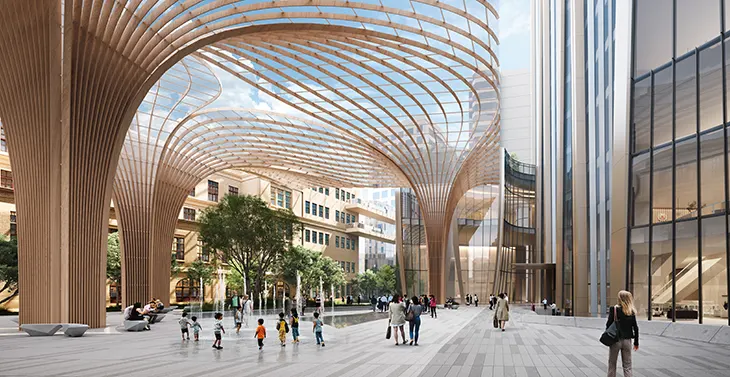
The project’s five-storey podium mirrors the scale of the adjacent heritage structure. Pleated columns support a sculptural glazed canopy, sheltering a new courtyard inserted between old and new buildings. This open-air space accommodates performances and public events, reinforcing NICFC’s civic role beyond its financial functions.
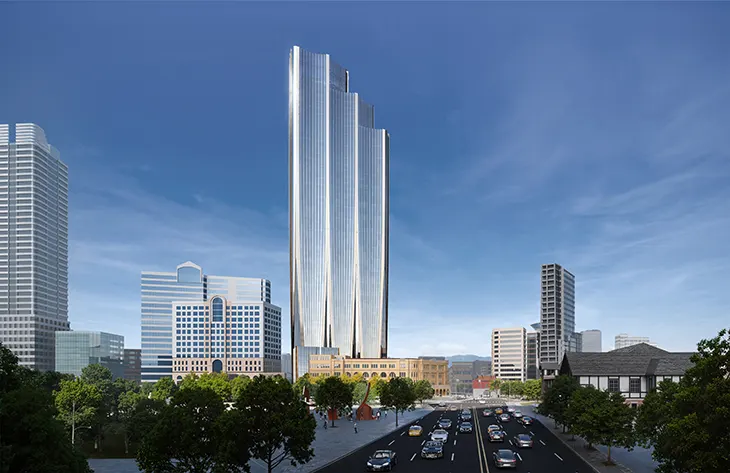
Set back from the historic post office, the 47-storey tower draws formal inspiration from the fluted geometry of Taiwan’s native Phalaenopsis orchid. The tower’s vertical articulation references the organic structure that supports the orchid’s petals and sepals, translating botanical logic into architectural expression. As the tower rises, it unfurls and extends outward, shaping a silhouette that differentiates it from Taipei’s orthogonal skyline.
Programmatic
Efficiency and Security
Designed to achieve floor area efficiency rates exceeding 70 percent, the tower organizes distinct zones for each of the four financial institutions. The layout balances privacy with vertical integration, while multiple floors provide shared office environments, meeting spaces, and a conference centre.
Operational logistics inform the circulation strategy. Three independent elevator banks serve institutional floors, rental office floors, and dedicated dignitary and service routes. This separation ensures secure daily operations and controlled access during major financial or governmental events.
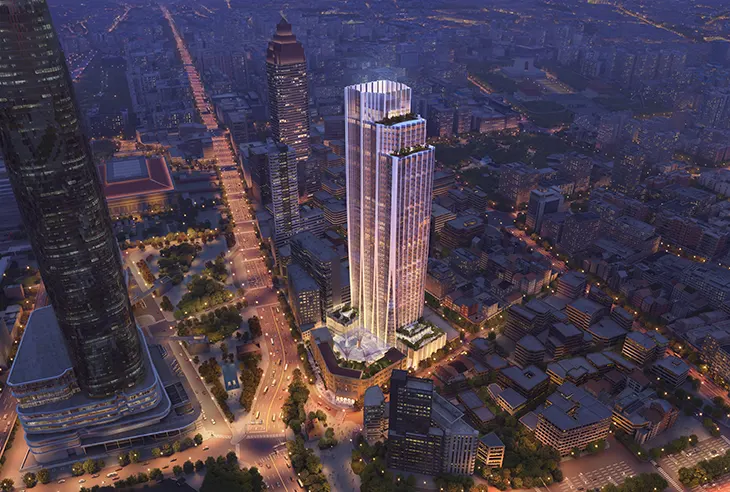
Concave bays along the northern façade frame panoramic views toward Qixing and Guanyin mountains. To the east, the tower aligns with the city’s primary axis, opening vistas toward Taipei 101 and the Xinyi District. On the western façade, a system of vertical pleats establishes rhythm while overlooking the Tamsui River’s natural landscape. The southern elevation adheres to civic guidelines governing the administrative district, stepping back at higher levels to provide shading and mitigate wind forces.
Environmental Performance
in a Subtropical Climate
NICFC targets dual sustainability certification under LEED Platinum and EEWH Diamond standards, with the ambition of operating at net-zero carbon emissions. The tower’s pleated façade system responds directly to Taipei’s humid subtropical climate. Varying depths and angles regulate solar gain and guide airflow, enabling passive environmental control integrated within the building’s curvature.
A high-performance double-glazed unitised curtain wall system operates in conjunction with the pleated façade to enhance energy efficiency. Photovoltaic panels integrate into the façade, while rooftop solar arrays contribute on-site renewable energy generation. Detailed digital mapping and 3D modelling optimize orientation and façade performance, supporting reductions in operational energy demand.
Material strategies prioritize recyclability, low-VOC components, and modular structural systems to reduce embodied carbon and extend lifecycle durability. Rainwater collection, storage, and reuse systems reduce reliance on municipal supply, reinforcing the building’s environmental objectives.
Reframing the Western Gateway
NICFC positions itself as both institutional headquarters and urban connector. By preserving the Beimen Post Office, introducing new public courtyards, and aligning with Taipei’s pedestrian networks, the project integrates heritage and forward-looking infrastructure within a single architectural composition.
In the Beimen district, where financial institutions intersect with cultural landmarks and transit nodes, NICFC proposes a new civic typology. Through botanical form, calibrated urban massing, and environmental precision, the project reframes Taipei’s Western Gateway as a district defined by accessibility, memory, and innovation.