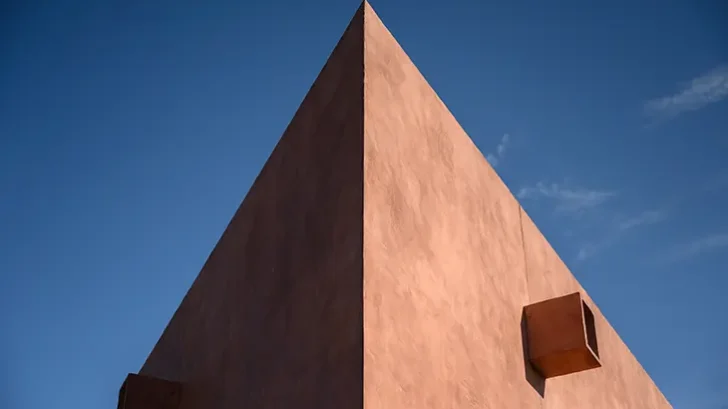


Set on an elevated portion of a rural site in Mendiolaza, Córdoba, Casa BP positions itself as a measured architectural response to topography, climate, and landscape. Designed by Santiago Bertotti, the residence occupies a gently sloping terrain, using height and orientation to frame expansive views while maintaining a controlled relationship with access and approach. Rather than standing apart from its context, the house embeds itself into the land through a green platform that follows the site’s natural contours.
RESIDENTIAL
The architectural composition is defined by a strictly longitudinal layout aligned with the site’s dominant boundaries. This linear strategy organizes the house as a single extended volume, reinforced by a clear distinction between mass and permeability. Toward vehicular access, the building presents itself as an opaque, monolithic body. Toward the landscape, it opens fully, dissolving into a sequence of galleries, glazed planes, and shaded thresholds.
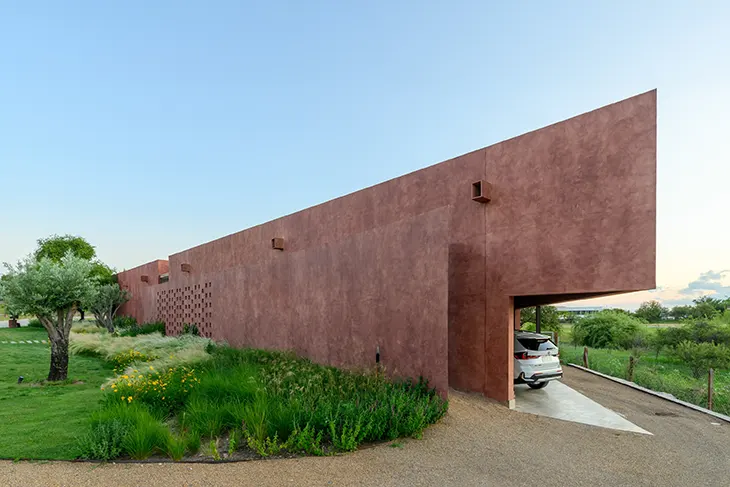
Two formal operations structure the project. The primary volume is conceived as a continuous earth-toned mass, rendered in pigmented cement with a handcrafted mineral texture. This monolithic body establishes a sense of weight, protection, and thermal stability. In contrast, a secondary pavilion detaches subtly from the main structure. Lighter in expression, it introduces black-framed glazing, expansive glass surfaces, and horizontal sun-shading elements that regulate light and transparency.
The internal organization reinforces this duality. Social spaces form a central, uninterrupted nucleus where living room, dining area, and kitchen coexist within a flexible plan. This core extends directly into a parallel longitudinal gallery, allowing daily activities to flow outward toward the landscape. The gallery operates as both circulation and inhabitable threshold, mediating interior life with exterior conditions.

The private sector occupies the right wing of the house, buffered by a linear corridor and the thermal mass of the external walls. Openings are precisely calibrated to balance privacy, daylight, and climate control. This careful modulation ensures stable interior conditions while maintaining visual connection to the surroundings where appropriate.
A complementary pavilion introduces a different spatial rhythm. Its metal structure and sun-shading systems filter light rather than block it, producing a softer, variable atmosphere. Here, transparency becomes adjustable, responding to seasonal changes and daily cycles.
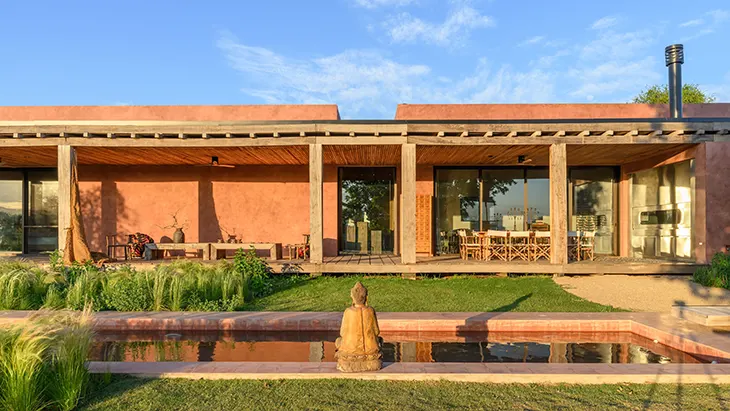
Landscape design plays an integral role in the project’s spatial logic. Conceived by Blas Spina, the garden draws exclusively from native species, including grasses, herbaceous plants, and local shrubs. The planting strategy avoids decorative gestures, instead extending the serrano ecosystem across the site. This approach reinforces continuity between built form and terrain, softening edges and anchoring the architecture visually.
A linear pool runs alongside the gallery, acting as a reflective plane that extends the house’s geometry into the landscape. Its horizontal presence amplifies the relationship between architecture and vegetation, reinforcing the project’s disciplined linearity.
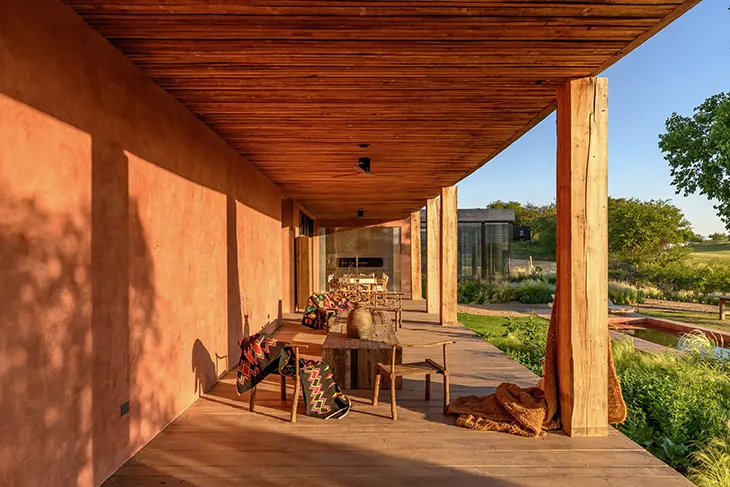
Material decisions remain closely tied to place. Pigmented cement walls register subtle chromatic shifts throughout the day, absorbing warm tones at sunrise and deepening into ochres at sunset. Solid wood structures in the gallery introduce tactile variation, while black metal and glass elements provide contrast without visual excess.
Casa BP operates as a territorial intervention rather than an isolated object. Through mass, restraint, and calibrated openness, the house reads the landscape and responds with clarity. Its architecture does not compete with its surroundings but accompanies them, allowing light, climate, and terrain to shape both form and experience.