
Set along the shore of Lac Archambault in Saint-Donat-de-Montcalm, La Maison de la Baie de l’Ours is a residential project by ACDF Architecture that derives its architectural force directly from the landscape it inhabits. Positioned between water, forest, and rocky escarpments, the house establishes a sustained dialogue with its surroundings, shaping daily life through horizon lines, framed views, and carefully modulated thresholds between shelter and exposure.
HOUSING
The site carries a history of light occupation. Once home to a summer camp, the land remained unused for years, allowing vegetation to reclaim much of the terrain. The architects chose to build within a partially cleared zone accessed by an existing service path, avoiding disturbance to steeper sections of the site. This decision anchors the project in restraint, allowing the natural topography to remain the primary spatial driver. Despite its generous scale, the house reads as discreet from the lake, maintaining a low visual profile while offering a deeply immersive interior experience.
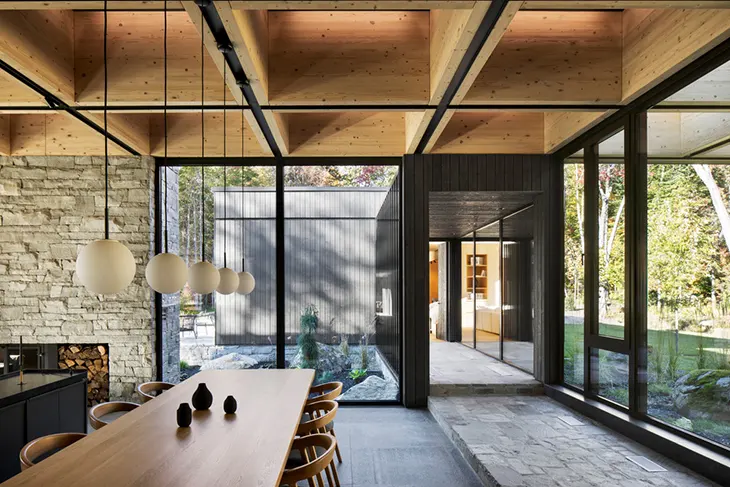
The project explores a measured paradox: openness without exposure. Through recesses, framed views, and controlled transparency, the house allows expansive visual connections to the landscape while maintaining a sense of enclosure. Occupants experience the surrounding forest and water as ever-present, yet filtered, creating a condition of withdrawal that avoids isolation.
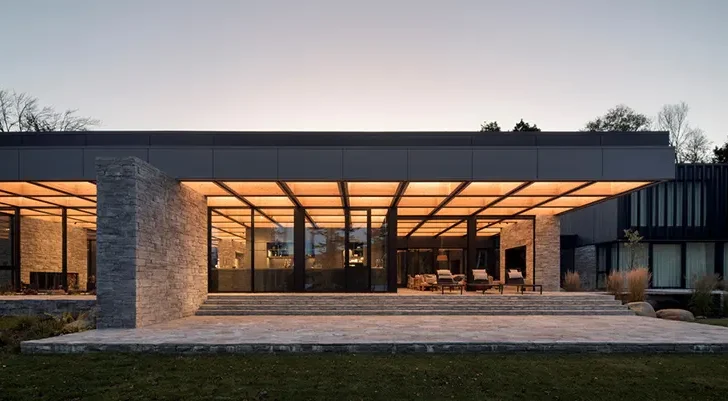
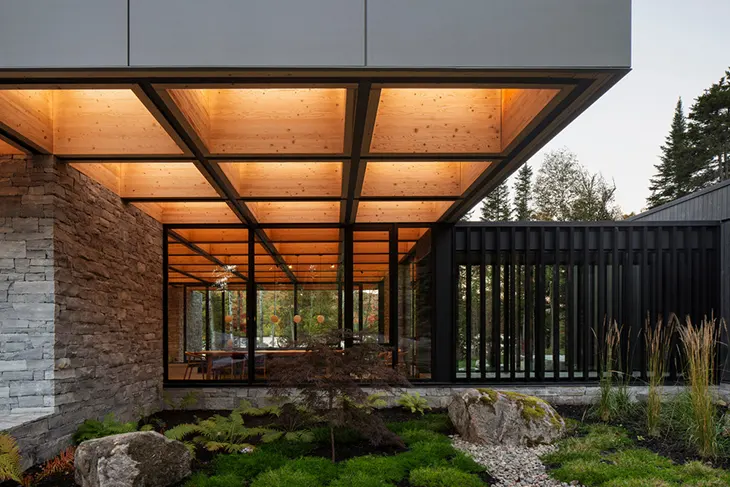
Architecturally, the house unfolds through three interdependent layers. The most defining element is the expansive timber roof structure that spans the main living areas. Composed of glulam beams assembled into a coffered grid, the roof generates deep cantilevers that extend outward, visually and spatially pulling the interior toward the lake and mountains. Its apparent weightlessness contrasts with its structural presence, framing the landscape while establishing a strong sense of refuge beneath.
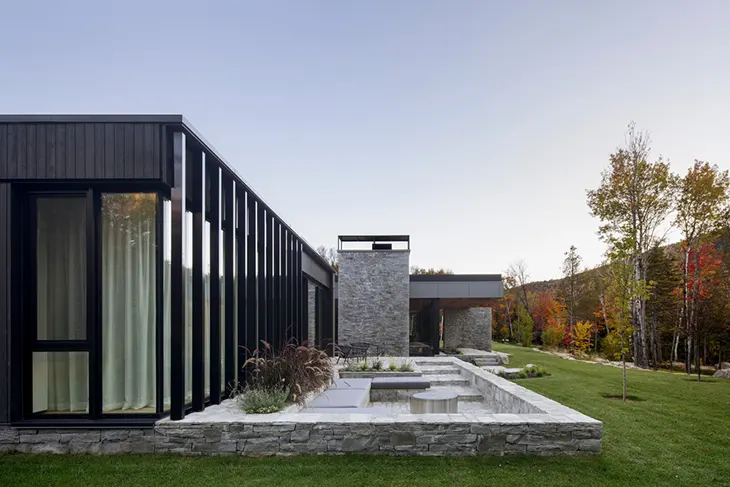
Supporting this floating plane are a series of stone walls conceived as monolithic elements. These walls function structurally while acting as geological extensions of the site, emerging from the terrain as if uncovered rather than placed. Columns remain concealed within these stone masses, reinforcing the perception of continuity between architecture and ground. In several instances, the walls extend outward and dissolve into low partitions that further root the building within the landscape.
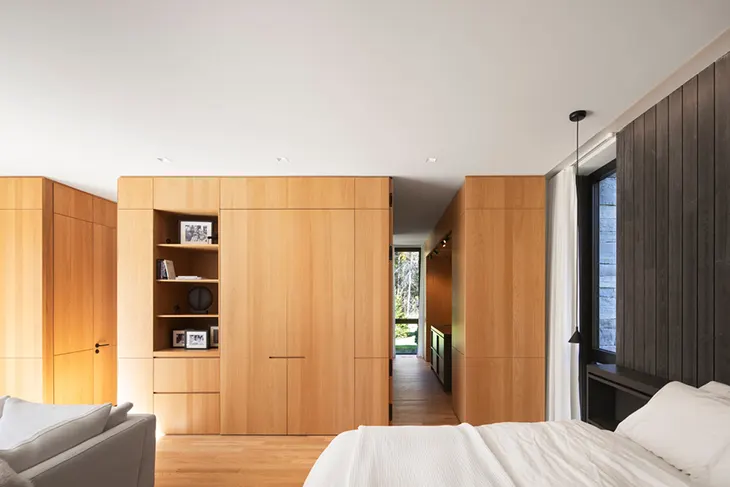
The third layer consists of darker wooden volumes that contain bedrooms and service spaces. These elements pull back from the roof’s perimeter, creating protected zones of privacy and retreat. Their more introverted character balances the openness of the main living spaces, producing a domestic rhythm that shifts between collective immersion and quiet withdrawal.
At the heart of the house, a 5-by-5-foot coffered timber ceiling defines the principal living areas. Acoustic panels integrated within each coffer temper sound, while discreet perimeter lighting traces the geometry of the structure. Skylights punctuate the roof, allowing daylight to animate the timber surfaces across hours and seasons. The effect remains calm and enveloping, reinforcing the house’s role as a retreat attuned to its environment.
Living spaces unfold in a continuous sequence. The kitchen, dining room, and sunken living area all open toward the lake, while the dining room maintains a secondary visual axis toward the forest. A central fireplace anchors the plan, visible from all shared areas and acting as a spatial and social fulcrum. A secondary kitchen, concealed within a dark wood volume, supports gatherings without disrupting the primary living zone.
Outdoor space forms an extension of this interior logic. A screened terrace beneath the roof overhang functions as an outdoor living room, protected from insects while remaining open to the landscape. An exterior fireplace aligns directly with the interior hearth, reinforcing visual continuity between inside and out. Additional terraces, sunken into the terrain and bordered by stone and built-in seating, offer quieter zones for reflection.
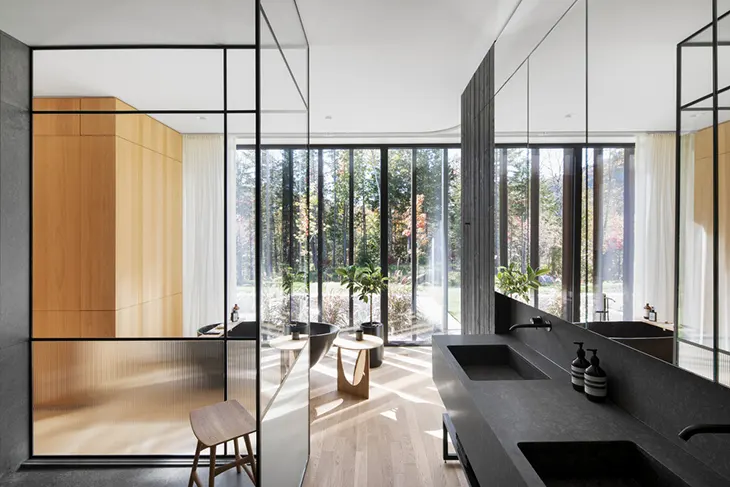
Private wings flank the central living spaces. One side houses the parental suite, accessed via a glazed corridor that serves as a threshold between shared life and retreat. The suite includes a lake-facing bedroom, lounge, walk-in closet, and a forest-oriented bathroom, all arranged to sustain a continuous relationship with the surroundings. The opposite wing accommodates children’s bedrooms and a large playroom that connects to outdoor terraces and upper-level guest and workspaces through bridges and transitional spaces.
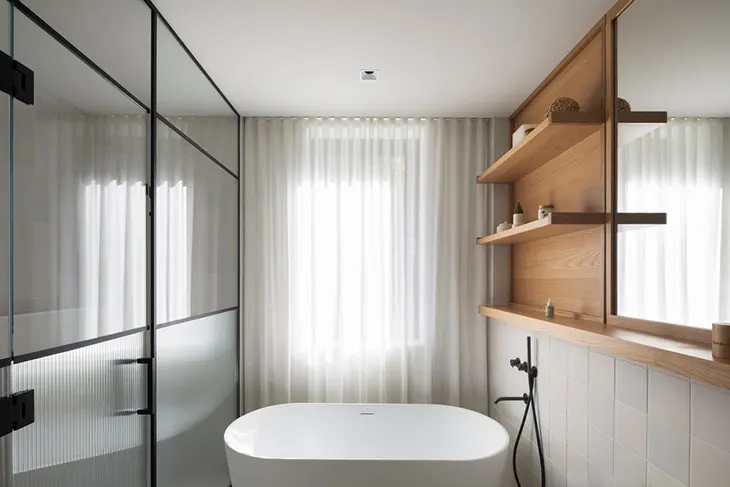
Throughout the project, material choices reinforce spatial intention. Timber, stone, and dark wood articulate structure, enclosure, and movement, while avoiding excess articulation. Architecture here operates as a mediator, allowing light, sound, and landscape to shape the experience of dwelling.
La Maison de la Baie de l’Ours presents an architecture grounded in revelation rather than assertion. By working with topography, light, and material presence, ACDF Architecture delivers a house that frames nature as a lived condition, offering a sustained, immersive relationship between people and place.