
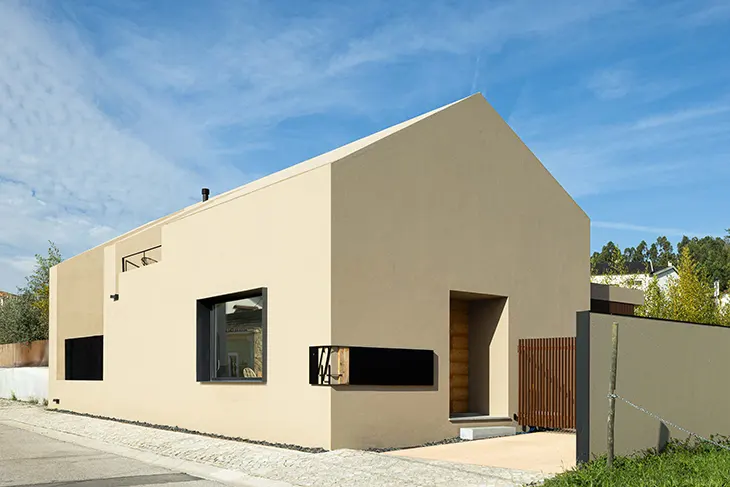
Designed by Filipe Saraiva with collaboration from architects Samuel Silva and Jéssica Casalinho, Casinha da Melroeira stands in Melroeira, in the parish of Nossa Senhora das Misericórdias, Ourém. Built upon a pre-existing structure, the 116.10-square-meter dwelling adopts the same pentagonal volumetric language as Casa da Melroeira on the adjacent plot. Although the two houses share geometry, their scale and spatial relationships differ according to their specific contexts.
HOUSING
The project engages directly with memory. The architect’s familiarity with the site shaped the design process, particularly the presence of a former ruin that once formed part of the landscape of Casa da Melroeira. That ruin carried symbolic weight tied to the threshing floor located near the public road. This agricultural element became the conceptual center of the new house. Casinha da Melroeira develops around this point, orienting its main living areas and bedrooms toward that memory-laden axis.
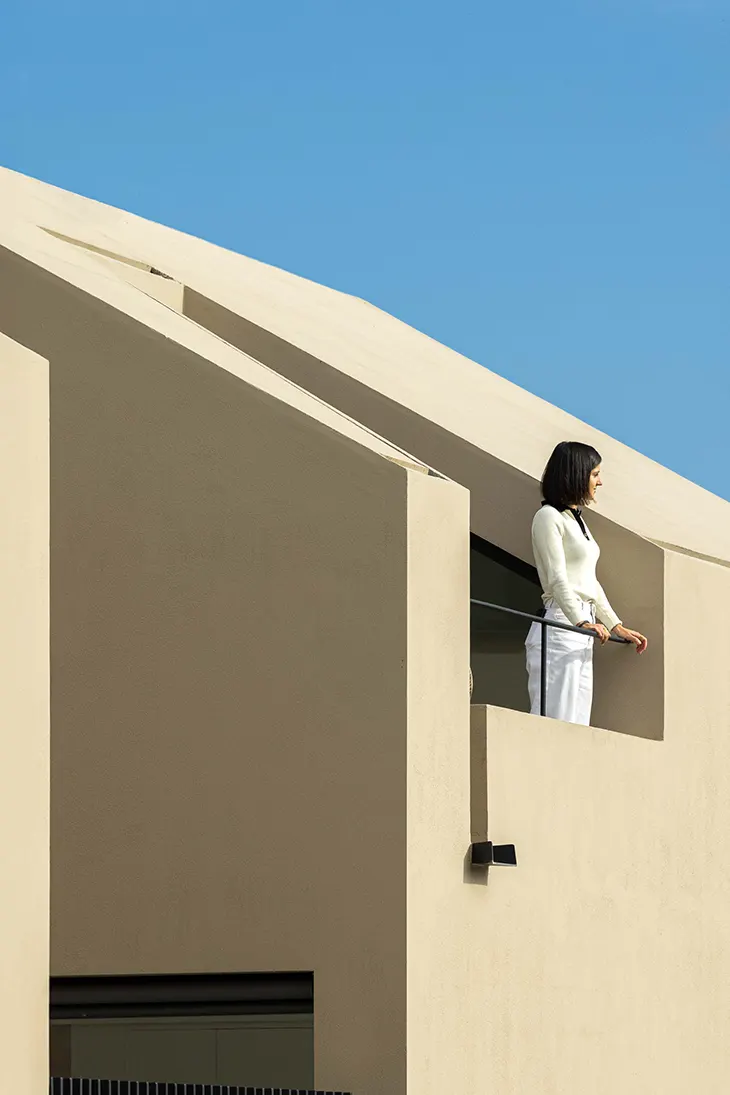
The limits of the original structure remain intact. Given the reduced dimensions of the plot, the design introduces carved voids within the mass to generate exterior extensions of the interior program. These voids avoid orthogonal cuts. Instead, their angled orientation responds to shifting daylight conditions, allowing each room to experience changing atmospheres throughout the day. Select openings on the second floor, including those in the office and bathroom, frame directed views toward the Castle of Ourém, transforming landscape into a composed visual element.
Without a predefined client, the project turned inward. The focus shifted toward the house as an object, its relationship to the body, and the dynamics of family life within compact space. The design prioritizes spatial continuity and comfort while maintaining clarity of form. Technical experimentation supports this intention. Exterior metalwork details, including the mailbox, railings, gargoyles, chimney, and firewood storage, express precision and continuity. Construction solutions allow the volume to flow seamlessly from wall to roof, reinforcing the unity of the pentagonal form.
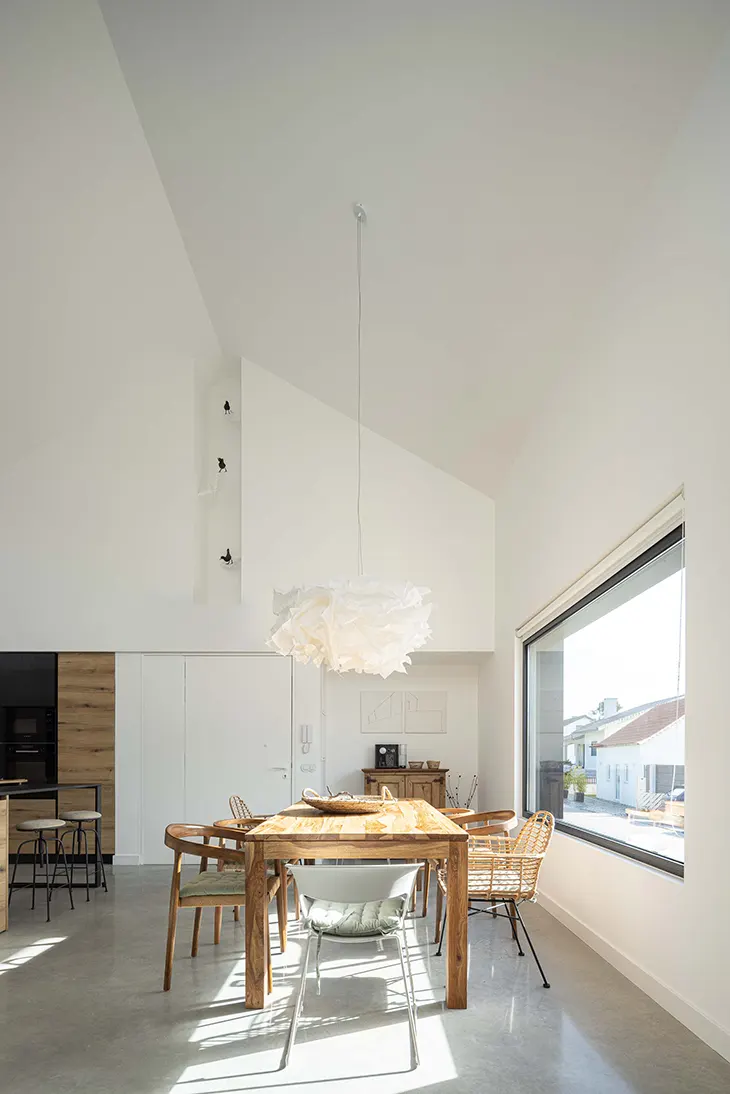
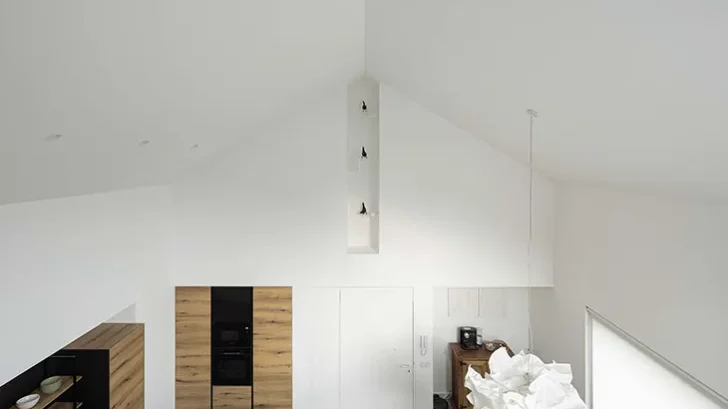
Upon entry, a double-height ceiling reveals itself immediately. The pentagonal geometry enables vertical expansion that introduces a sense of openness. This generous space transitions into more intimate zones scaled to embrace daily routines. The interior balances spatial variation with material warmth. Antique furniture pieces, handcrafted elements by the architect, and natural decorative components create layered domestic character.
Among these objects, a blackbird sculpture occupies a niche above the entrance, referencing the village name “Melroeira,” associated with the abundance of blackbirds in the area. Paintings depicting blackbirds and perspectives of the house, a handmade mezzanine lamp, and a repurposed dining fixture reinforce the dialogue between craft and memory. These coexist with commercially available pieces and the Shell chair by Hans Wegner, acquired second-hand.