

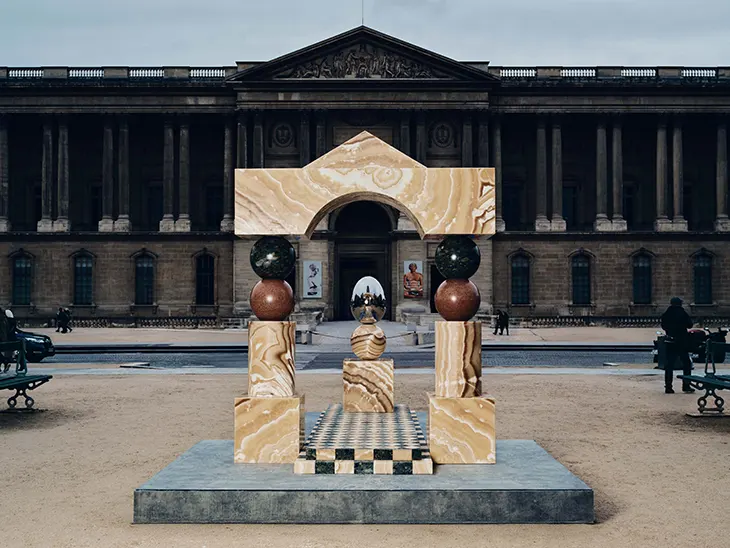
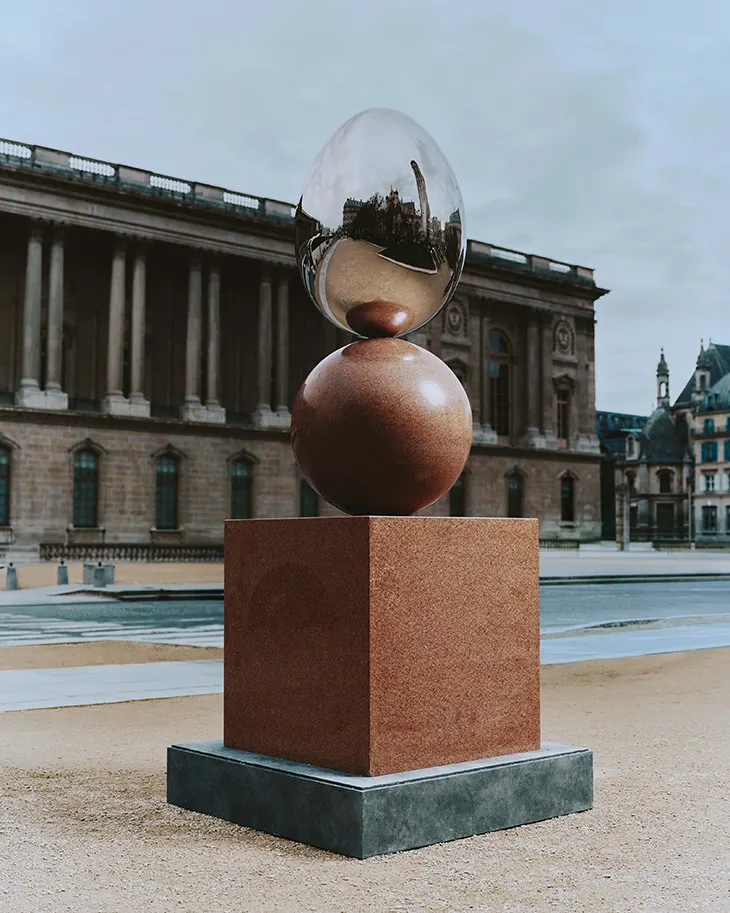
Installed at Place du Louvre, “Mirror Gate II” introduces a monumental sculptural presence by Pilar Zeta that frames Paris through an architectural gesture shaped as a portal. The work positions itself opposite the Louvre, establishing a spatial dialogue that links site, form, and history through scale and placement. Conceived as a passage between past and present, the sculpture approaches ancient Egyptian culture through a contemporary artistic language rather than historical quotation.
ART
Before arriving in Paris, “Mirror Gate II” appeared in a markedly different context. The work was originally presented facing the Pyramids of Giza, where its form engaged directly with one of the most charged archaeological sites in the world. For its Paris installation, the sculpture returns altered by context, carrying traces of its initial setting while responding to the urban environment and institutional surroundings of the French capital.
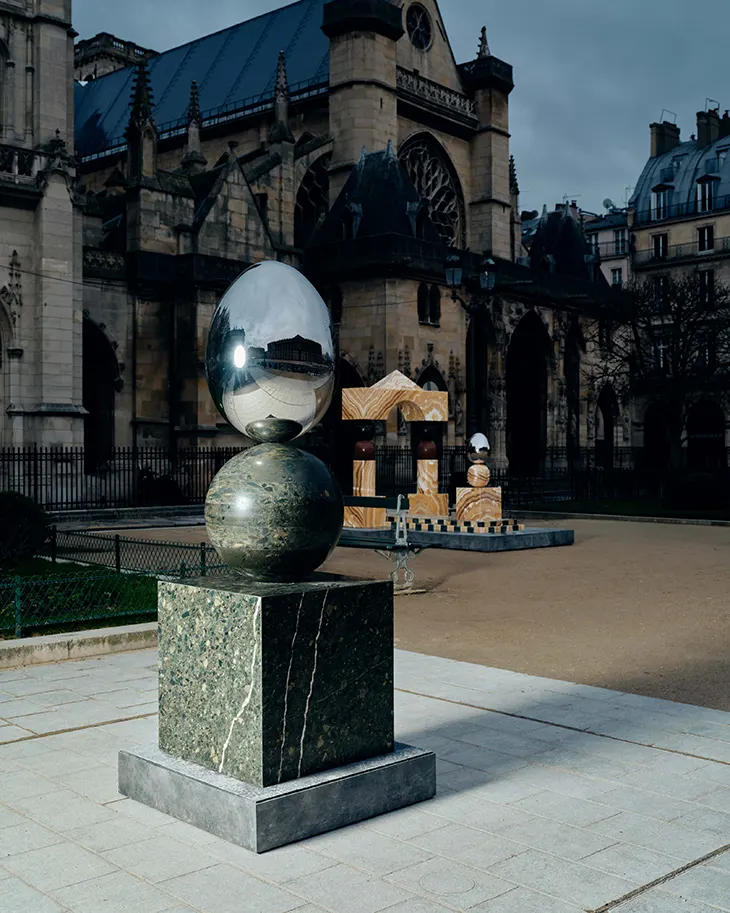
Material choice anchors the sculpture in a lineage tied to ancient Egyptian architecture and sculpture. Stones sourced from Marmonil quarries form the structure, including yellow alabaster, red Aswan granite, and Fawakheer breccia. These materials give physical weight to the work and establish a direct connection to geological sources historically associated with pharaonic construction.
A checkerboard path runs through the portal, introducing a motif associated with duality and symbolic systems found throughout Egyptian history. This patterned route directs visitors inward, shaping the experience through progression rather than static observation. At the center, a mirrored egg forms the focal point of the installation.
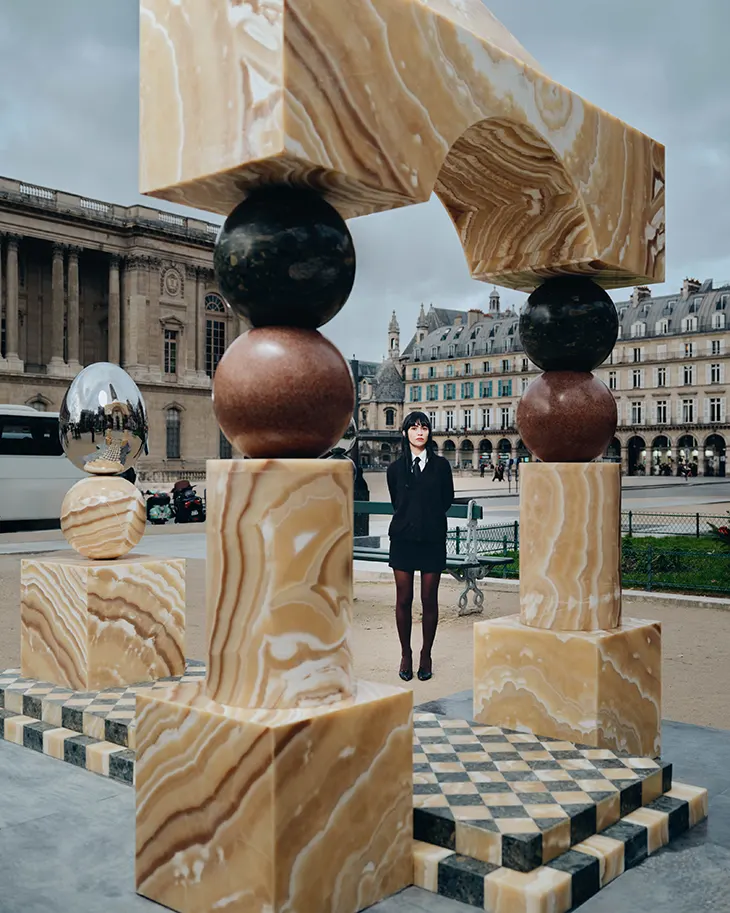
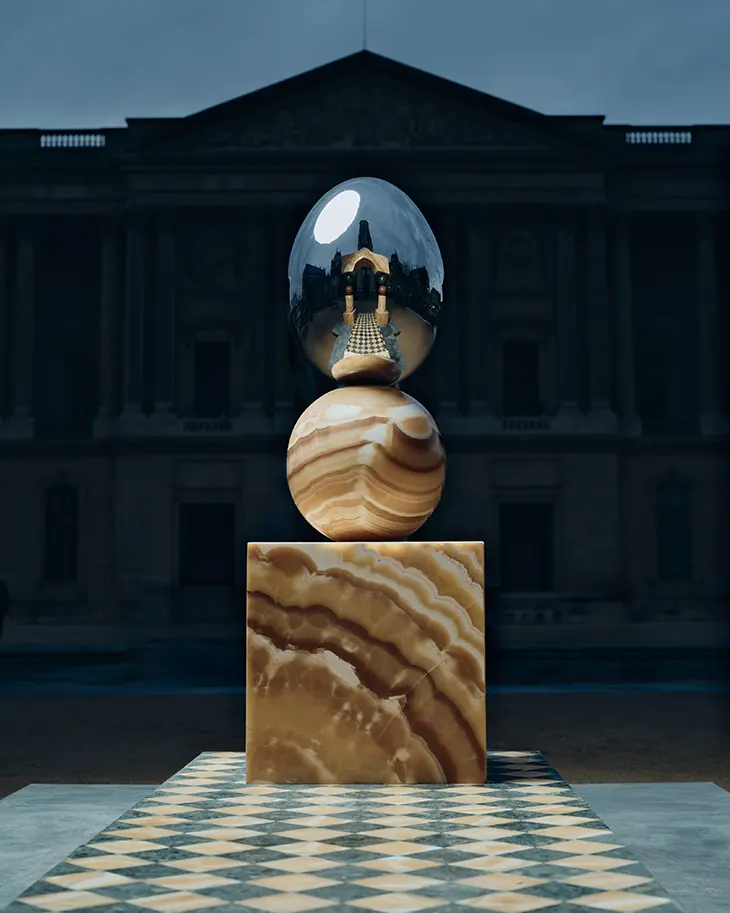
The work appears 190 years after the placement of the Luxor Obelisk in Paris, a gift from Egypt’s Viceroy Mehmet Ali. Within this longer historical arc, “Mirror Gate II” enters the city as a contemporary gesture that acknowledges an ongoing cultural exchange between France and Egypt through art and architecture.
Pilar Zeta’s broader practice informs the structure and intent of the work. Known for exploring geometry, philosophy, symbolism, and mysticism through immersive and architectural forms, Zeta often constructs environments that shape perception through spatial experience. “Mirror Gate II” follows this approach, presenting a sculptural form that operates through movement, reflection, and scale rather than representation.
The realization of the sculpture involved Marmonil, a leading presence in Egypt’s natural stone industry. Drawing on generations of quarrying knowledge, Marmonil works with master stonecutters who translate raw stone into architectural and sculptural forms. This expertise supports projects that connect ancient material sources with contemporary applications. Beyond this collaboration, Marmonil has supplied more than 110,000 square meters of marble and granite for the Grand Egyptian Museum, including Aswan granite from the same quarry used for the colossal statue of Ramses II displayed in the museum atrium.
The collaboration between Pilar Zeta and Marmonil began with a chance encounter in Mexico City in 2024, rooted in a shared approach to stone and symbolic form. That meeting led to the realization of “Mirror Gate” at the Pyramids of Giza and continues with “Mirror Gate II,” presented in Paris from January 16 to February 15, 2026.