
The AEROTIM Hangar functions as a working environment, training base, and collective headquarters for AEROTIM, the team led by Timur Fatkullin whose work spans aerobatics, freestyle motocross, and skydiving. Rather than relying on visual excess, the project channels the discipline, intensity, and mental focus of extreme aviation culture into a spatial system defined by precision, control, and purpose.
INTERIOR DESIGN
Conceived as a multifunctional hangar accommodating sport aircraft maintenance, storage, and crew facilities, the building consolidates all operational needs into a single, uncompromising volume. With a hangar area of 400 square metres and a second-level Crew Station measuring 94 square metres, the structure is organized around a full-height central hall. The architecture remains fully exposed, revealing steel trusses, corrugated metal roofing, and visible engineering systems. Nothing is concealed, reinforcing a sense of operational clarity and technical honesty.
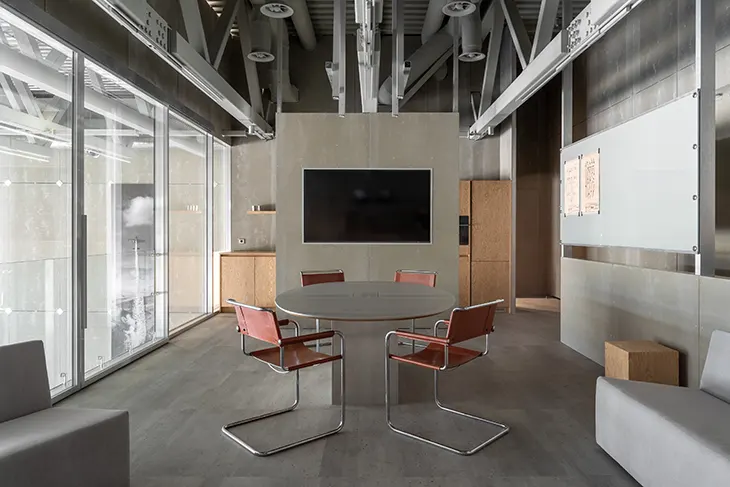
Interior and concept development was led by Dan Vakhrameyev, whose approach centers on restraint and material discipline. As Vakhrameyev notes, the design language relies on exposed surfaces, honest materials, and precise detailing to support the rhythms of pre- and post-flight routines. This attitude governs the entire project, from façade to furnishings.
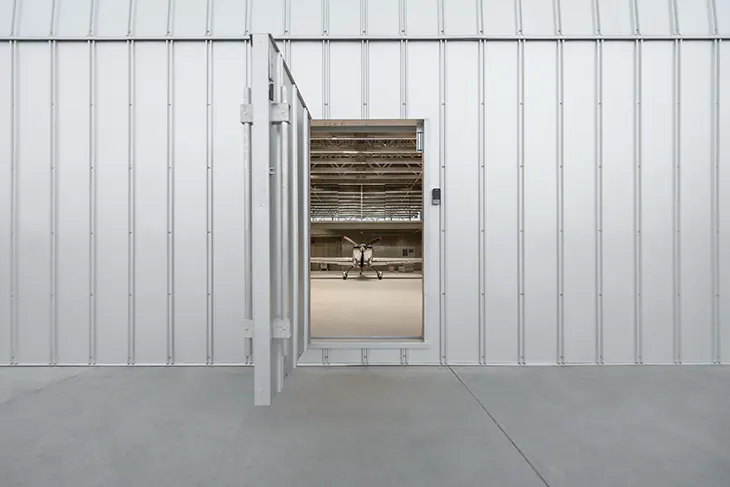
The primary entrance is defined by a full-width, vertically lifting gate clad in raw zinc sheets. Its scale allows unobstructed aircraft movement while establishing a direct visual link between exterior and interior. Above, a polycarbonate fronton introduces daylight into the hangar, reinforcing the building’s functional identity and aviation-driven logic. Light enters the space with purpose, responding to movement and time rather than atmosphere alone.
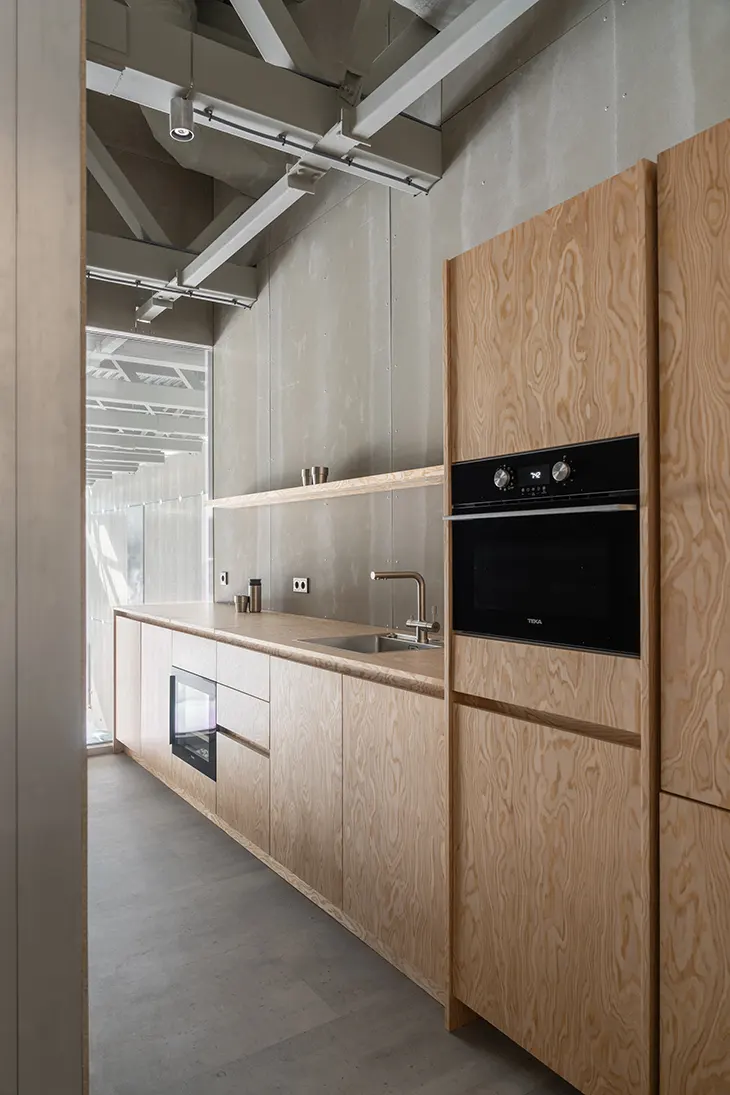
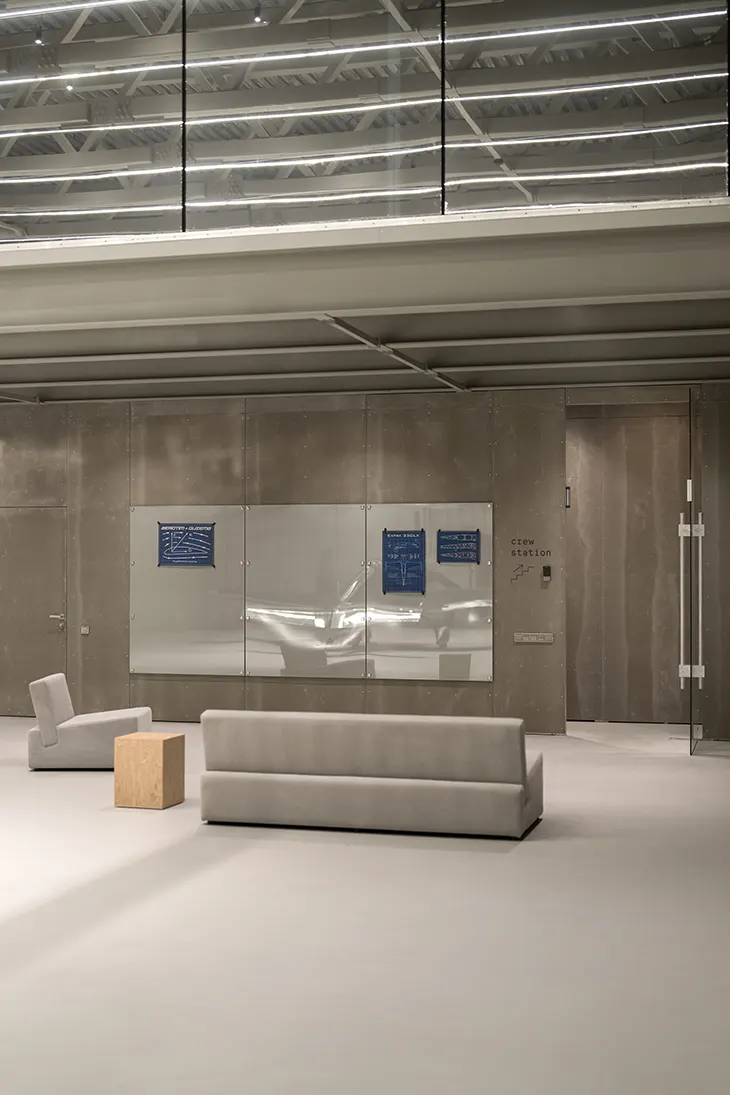
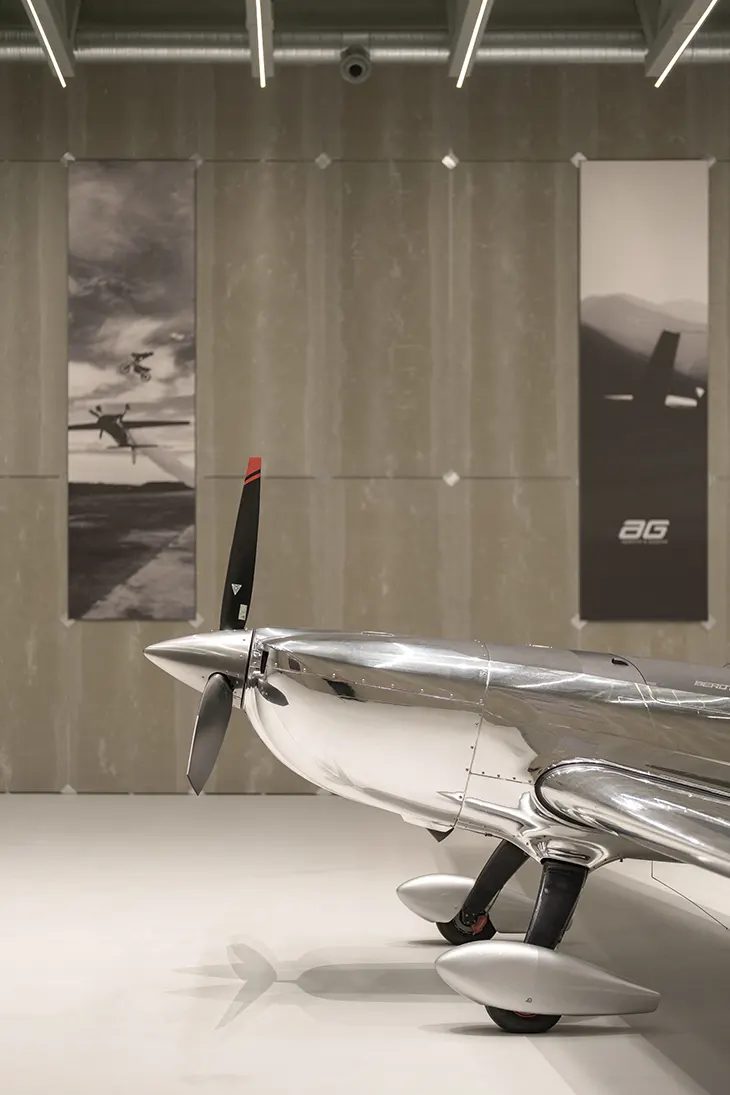
Material selection inside the hangar responds directly to structural constraints. Large-format Cement Bonded Particle Board panels were chosen for wall finishes, offering durability, ease of replacement, and a texture aligned with the project’s raw material concept. The panels are mounted with visible joints inspired by aircraft fuselage fastening techniques, referencing riveted construction without slipping into imitation. This logic extends throughout the project, with the same panels used to fabricate doors, worktables, and shelving, ensuring continuity and material efficiency.
Large-format banners are embedded directly into wall recesses, following the hangar’s architectural grid. Concealed backlighting produces a soft, matte glow, allowing the imagery to communicate the crew’s achievements, ambitions, and aviation culture without dominating the space. These elements function as a quiet narrative layer, integrated into the architecture rather than applied onto it.
The Crew Station occupies the second level and is defined by a single frameless glass façade. From this elevated position, the entire hangar unfolds in one continuous view. A central panoramic sliding window maintains an uninterrupted visual connection with aircraft activity below, reinforcing situational awareness and spatial command. The Crew Station operates as both observation point and living environment, suspended above the operational core.
Inside, the layout balances collective and private needs. A central table anchors the space for briefings and discussions, while adjacent zones accommodate leisure, work, rest, and recovery. Seating combines contemporary ProPro sofas with selected vintage chairs, introducing subtle variation within a largely monochromatic palette. Red-brown accents punctuate the interior sparingly, while warm wood cabinetry in the kitchen softens the industrial framework without disrupting the overall logic.
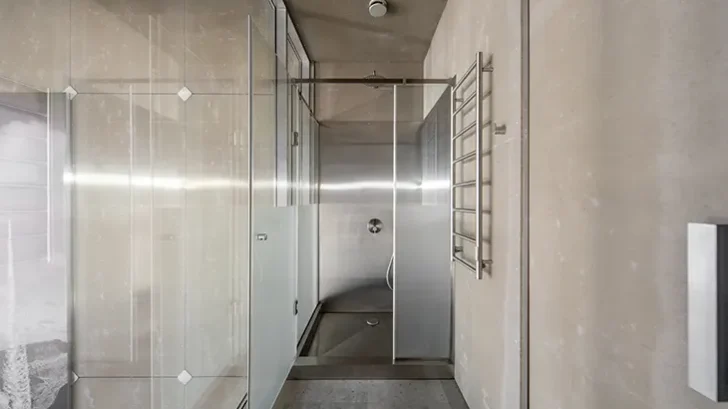
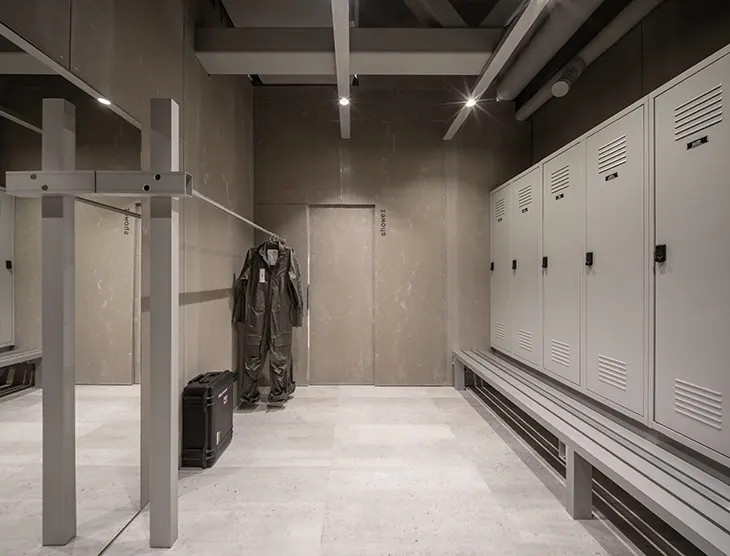
Rest areas are treated with the same attention to performance. Compact bulk beds are arranged to support deep rest between flights, enclosed by upholstered fabric panels that improve acoustics and sound insulation. Integrated lighting remains subdued, prioritizing mental reset over visual emphasis. The changing room and shower zone form a direct transition space between preparation and recovery, constructed from aluminum profile offcuts and stainless steel elements. A transparent glass window connects the shower area visually to the main hangar, preserving continuity with the space below—a decision fully embraced by the AEROTIM athletes.
Lighting throughout the hangar follows the structure’s logic. Linear LED fixtures trace the steel framing, emphasizing the rhythm of the trusses while delivering even, controlled illumination across the main volume. Accent lighting is applied selectively to define zones and highlight aircraft, stairways, and second-level areas. A custom on-site luminaire, fabricated from aluminum wall-profile offcuts, provides focused task lighting while reinforcing material consistency.
Flooring remains utilitarian and precise: a seamless polymer surface in the main hangar and durable vinyl on the second level, both selected for performance and maintenance efficiency. Across all spaces, the interior prioritizes clarity, flexibility, and operational readiness.