
EK Design approaches Bay Park Center Private Club through a clear conceptual framework titled “The Growing Garden.” The project, located in Shenzhen and spanning 600 square meters, treats space as a living system rather than a fixed composition. Architecture, light, and planting work together to create an environment that evolves through movement, perception, and daily use.
INTERIOR DESIGN
The existing building presented a fragmented layout, combining street-level retail with upper villa spaces. Circulation lacked clarity, and daylight struggled to move through the interior. Chief designer Mao Hua restructured the plan, introducing a cruciform spatial core that organizes movement and visual connections. A continuous axis now links the entrance, courtyard, and central garden, establishing a clear spatial sequence.
At ground level, the boundary between street and interior shifts through adjustable frosted glass. At times, the facade opens to reveal planting and light; at other moments, it softens into an opaque surface that creates a contained forecourt. This controlled interface defines the project’s approach to privacy and exposure. Vertical circulation follows a quieter logic, where each level acts as part of a layered garden rather than a strictly programmed floor.
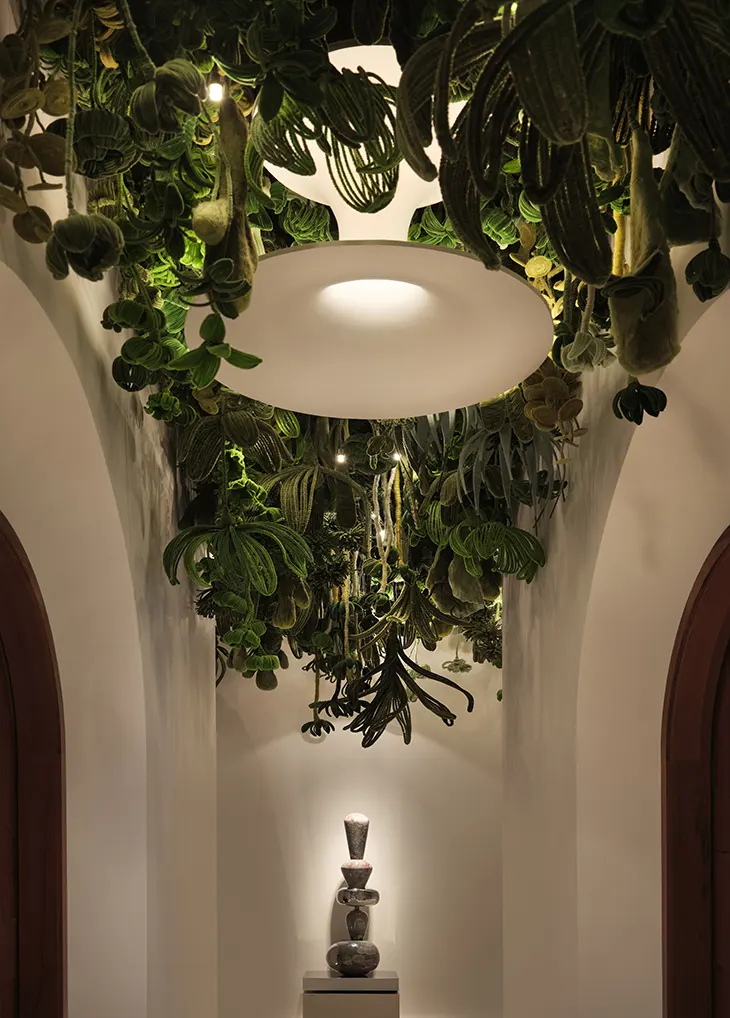
Inside, the project develops through a sequence of spatial scenes shaped by light and material. The entrance foyer introduces the central idea through a sculptural ceiling and suspended planting. Light diffuses across curved surfaces, drawing attention upward and setting a slow spatial rhythm from the moment of arrival.
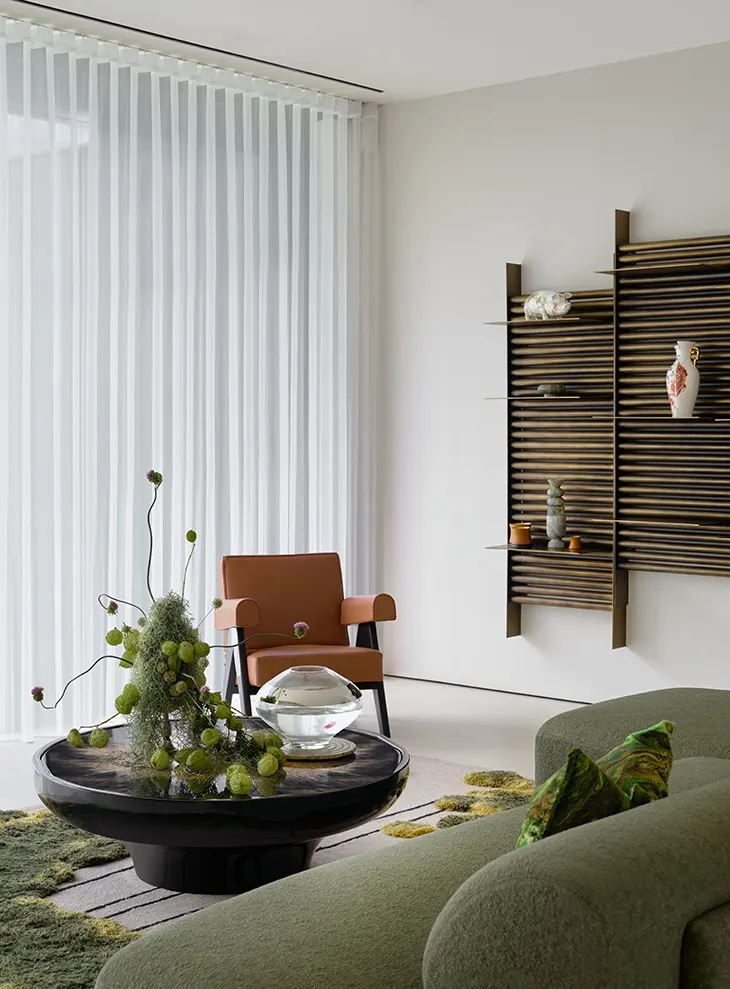
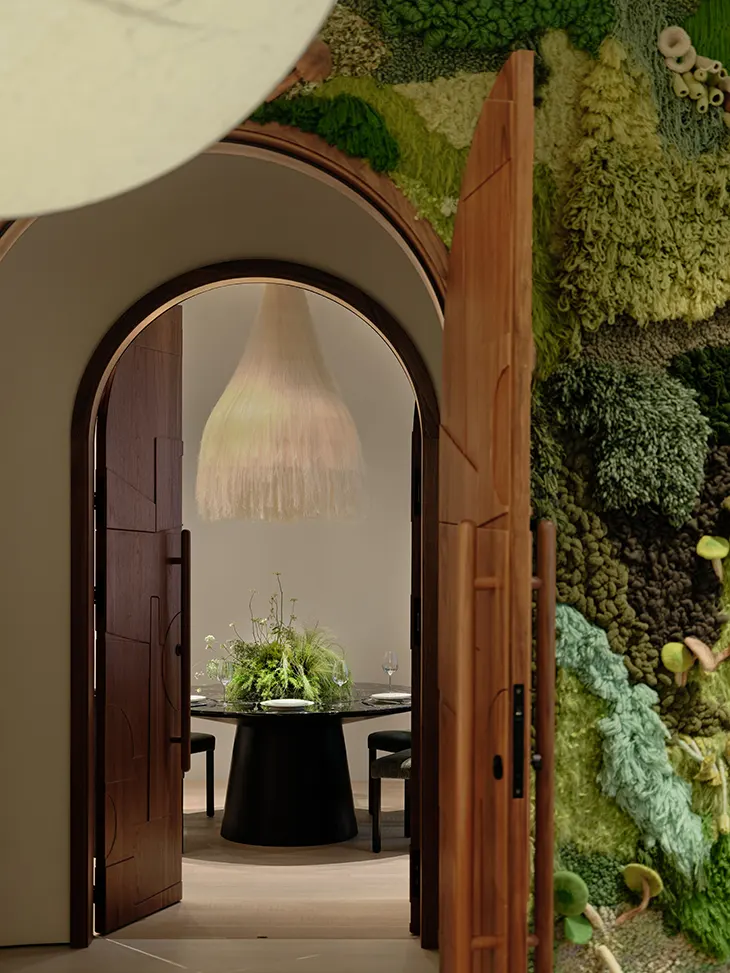
The dining area extends this language through a dense plant wall that integrates sculptural elements. Surfaces carry a tactile quality, with forms that appear to emerge from within the material itself. The space avoids static decoration and instead constructs an environment where art and nature remain in constant relation.
Further along, a feature wall leading to the private room shifts the atmosphere toward an underwater register. Layered textures and biomorphic forms create depth, introducing variation while maintaining continuity with the broader concept. Each zone reads as part of a larger system rather than an isolated interior moment.
A full-height atrium anchors the project, extending from the ground floor to the upper levels. Curved surfaces and suspended sculptural elements define the vertical space, while bridges connect the different floors. Daylight travels through this central void, shaping the interior environment and reinforcing the sense of upward movement.
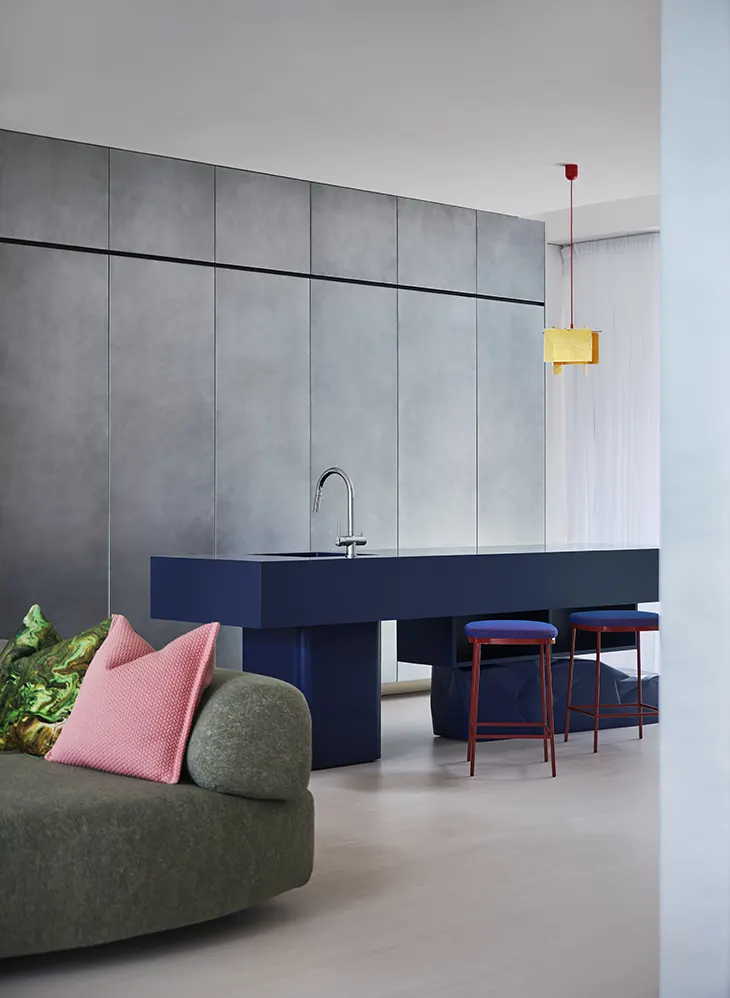
The atrium operates as a structural and atmospheric device. It organizes circulation, distributes light, and establishes visual continuity across levels. This vertical connection supports the project’s central idea, allowing spatial experience to unfold gradually rather than through fixed viewpoints.
The project accommodates a wide range of functions, including dining, lounge areas, tea rooms, fitness spaces, and private rooms. Each program integrates within the overall spatial system without breaking its continuity. Functional elements remain embedded within walls and curved surfaces, keeping the environment visually cohesive.
On the upper levels, the program shifts toward more private and controlled environments. The tea room introduces a quieter atmosphere shaped by curated objects and restrained material choices. The spa and bedroom areas continue this approach, using soft forms and reduced detailing to support rest and retreat.
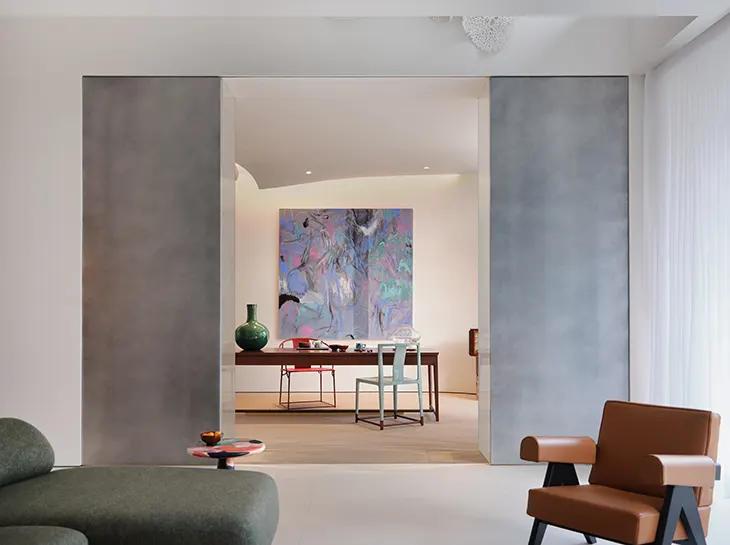
Outdoor space extends the project beyond the interior. The garden introduces natural variation through planting, stone, and color accents. This exterior zone maintains the same spatial language, allowing movement between inside and outside without disruption.
Bay Park Center Private Club avoids fixed visual statements. EK Design builds the project as a system where structure, light, and planting interact continuously. Each element contributes to an environment that shifts through time, use, and perception. The project holds together through consistency in spatial logic, allowing architecture to operate as a framework for ongoing change rather than a finished object.