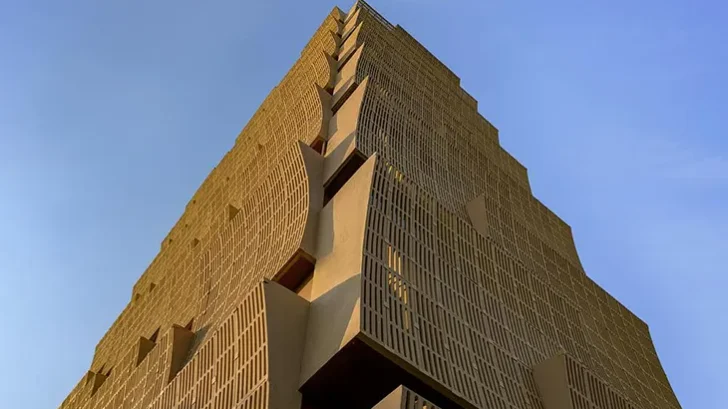

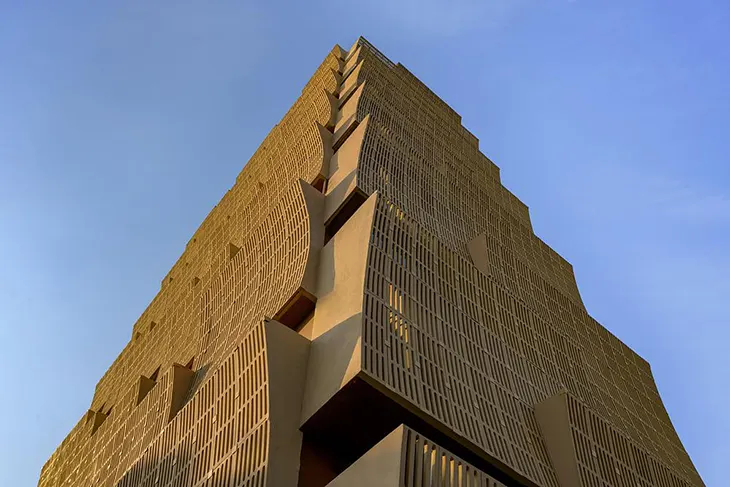
Cielo is a compact residential project in Nagpur, Maharashtra, designed by Sanjay Puri Architects, that turns regulatory constraint and climatic pressure into a clear architectural proposition. Rising twelve storeys on a modest 900-square-metre plot, the building demonstrates how spatial discipline and environmental response can shape a distinctive urban presence without excess.
RESIDENTIAL ARCHITECTURE
Local development rules and mandatory open spaces on all sides reduced the buildable footprint to just 270 square metres per floor. Within these limits, the architects organised a single three-bedroom apartment on each level, creating a vertical stack of private residences rather than a dense multi-unit plan. This decision gives every apartment a sense of autonomy, while allowing the building’s envelope to perform as an active environmental mediator rather than a static façade.
The internal layout prioritises airflow and clarity. Three bedrooms occupy three corners of the plan, with the kitchen anchoring the fourth. This configuration allows cross ventilation in every primary space, a critical consideration in Nagpur’s climate, where summer temperatures exceed 40°C for much of the year. The living and dining areas sit at the centre, forming a shared social core that connects visually and spatially to the surrounding rooms. Circulation remains compact, keeping the focus on usable space rather than corridors.
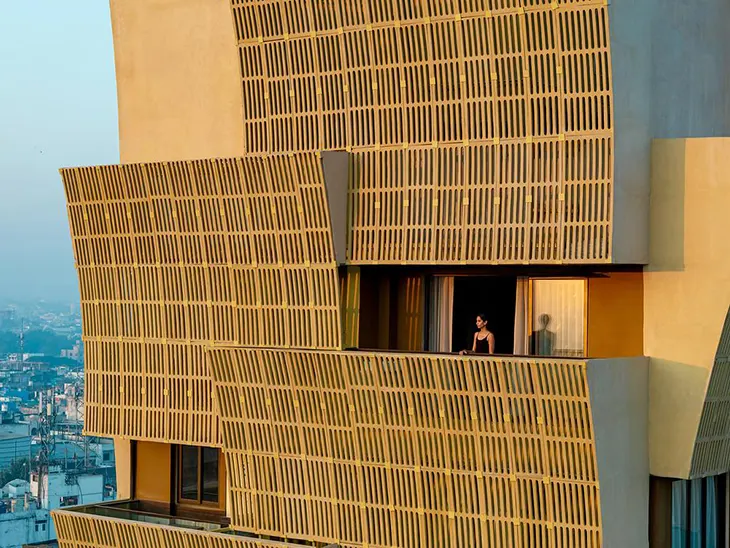
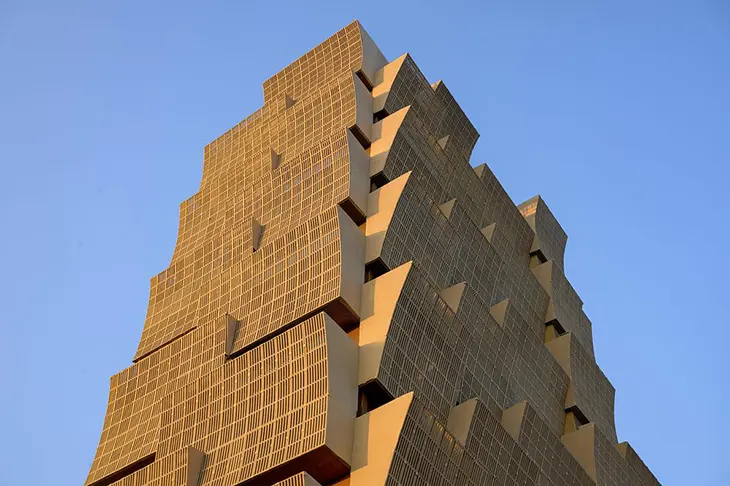
Climate response defines the project’s most recognizable feature: its layered balcony system. Each main room opens onto two outdoor spaces, one fully open and one screened. This pairing moderates heat gain while offering varied degrees of exposure, allowing residents to adapt their use of space throughout the day and across seasons. The screened bays operate as environmental buffers, reducing direct solar impact while maintaining airflow and daylight.
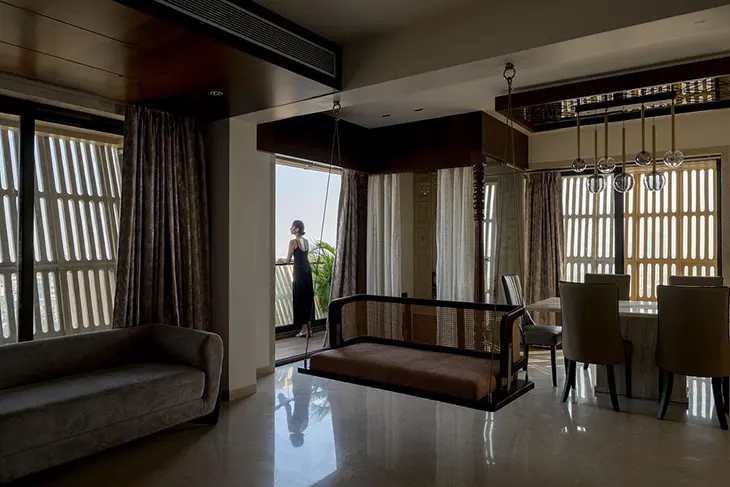
These screens take the form of sectional curves that alternate horizontally and vertically across the façade. At lower levels, they act as protective screens; above, they project outward to become balconies. This shifting geometry gives the building a sculptural quality that changes with viewpoint and light. Beyond aesthetics, the system references the architectural heritage of the region, where perforated screens have been used for centuries to regulate climate and privacy. Here, that lineage is translated into a contemporary language suited to high-rise living.
The façade’s articulation also introduces pockets of greenery at every level, integrating planted spaces into the daily life of each apartment. Rather than treating landscape as an afterthought or a ground-level amenity, Cielo distributes it vertically, reinforcing the relationship between indoor and outdoor environments even within a dense urban condition.
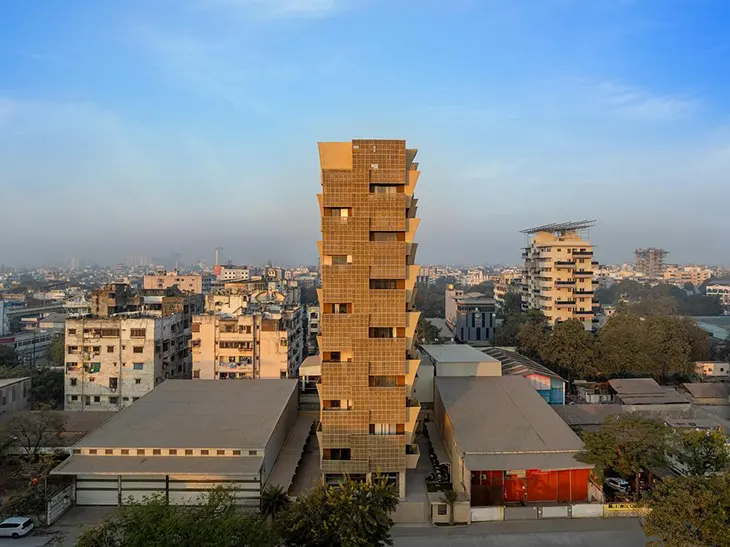
Environmental performance extends beyond passive strategies. The building incorporates a full solar-panel roof, water harvesting, and recycling systems, reducing operational energy demand and long-term resource consumption. Combined with the screened envelope and cross-ventilated layout, these measures significantly lower reliance on mechanical cooling, an important consideration in a city where air-conditioning often dominates residential energy use.
Cielo’s contribution lies in how seamlessly these systems integrate into the architectural expression. Sustainability does not appear as an added layer or technical showcase. Instead, it informs the building’s massing, section, and daily experience. The result is a structure that responds to climate through form, rather than through hidden technologies alone.
Completed in January 2026 for Prestige Builders, the project spans approximately 3,600 square metres and reflects Sanjay Puri Architects’ broader approach to contextual and environmentally responsive design. With work underway across dozens of cities and an extensive record of international recognition, the firm continues to explore how architecture can remain specific to place while addressing universal challenges.