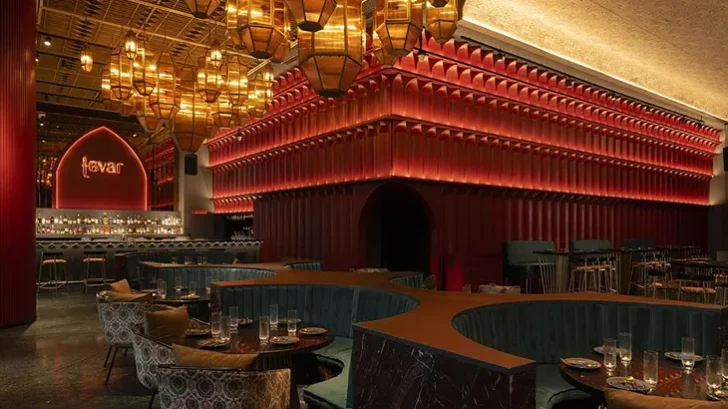

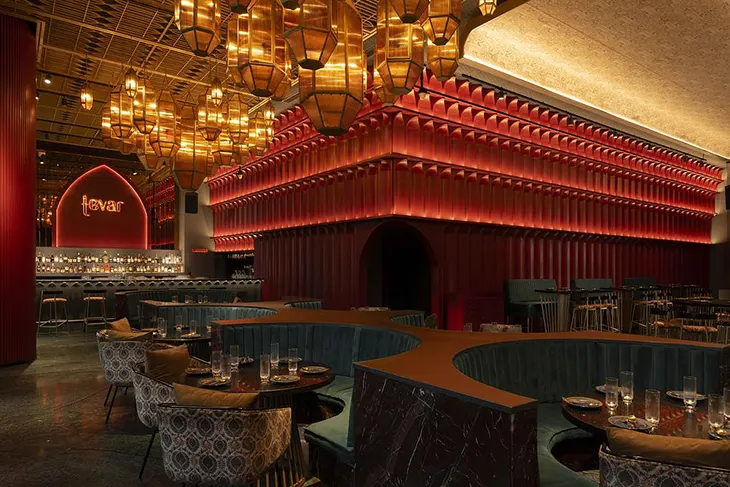
Love of Light approaches Tevar – The Progressive Indian Kitchen & Bar as a project where lighting defines spatial experience rather than supporting it. Working alongside the interior design team, the studio develops a system that responds directly to the restaurant’s formal language, where curved geometries and deep material tones demand careful calibration. The design avoids uniform brightness and instead constructs a hierarchy of illumination that reveals the space gradually, allowing visitors to read texture, depth, and volume over time.
LIGHTING
The interior establishes a strong visual framework through repetition and curvature, which the lighting strategy reinforces through controlled contrast. Ambient light sets a base layer, while focal accents introduce points of intensity that guide attention across the dining areas. This structure creates a rhythm that aligns with the architecture, ensuring that light works in tandem with form. Rather than flattening the environment, the system builds a sequence of visual moments that shift depending on position and movement within the space.
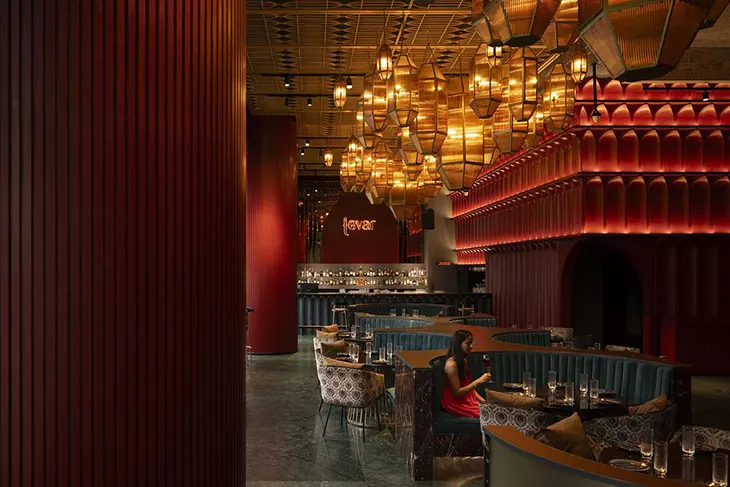
At the center of the project, a large chandelier installation anchors the main dining volume. Composed of eighty-nine lantern-like fixtures, the installation forms a suspended field of warm light that defines the ceiling plane without adding visual weight. Each element results from an extended process of prototyping, reflecting a focus on precision and material performance. The use of recycled aluminium and locally sourced hand-blown glass introduces a material logic tied to the region, while the clustered configuration maintains openness across the volume.
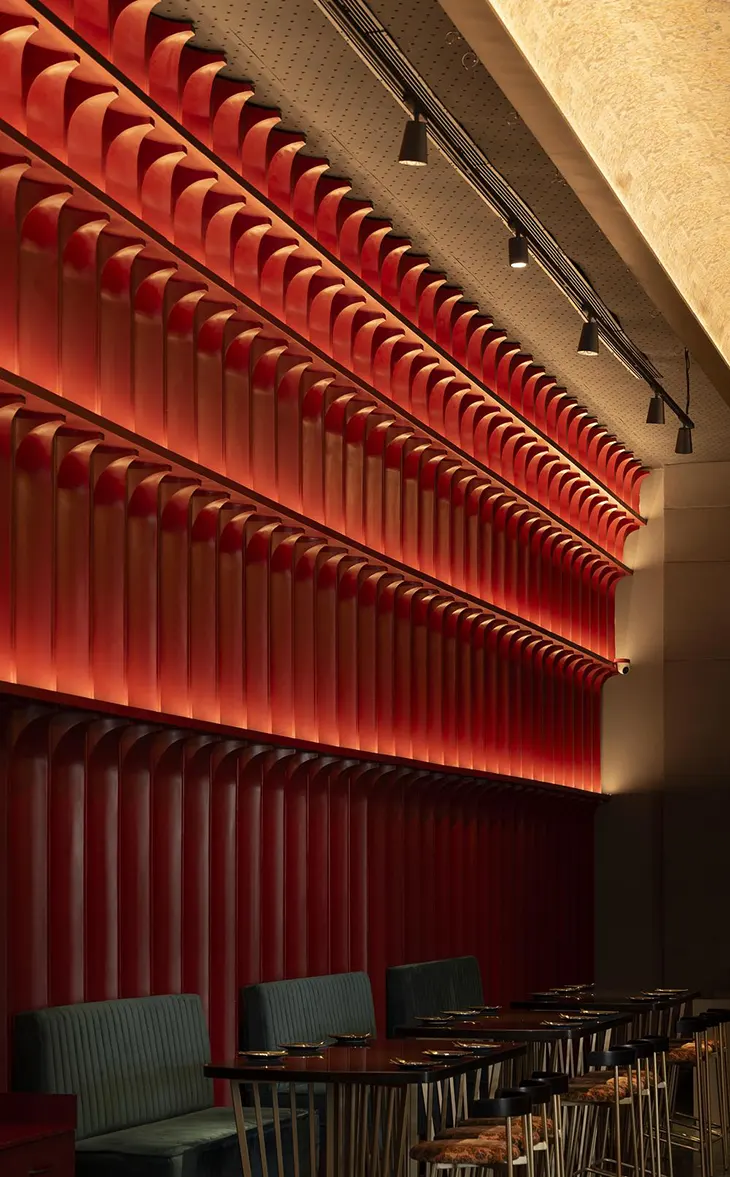
The surrounding walls extend this approach through a series of jharokha-inspired modules that introduce depth and articulation to the perimeter. Integrated linear lighting grazes these surfaces, emphasizing texture while maintaining a controlled luminance level. This technique allows the architecture to remain legible without overpowering the overall atmosphere. Operating at 2700 kelvin with a high color rendering index, the system ensures accurate perception of both materials and food, aligning visual clarity with the functional needs of a dining environment.
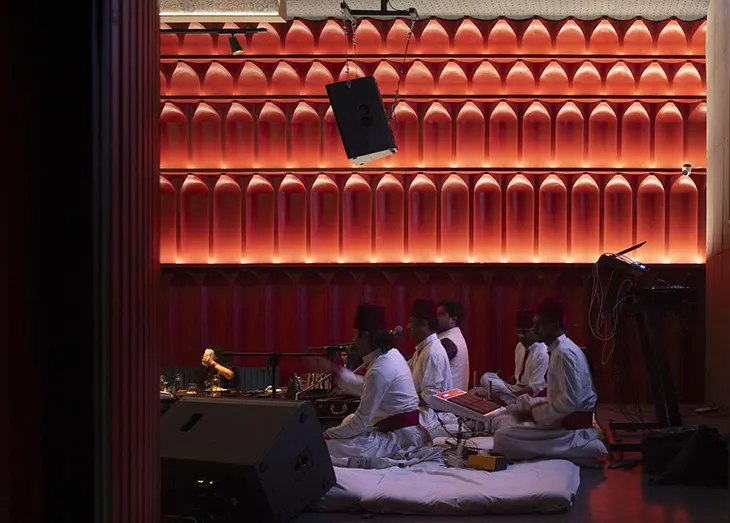
Lighting controls play a central role in maintaining this balance. A fully integrated dimming system adjusts brightness levels throughout the day, responding to shifts in natural light and changes in program. The transitions between lunch service, evening dining, and performance settings occur through gradual modulation rather than abrupt changes. This level of control supports both operational flexibility and energy efficiency, allowing the space to adapt without compromising its visual coherence.
Secondary areas receive a more restrained treatment, where lighting integrates directly into architectural elements. The bar uses backlighting to define materials and highlight bottles, while service counters incorporate soft underlighting to maintain comfort. Performance zones and acoustic ceiling forms receive targeted illumination that emphasizes geometry while avoiding glare. Each intervention follows the same principle of precision, ensuring that no element disrupts the overall balance of the space.
The project extends its logic into technical and environmental considerations through a modular lighting infrastructure. Components such as profiles, drivers, and wiring systems allow for individual replacement and maintenance, reducing long-term material waste. This approach supports adaptability, ensuring the system can evolve alongside the space. Combined with the use of locally sourced materials, the design reflects a measured approach to sustainability grounded in practical decisions rather than formal gestures.
Tevar demonstrates how lighting can define the identity of a hospitality interior through control, material awareness, and spatial clarity. Love of Light constructs an environment where illumination shapes perception at every scale, from the overall volume to the smallest surface detail. The result is a dining space where light directs experience, guiding movement, framing interaction, and reinforcing the architectural language without excess.