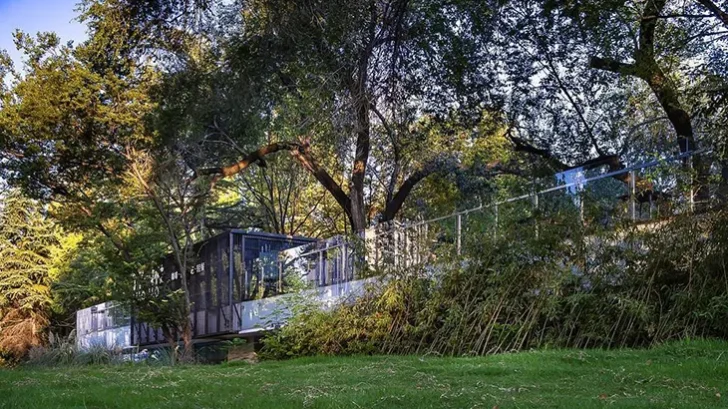

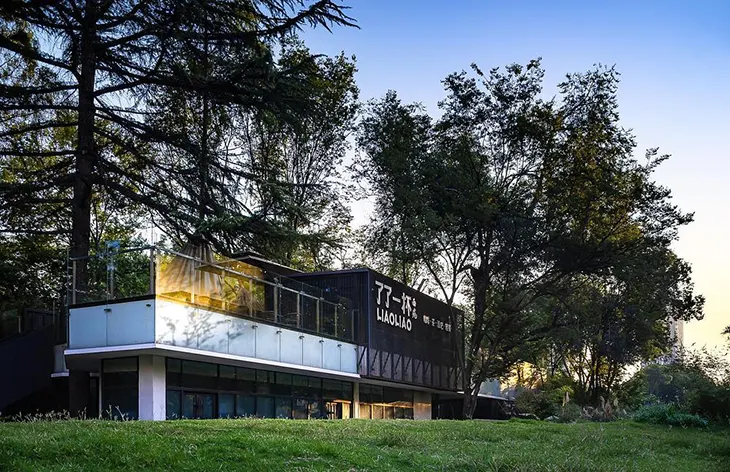
Designers Zhijiang Shan and Fan Li of Rongjie Design & Construction Engineering Co, LTD have completed LIAO LIAO Cafe on the grounds of the Luoyang Museum in Henan Province. The 350-square-meter project transforms a roadside plot into a specialty coffee destination that links the museum’s cultural presence with the rituals of everyday life. The building establishes its identity through form and material, creating a contemporary counterpoint to one of China’s major repositories of Bronze Age and Tang Dynasty artifacts.
CAFE & RESTAURANT
The defining gesture is the continuous wave-form roof. A sweeping steel canopy rises and dips along the length of the structure, referencing the silhouettes of the Qinling and Funiu mountain ranges visible in the region. The undulating profile shapes the interior, generating varied ceiling heights that organize seating, circulation, and the central bar. From across the street, the roof reads as a single fluid line set against the sky, announcing the cafe without competing with the museum’s monumental architecture.
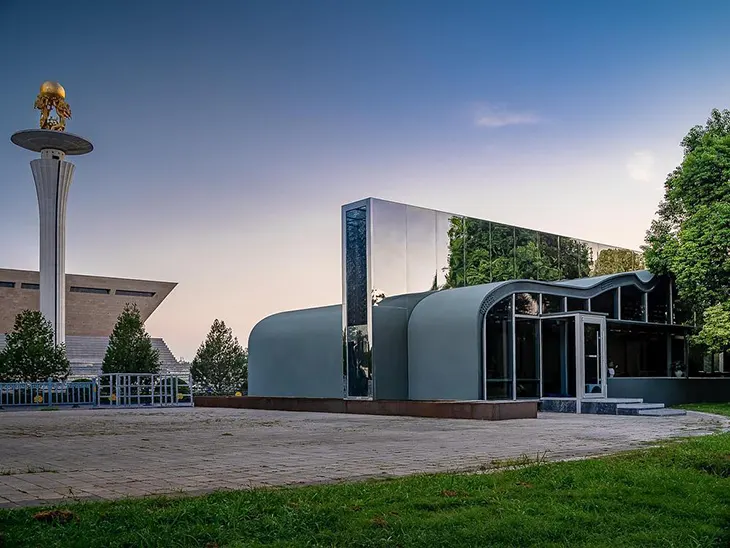
Material contrast strengthens this presence. A mirror-finish stainless steel volume anchors one end of the building, reflecting parkland and sky to soften its edge within the landscape. Along the main body, weathered Corten steel panels and dark-toned metal cladding introduce warmth and a sense of geological time. A perforated concrete-block screen lines the lower facade, filtering light and views between the interior and the covered terrace while establishing a porous boundary.
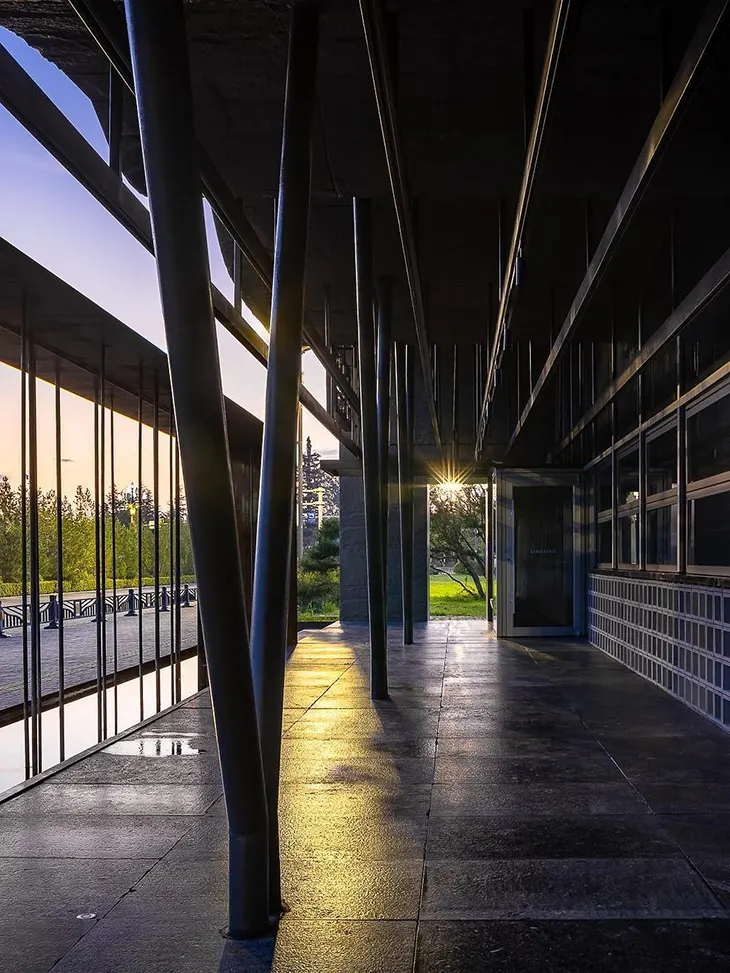
Structure remains visible and expressive. Exposed steel columns branch upward beneath the canopy at varied angles, supporting the roof while echoing the mature trees that populate the museum grounds. The raw concrete soffit stays unfinished, its textured surface interacting with linear track lighting mounted along the steel beams. Inside and out, the structural elements lend the cafe a direct, workshop-like clarity.
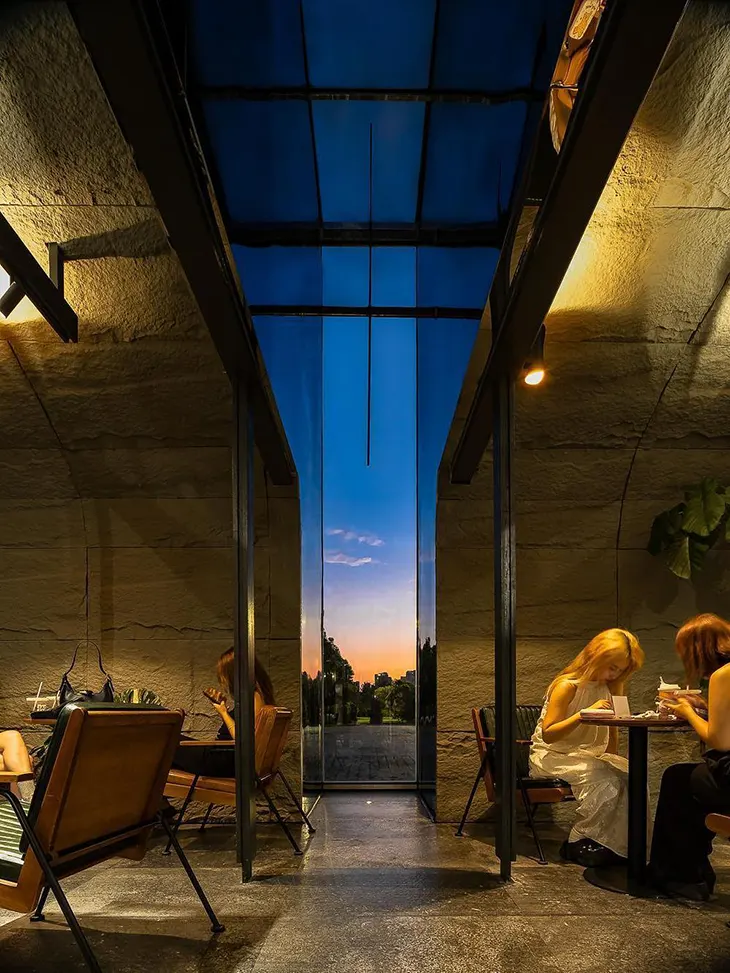
Daylight shapes the interior experience. Floor-to-ceiling glazing wraps the seating areas, dissolving the boundary between cafe and landscape. A continuous skylight slot runs along the roof ridge, allowing light to wash down stone-textured walls and shift in tone throughout the day. At sunset, the narrow glass opening frames the sky in a vertical slice, offering visitors a focused moment of stillness. Dark stone flooring, leather-and-wood lounge chairs in green and caramel hues, and blackened steel fixtures establish a restrained palette that allows natural light to define atmosphere.
The bar occupies the center of the plan as the social core. Its front face uses the same perforated concrete block found on the exterior, creating material continuity across the threshold. The open-kitchen format reveals the preparation process, reinforcing the cafe’s craft-driven identity. Seating arranges itself in intimate clusters instead of rigid rows, encouraging conversation and small-group gathering.
Positioned directly beside the Luoyang Museum, LIAO LIAO Cafe functions as a threshold space where cultural contemplation meets daily routine. The shaded terrace, furnished with wooden deck chairs beneath existing trees, offers a place for pause before or after a museum visit. Through its roofline, structure, and material strategy, the project secures its place within the cultural precinct by responding to terrain, climate, and context with clarity and confidence.