
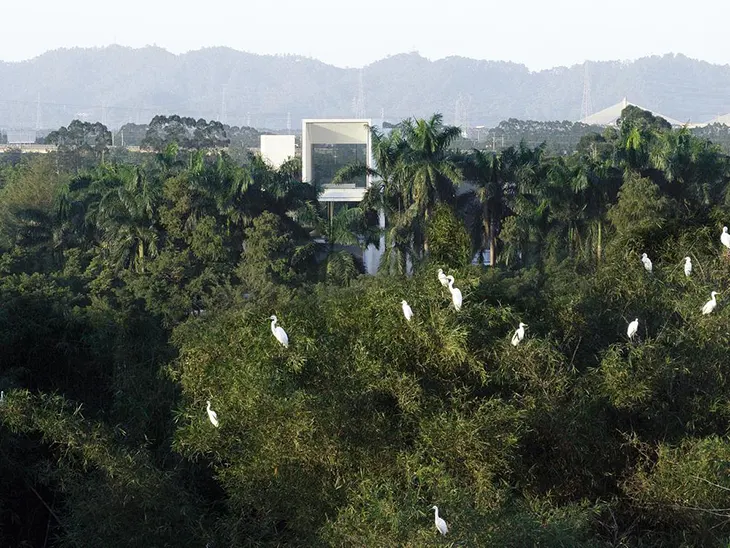
The Shunde Yunlu Wetland Museum is a cultural and ecological project located within Yunlu Wetland Park in Shunde, China, adjacent to an ecological island inhabited by approximately 25,000 egrets. Designed by Studio Link-Arc, the project combines a bird-watching tower and a wetland museum, positioning architecture as a quiet mediator between visitors and a fragile natural environment.
MUSEUMS
The project is rooted in a long-term ecological story. More than two decades ago, local resident Xian Quanhui, known as “Uncle Bird,” planted a bamboo forest that gradually attracted a large population of egrets. His sustained effort transformed the area into an urban refuge for wildlife. Building on this foundation, the Shunde government expanded the protected Egret Paradise area thirteenfold, collaborating with scientists, engineers, and designers to restore water systems, regenerate bamboo forests, and shape the broader Yunlu Wetland Park.
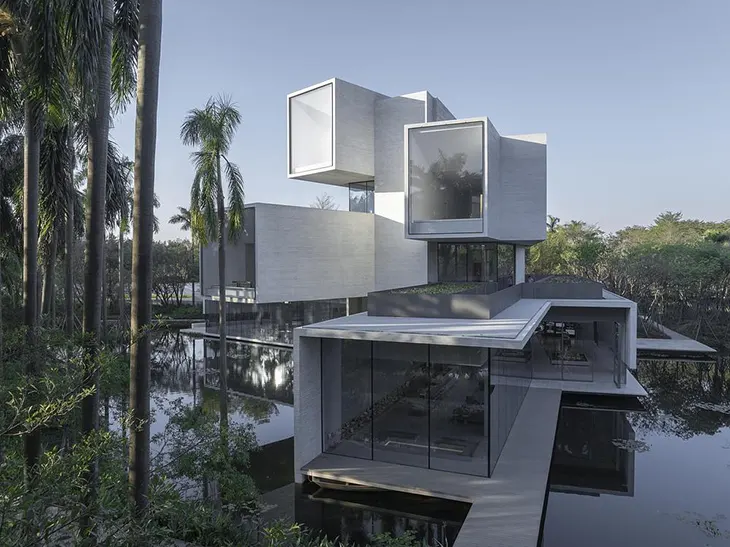
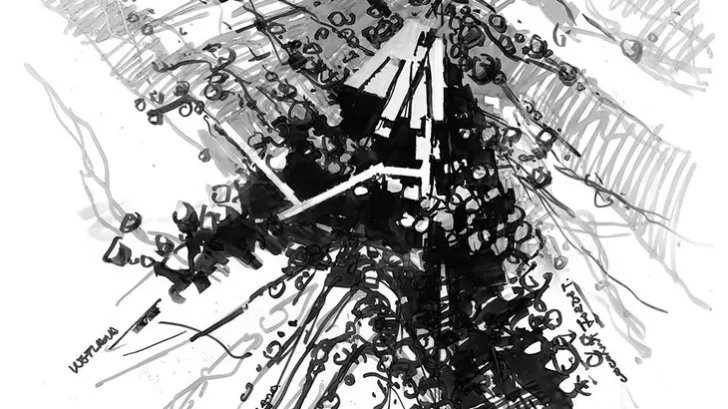
Rather than asserting itself as a landmark object, the museum is deliberately concealed behind an existing cedar forest. Its form is composed of four vertically stacked concrete tubes, each rotated horizontally like a lens directed toward specific views of the surrounding wetland. From the perspective of the nearby Egret Island, the building recedes into the subtropical landscape, minimizing its visual impact and reinforcing a strategy of architectural restraint.
Inside, each tube aligns with a distinct ecological viewpoint. The four levels frame the wetland from root to canopy, allowing visitors to observe tree bases, trunks, crowns, and treetops in sequence. This vertical progression dismantles a conventional human-centered perspective, replacing it with a dispersed, nature-oriented way of seeing that shifts attention toward seasonal change, light, and movement.
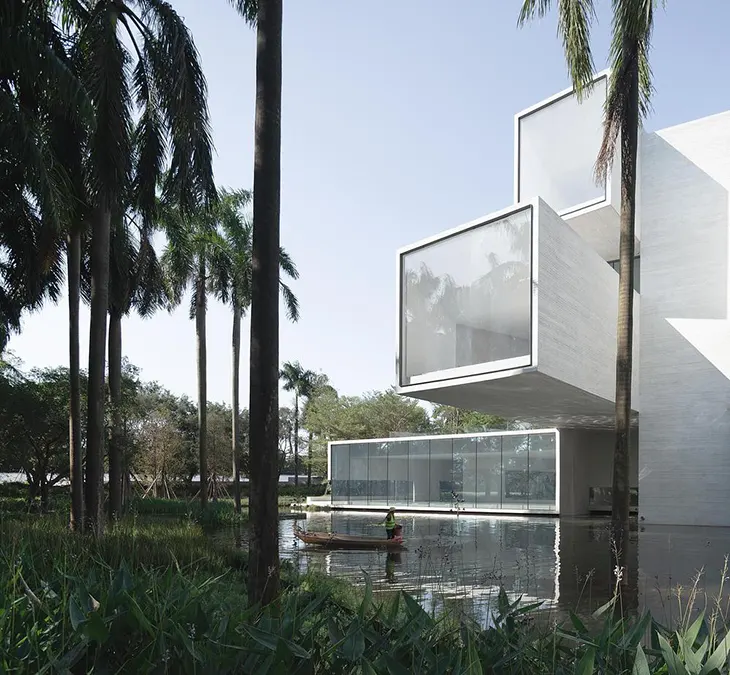
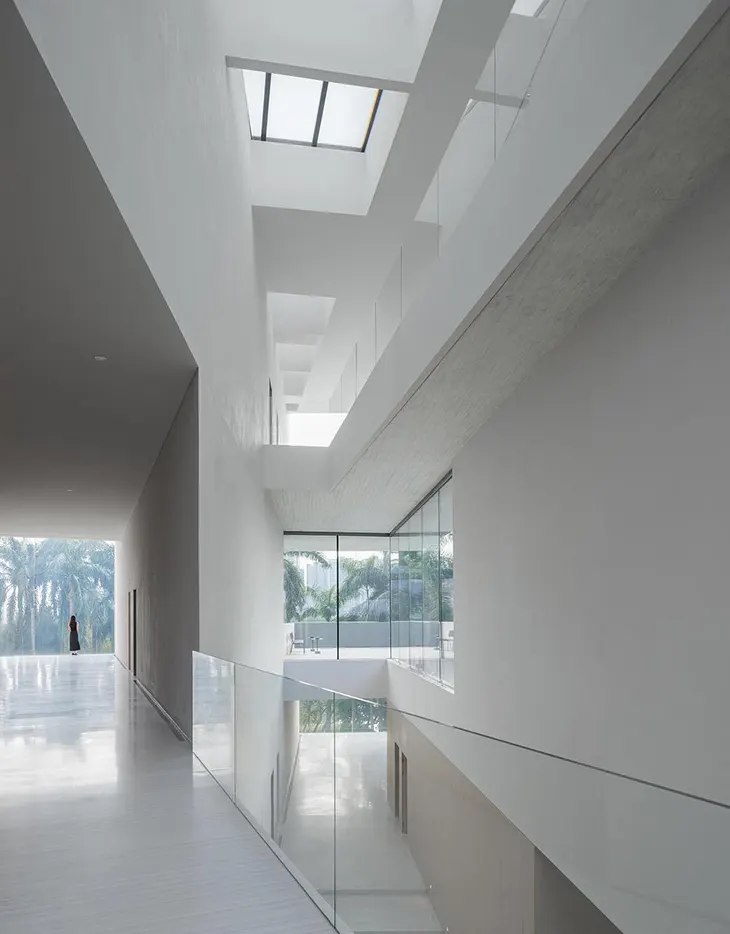
A triangular vertical atrium carved through the stacked volumes connects all four floors, acting as a shared spatial hinge. From this internal void, visitors can simultaneously look out through multiple viewing directions, turning the building into a series of carefully composed frames. The viewfinder-like openings at the ends of each tube present the wetland as a set of living landscapes rather than static exhibits.
The building uses a box-type concrete structural system, with side walls, floor slabs, and roof plates working together to carry loads. Daylight enters through skylights and filters along deep structural beams, producing a slow-changing interior atmosphere that reflects the rhythms of the wetland outside. The experience emphasizes time, weather, and seasonal variation rather than spectacle.
Environmental sensitivity guided the project’s footprint and placement. After surveying 560 existing trees, the architects adjusted the building’s position and rotated each volume to preserve vegetation while securing optimal bird-watching views. The exterior is finished in cast-in-place pine-moulded concrete, whose fine grain echoes the texture of the surrounding forest. On the roof, lotus ponds further soften the building’s presence, reducing its visual impact from above and contributing to local ecological systems.
With a total area of 1,800 square meters, the Shunde Yunlu Wetland Museum demonstrates how cultural architecture can operate quietly within sensitive landscapes. Through concealment, framing, and spatial sequencing, Studio Link-Arc proposes an “invisible museum” that prioritizes coexistence, observation, and ecological awareness over architectural dominance.