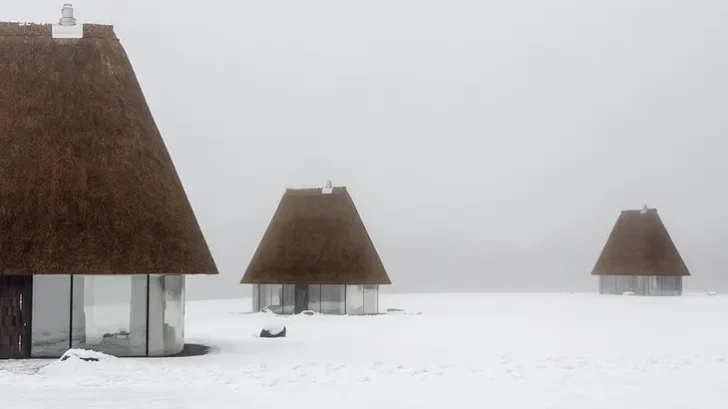

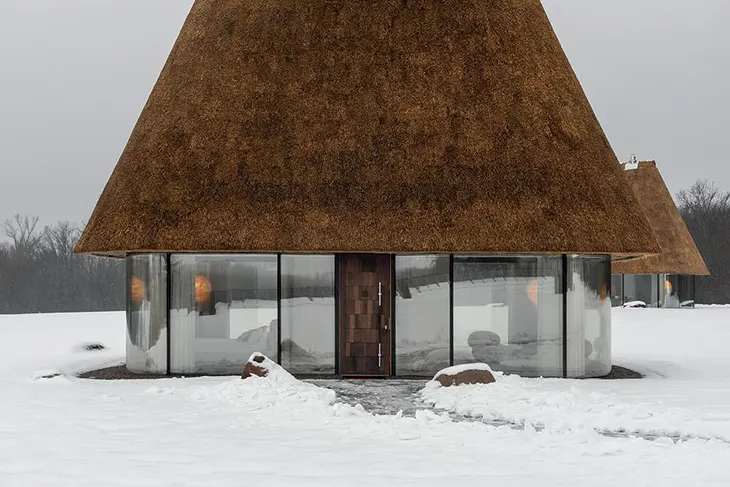
Set on a private estate in central Ukraine, Under the Reed Roof Guesthouses presents a contemporary architectural reading of the Ukrainian hata-mazanka, the archetypal rural dwelling shaped by climate, ritual, and material necessity. Designed by YOD Group, the project reframes vernacular memory through transparency, light, and a roof that assumes both symbolic and spatial dominance.
HOTELS
Traditional Ukrainian domestic architecture relied on direct, expressive means: thick whitewashed walls, tactile plaster surfaces, and protective thatched roofs, regularly renewed as an act of care and order. YOD Group translates these values into a sharply contemporary language. Instead of solid walls, the guesthouses adopt fully glazed façades, allowing light and landscape to replace opacity. In contrast, the roof is deliberately oversized, asserting itself as the project’s defining architectural gesture.
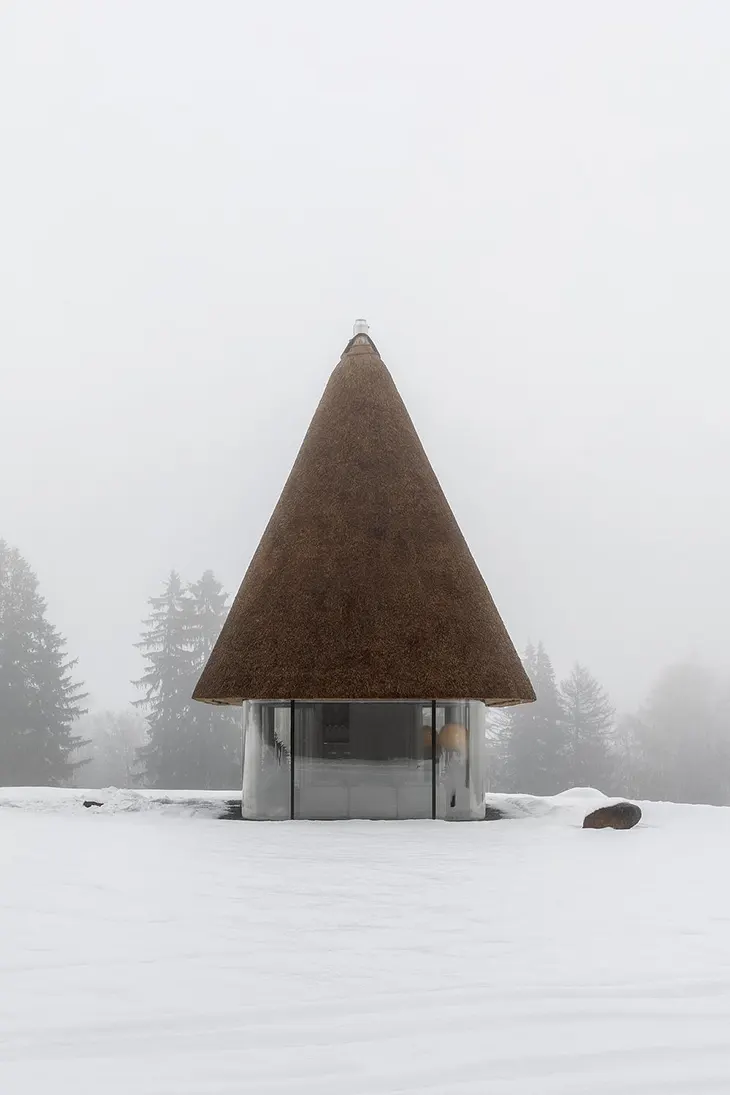
Its sculptural silhouette evokes multiple references at once: the verticality of a traditional tall hat, the organic presence of an oversized mushroom emerging from the ground. This exaggerated form anchors the building visually within the landscape, creating an instantly recognizable profile that bridges folklore and abstraction.
As Volodymyr Nepiyvoda, co-owner and managing partner of YOD Group, explains, the project is grounded in a deeper reading of place. Rather than reproducing familiar forms, the studio sought to decode the cultural meanings embedded within the traditional Ukrainian house and reinterpret them through contemporary architectural logic.
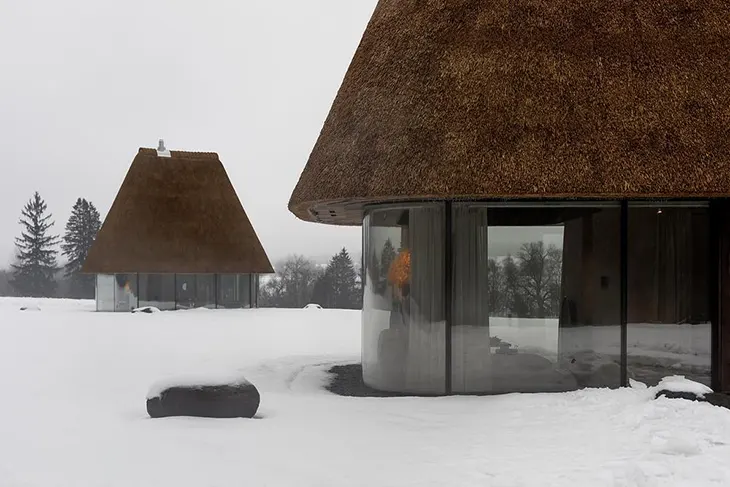
Internally, the spatial organization is precise and restrained. A central concrete core houses the bathroom, forming the functional anchor of the plan. On either side, the bedroom and living area unfold with minimal partitions, reinforcing visual continuity. The living space centers on a minimalist fireplace, a subtle reference to the traditional Ukrainian stove, reframed as a focal element for gathering and contemplation.
The absence of a television is intentional. Instead, guests are encouraged to engage with the live flame visible through the fireplace’s circular opening and maintain uninterrupted visual contact with the surrounding nature. This choice positions the architecture as an instrument for informational detox and emotional recalibration rather than passive consumption.
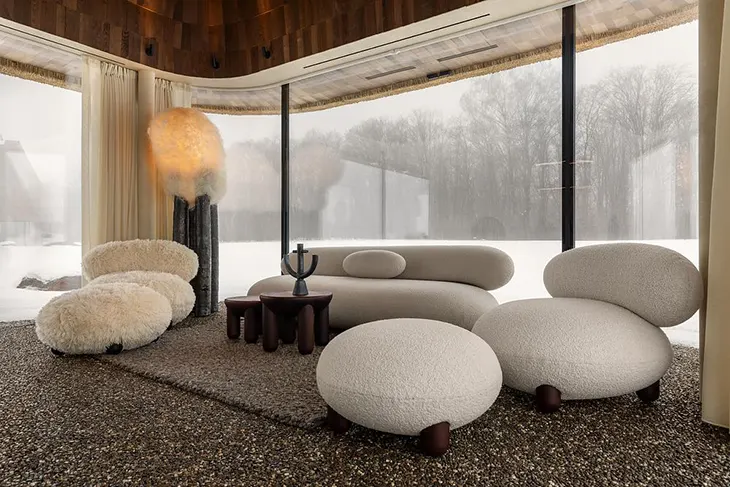
During daylight hours, the glass façades visually dissolve, heightening the sensation that the substantial thatched roof hovers above the terrain. A continuous stone-carpet flooring extends seamlessly from interior to exterior, offering a tactile surface that feels soft underfoot and reinforces the sense of immersion. The boundary between inside and outside becomes perceptual rather than physical.
When privacy is required, dense yet visually light curtains can be deployed through an automated system controlled from the bedside. This flexibility allows the architecture to shift between openness and enclosure without altering its spatial clarity.
The interior design follows principles of eco-minimalism, grounded in a natural palette and tactile richness. Furniture by Noom, black clay decor by Guculiya, and textured wooden elements establish a calm, cohesive environment rooted in local production. A custom floor lamp made from ceramics and natural fibres introduces a sculptural presence within the bedroom, reinforcing the project’s emphasis on material intimacy.
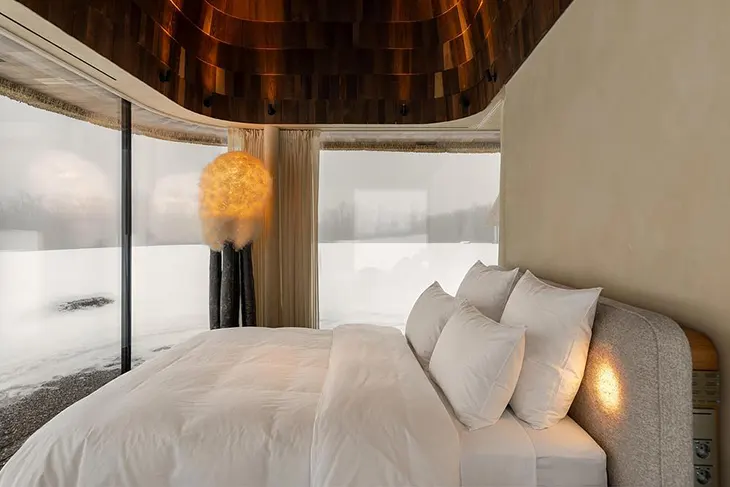
Engineering systems are fully embedded within the architecture. The inner surface of the roof dome is clad in wooden tiles that reference traditional Ukrainian shingles. Rising to ten meters at its apex, the dome amplifies verticality while concealing all technical infrastructure. Climate control is handled through a heat pump system, with ventilation and air-conditioning integrated discreetly via linear slots and concealed outlets within the dome and central core.
Under the Reed Roof Guesthouses demonstrates how vernacular architecture can be reinterpreted without nostalgia. Through abstraction, material restraint, and spatial clarity, YOD Group creates a contemporary retreat that remains deeply connected to Ukrainian cultural memory while addressing present-day ideas of comfort, sustainability, and emotional well-being.