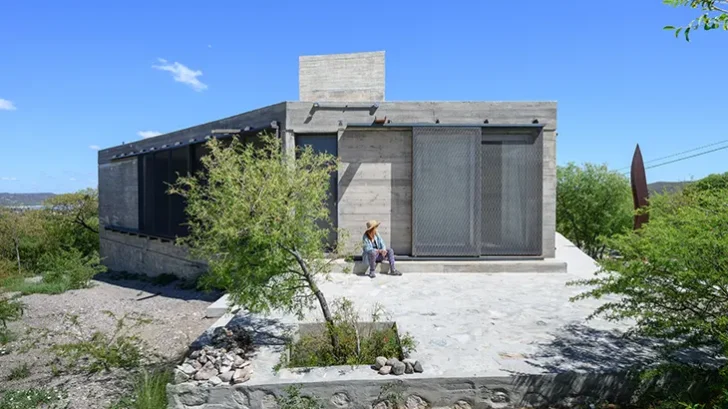

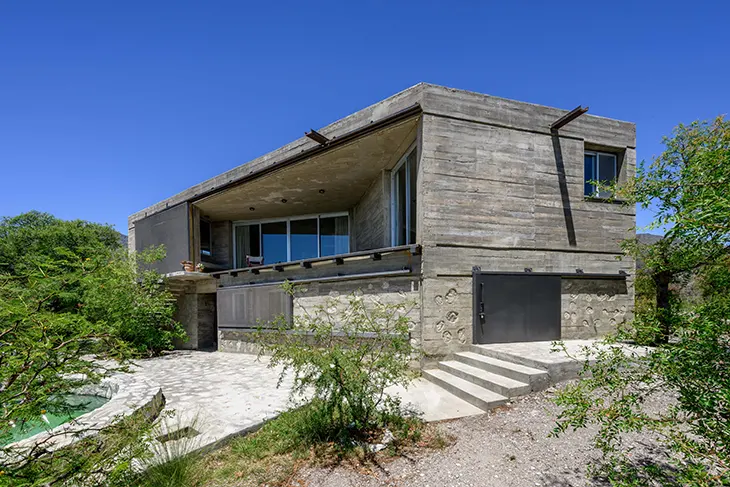
Casa Cosmos stands in the foothills of the Punilla Valley in Capilla del Monte, in Argentina’s Province of Córdoba. Architect Cristián Nanzer placed the house on a steep site bordering a protected natural reserve where dense woodland of red quebrachos, black algarrobos, chañares, and aromitos grows across the semi-arid terrain. The plot slopes strongly from east to west and descends sharply toward the reserve on its southern edge. From this setting, the architecture emerges as a deliberate response to both geography and horizon.
HOUSING
The design begins with a geometric decision. Nanzer conceived the house as a panoptic device that orients itself toward three specific landscape views. The southern axis looks toward the natural reserve with the Las Gemelas hills rising behind it. The northeast direction frames Mount Uritorco, while the western opening captures the distant surface of El Cajón Dam. These visual anchors generate a triangular matrix that shapes the entire plan of the house.
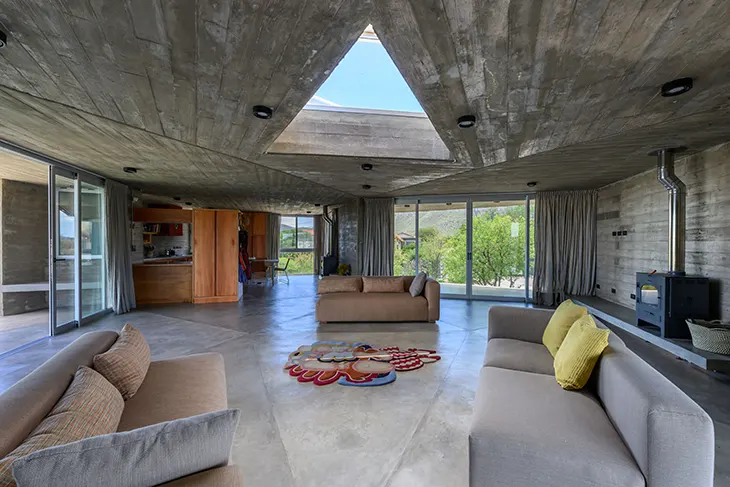
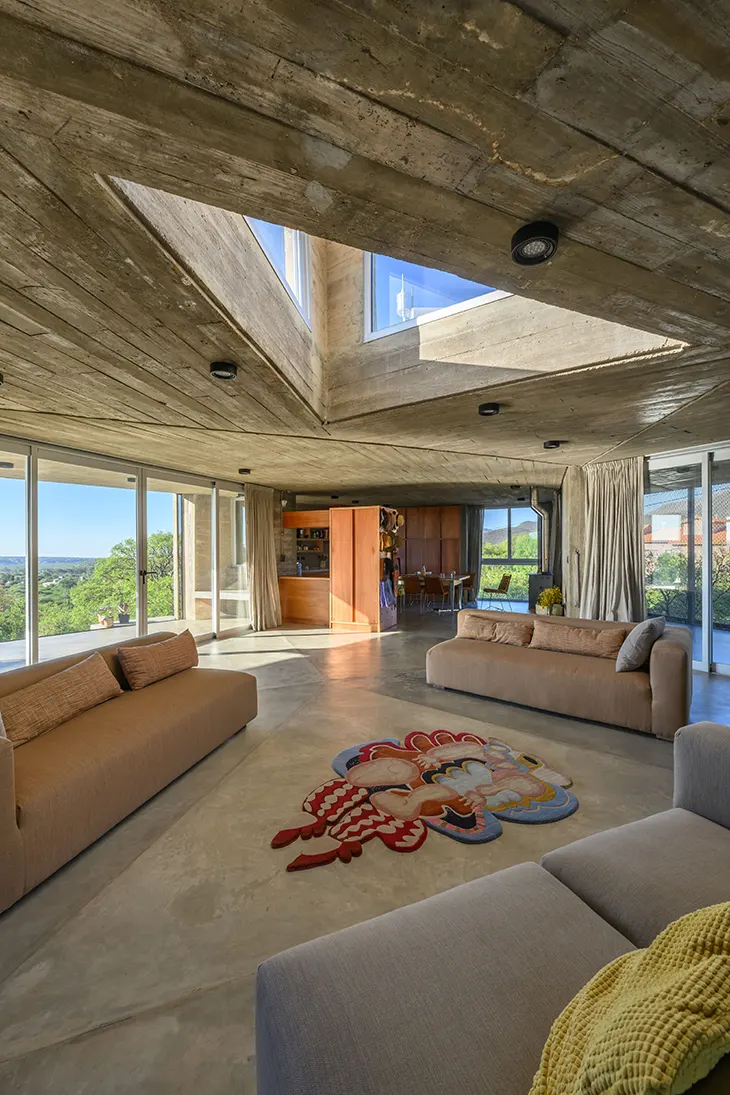
At the center of this triangular structure sits the main social space. The kitchen and dining area connect directly with this central zone, forming the core of daily life within the dwelling. Around this nucleus, the plan distributes a bedroom suite and a studio. Thick structural walls separate these private areas from the communal center while providing environmental stability through their thermal mass.
Light plays a crucial architectural role within this composition. A triangular skylight above the central space introduces diffused daylight that changes throughout the day. As the sun shifts across the sky, the light inside the house gradually transforms. The movement of brightness functions almost as a clock, allowing inhabitants to perceive time through subtle variations of illumination.
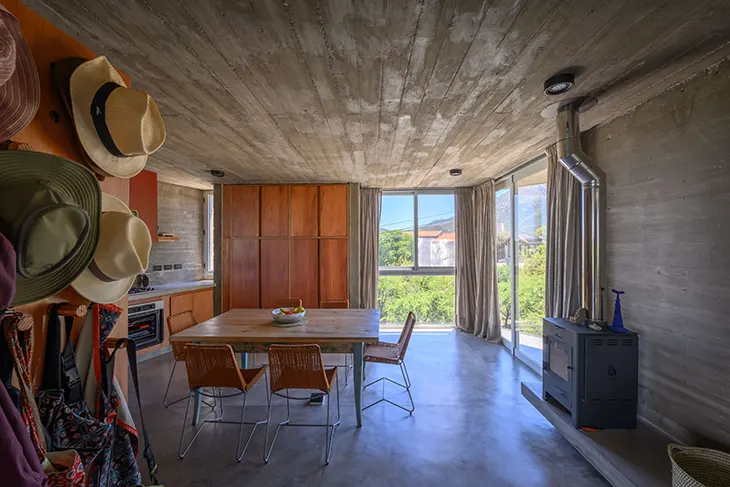
Nanzer describes the spatial atmosphere as a “diaphanous cave.” The house takes the form of a heavy polyhedral mass carved at three precise points. These openings appear as deep galleries that extend outward from the main volume. Their thickness creates shaded transitional spaces that mediate between interior rooms and the surrounding landscape. Each gallery provides protection from strong sunlight while framing distant views.
Expanded metal sliding shutters complete this system of environmental control. Positioned across the openings, the shutters regulate the amount of light entering the house while also influencing air movement. They offer additional protection and privacy while maintaining a visual connection to the terrain beyond the walls.
The steep topography of the site shaped the vertical organization of the building. Nanzer introduced a plinth that absorbs the natural slope and establishes a level platform for the main living floor. Within this base level sit an independent residential unit along with technical spaces and storage rooms. The strategy allows the principal living spaces to rise slightly above the terrain, strengthening the relationship between the house and the wider landscape.
Material choices reinforce this connection to place. The plinth consists of 40-centimeter-thick rammed stone walls that retain the surrounding earth and stabilize the new ground plane. Above it, the upper level uses board-formed exposed concrete for the structural walls. Integrated insulation within the exterior wall assembly improves the hygrothermal performance of the building while preserving the clarity of the construction system.
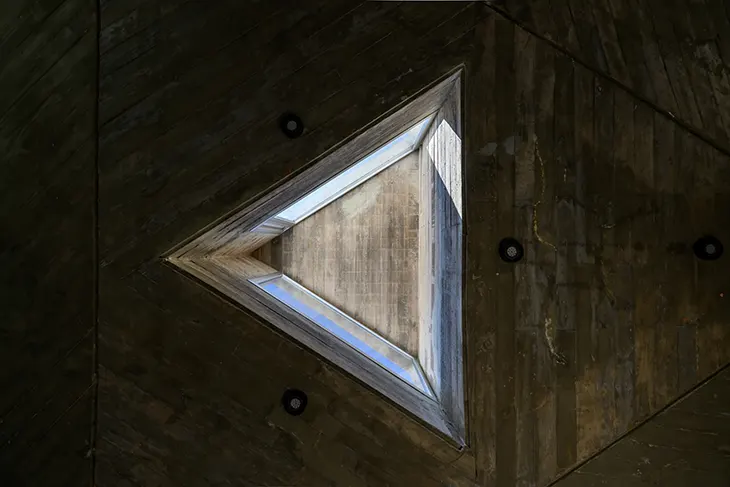
Nanzer allows the materials to remain fully visible. The textures of rammed stone and concrete reveal the construction process and reference local building traditions. Their muted tones also reflect the arid landscape of the Punilla Valley, allowing the architecture to maintain visual continuity with its environment. Inside, the restrained material palette creates spaces defined by shadow, light, and proportion.
Casa Cosmos ultimately functions as an instrument for observing its surroundings. The house captures the movement of daylight, the changing atmosphere of the valley, and the shifting colors of the sky throughout the year. Through its geometry, mass, and carefully framed openings, the building offers a direct encounter with landscape and time, allowing its inhabitants to experience the rhythms of place from within a carefully constructed architectural shelter.