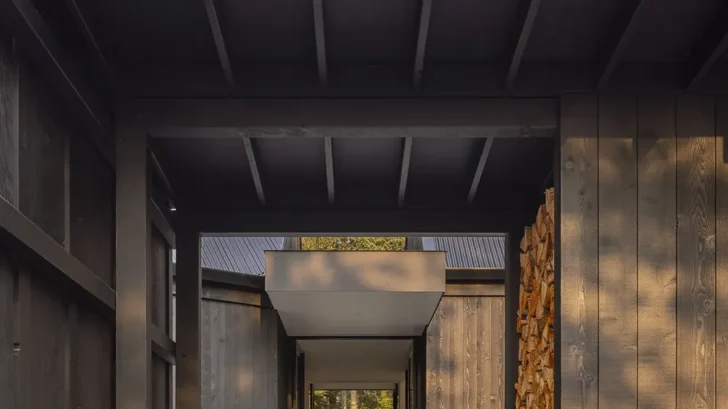

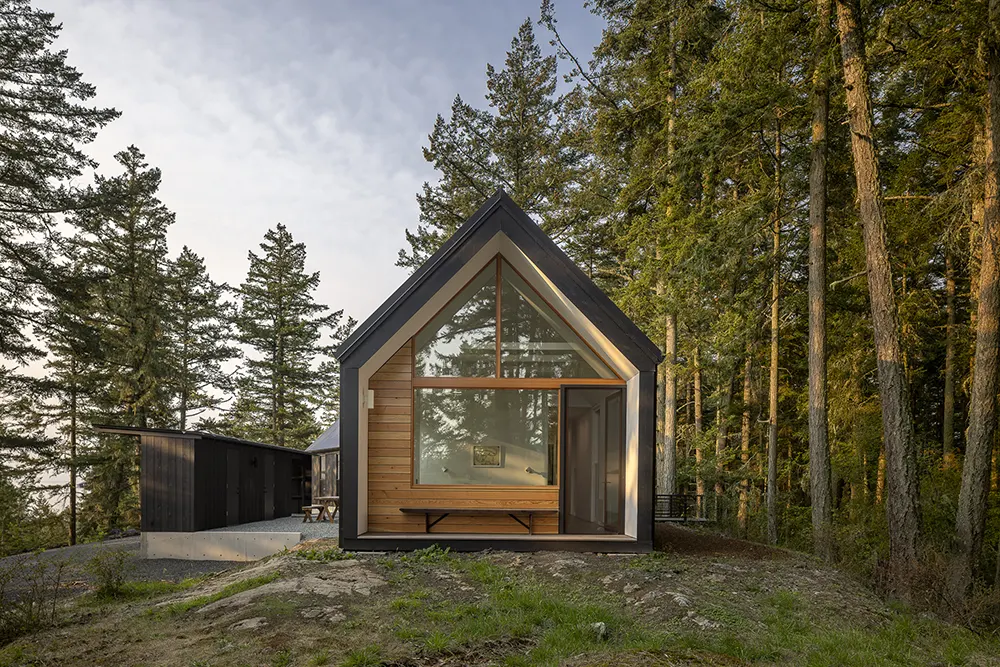
Doe Bay Retreat sits on a narrow rocky knoll above the coastline of Orcas Island, positioned within a dense grove of old-growth trees. Heliotrope Architects shapes the project with a clear focus on restraint, cost awareness, and spatial clarity. Designed for a retired couple, the house works as a part-time residence that requires minimal upkeep while maintaining a strong connection to its surroundings.
RESIDENTIAL
The structure adopts a direct gabled form built with prefabricated trusses. This decision establishes both an economic framework and a spatial one. The interior gains height and volume without introducing complexity, and the exterior maintains a familiar outline that sits comfortably within the wooded site. At 1,450 square feet, the house remains compact, yet it avoids compression through proportion and sectional height.
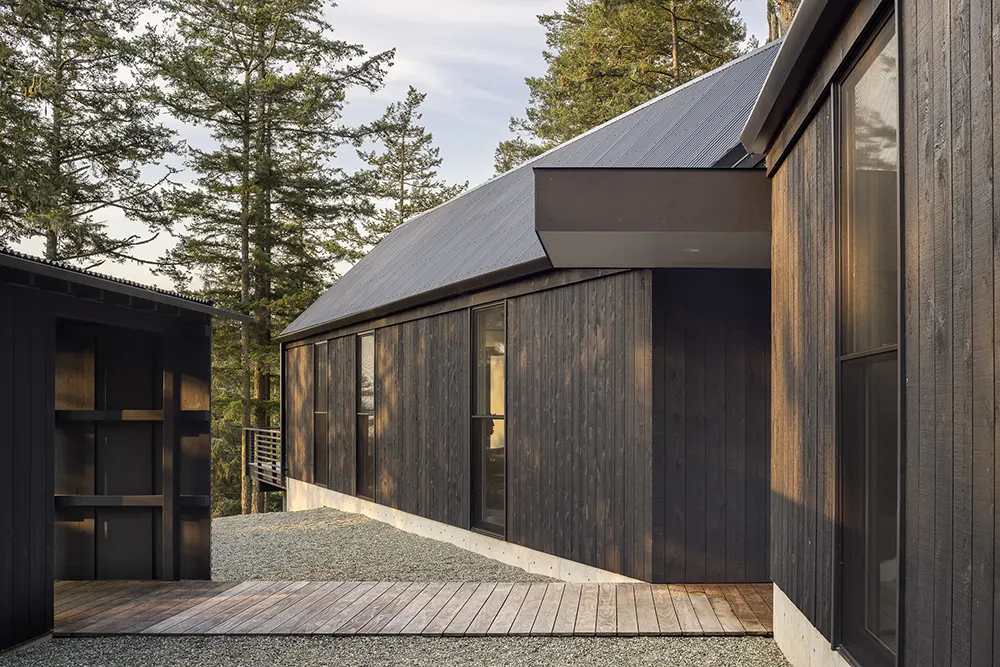
The architects split the gable into two volumes, aligning each toward distant views to the north and south. This move organizes the building around a central entry, where the two forms meet. The geometry of the site supports this arrangement, allowing the creation of a controlled arrival sequence. A linear storage structure screens vehicles and separates them from the living areas, while a small courtyard and turning area establish a measured transition from access road to interior space.
Inside, the plan follows a straightforward division. Public functions occupy the southern portion of the house, where living, dining, and kitchen spaces open directly onto a cantilevered deck. The deck extends into the tree canopy and frames views toward the water, creating a continuous relationship between interior and landscape. Private spaces sit to the north, including the primary suite, which connects directly to the rocky ground and the quieter edge of the site.
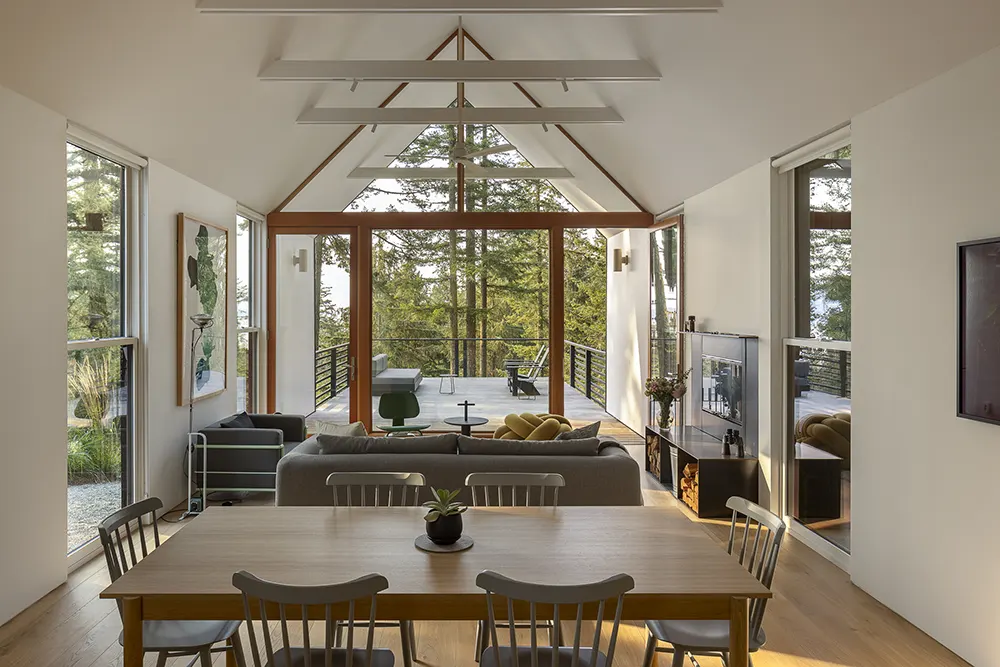
Material decisions remain controlled and deliberate. A limited palette of black, white, and weathered wood defines both the exterior and interior. This approach reduces visual noise and allows the owners’ art collection to define the atmosphere of the rooms. The architecture recedes, creating a setting that supports rather than competes with the objects placed within it.
Light plays a central role in shaping the interior. Full-height glazing at the gable ends draws in long views and increases the sense of depth within the compact footprint. Along the east and west elevations, a sequence of double-hung windows introduces a steady rhythm that breaks the linearity of the plan and carries daylight into the center of the house. These openings also reinforce the relationship between the building and the surrounding forest, keeping the landscape present at all times.
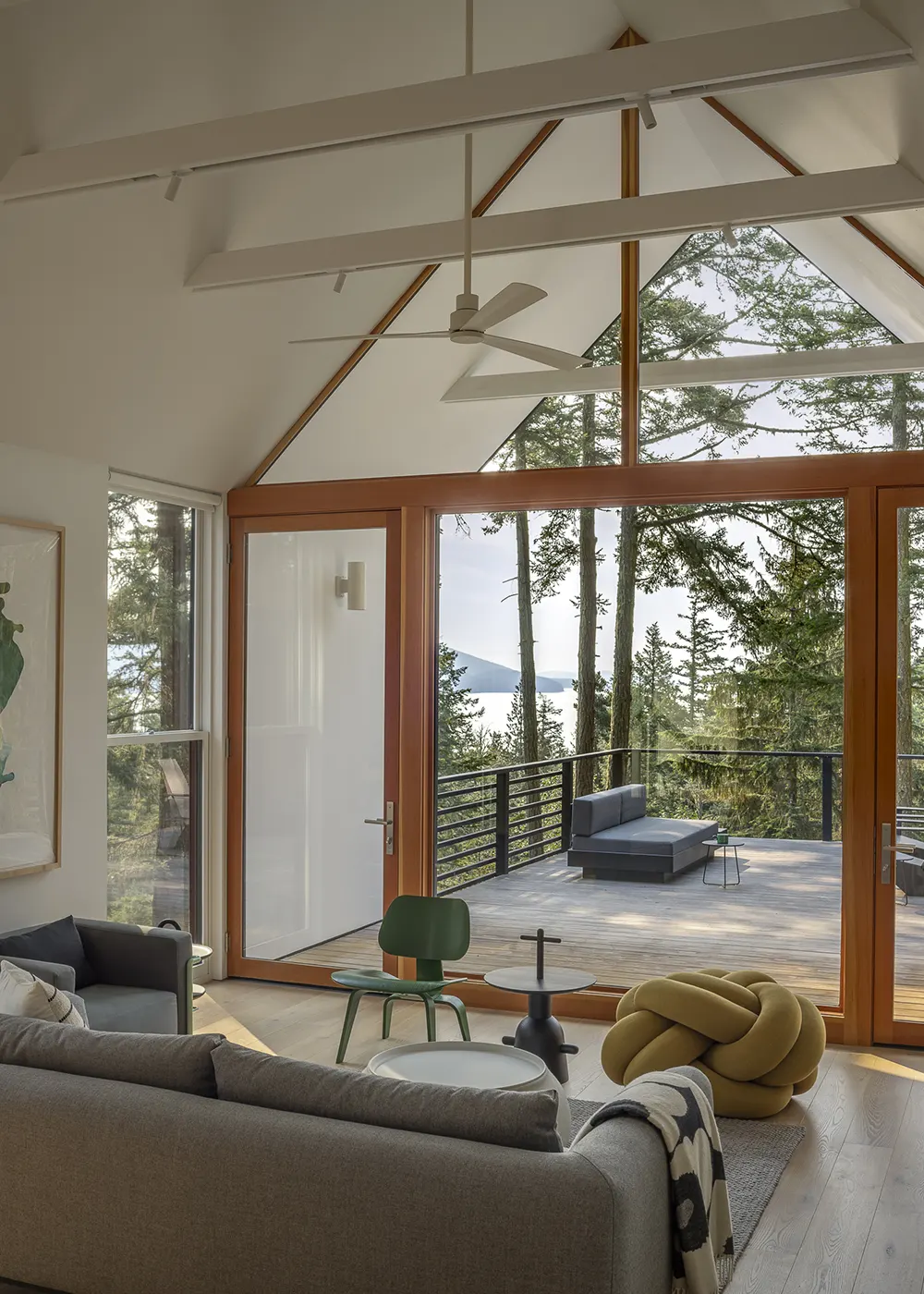
Despite its modest size, the house achieves a sense of expansion through height, light, and carefully framed views. Every decision supports a clear objective: to create a calm, efficient retreat that aligns with the routines of its owners. Doe Bay Retreat presents a precise response to site, budget, and program, showing how a restrained architectural approach can produce a focused and lasting result.