
Japanese Semi is a residential renovation by Picnic Design located in downtown Toronto. The project transforms a semi-detached house built in 1910 into a home tailored for a mixed-race family who had lived there for more than a decade without major updates. The renovation focused on reorganizing previously fragmented interiors while introducing spatial concepts influenced by Japanese domestic rituals. Through this process, the design team created a house where cultural references, daily routines, and contemporary living intersect.
HOUSING
The project addresses a total area of 166 square meters, with 111 square meters undergoing renovation. Prior to the intervention, the interior contained a sequence of compartmentalized rooms and uneven floor levels created by successive renovations over many years. Picnic Design approached the house as an opportunity to restore spatial continuity while shaping the interiors around the family’s habits and preferences.
The design concept began with the bathroom. Drawing inspiration from traditional Japanese bathing practices, the original three-piece washroom was divided into two distinct functions. One room contains the sink and toilet, while a separate space is dedicated entirely to bathing. This arrangement allows washing to occur before entering the tub, reflecting the sequence used in Japanese bathing culture.
At the center of the bathing space sits a custom hinoki wood ofuro soaking tub produced by Bartok Design. The tub differs from a conventional bathtub through its proportions. It is shorter and deeper, designed for soaking in a seated position after showering. Unlike fixed bathtubs, the ofuro can be moved if necessary, adding flexibility to the room. The shower area also accommodates seated bathing, supported by a small wooden stool. Faucet controls are positioned lower than usual to ensure comfortable access from a seated position. A central linear drain collects water from both the shower and the tub, simplifying the spatial layout of the room.
Adjacent to the bathing area sits the washroom, where pink geometric porcelain tiles by Ciot create a vibrant contrast with a white Corian countertop and a white oak veneer vanity cabinet. Together, these spaces form part of a larger Japanese-inspired zone located at the rear of the second floor.
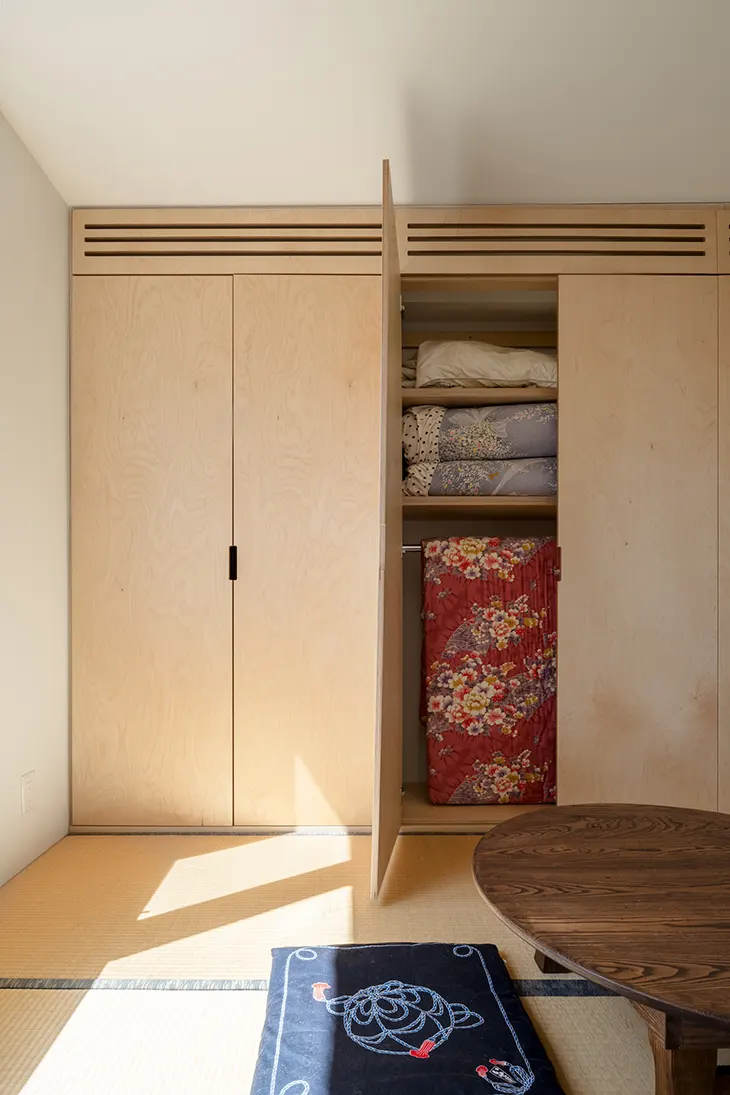
Next to the bathroom lies the tatami room, whose proportions follow the exact dimensions of six traditional tatami mats. The room functions as a flexible sleeping area where futons can be rolled out at night. During the day, the futons are stored in a ventilated closet designed specifically for this purpose. This arrangement introduces an adaptable living space within the limited footprint of a semi-detached house.
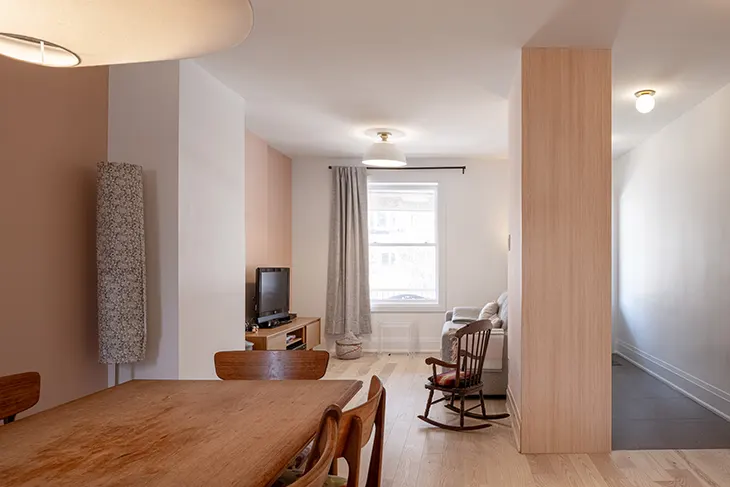
Japanese spatial principles continue on the ground floor. Over time, layers of tile from previous renovations had created uneven steps throughout the house. Removing these layers allowed the design team to establish a continuous floor plane extending from the front entrance to the back patio. Porcelain tiles define entry zones at both ends of the house, while white ash floorboards connect the interior living areas between them.
The tiled sections function as genkan-style entry points, where residents remove shoes before stepping onto the wooden floor. This subtle transition marks the boundary between exterior and interior space while supporting everyday routines.
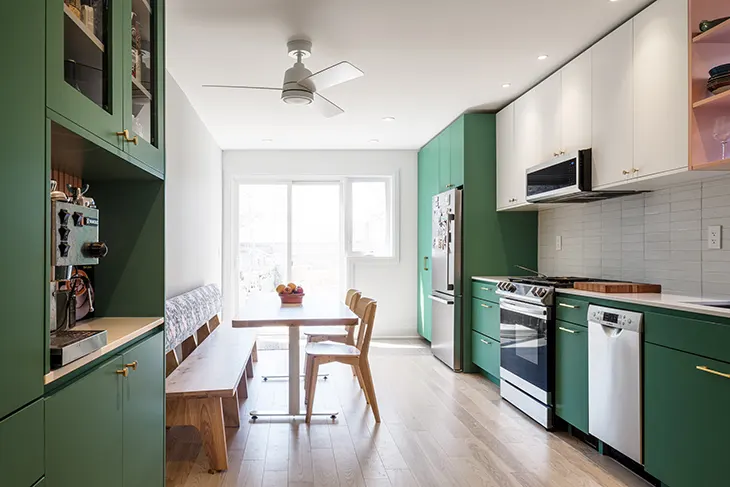
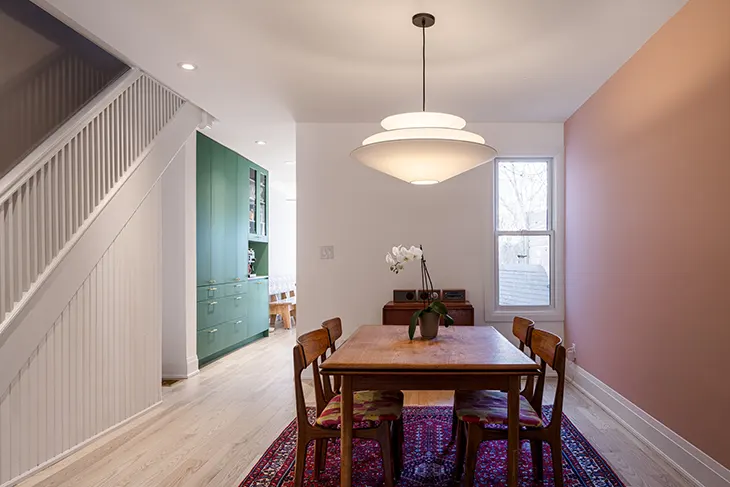
The ground floor layout was also reconfigured to increase openness. A dividing wall between the hallway and dining area was removed, allowing the dining space to expand visually. At the back of the house, the kitchen was combined with a breakfast area to form a large communal space. A tall pantry integrates seamlessly with the rear entry closet, providing ample storage without disrupting the spatial composition.
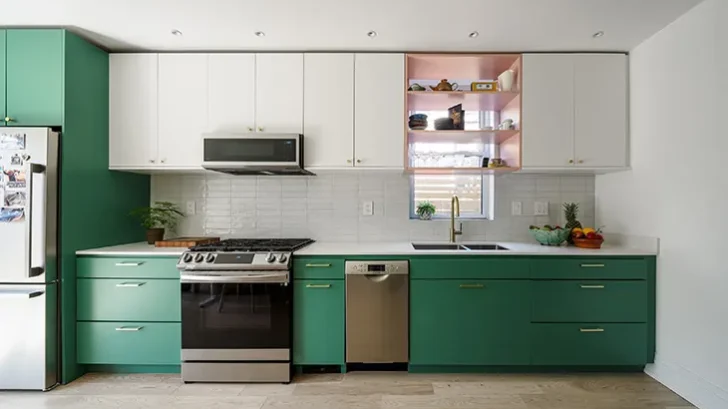
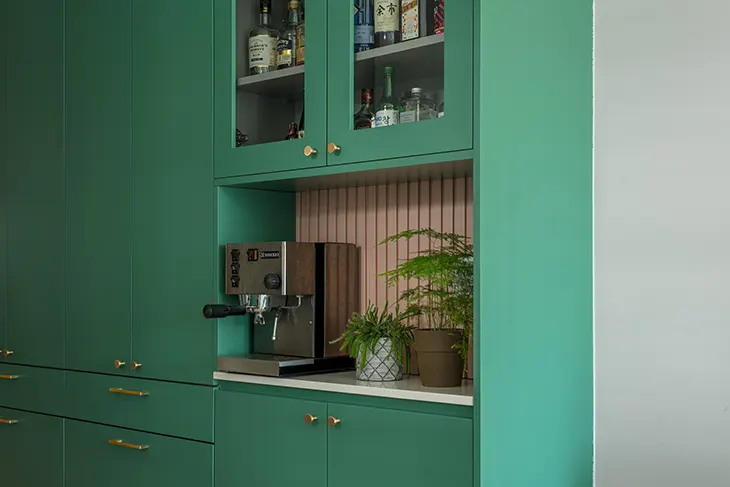
While the project borrows elements from Japanese domestic culture, the interior palette reflects the clients’ desire for strong color. Bold tones and patterns appear throughout the house, creating contrast with the calm presence of wood surfaces. Teal green kitchen millwork, painted in Treetop by Para Paints, anchors the rear of the ground floor. Muted pink tones extend through the dining and living areas, creating visual continuity with the porcelain tile in the washroom.
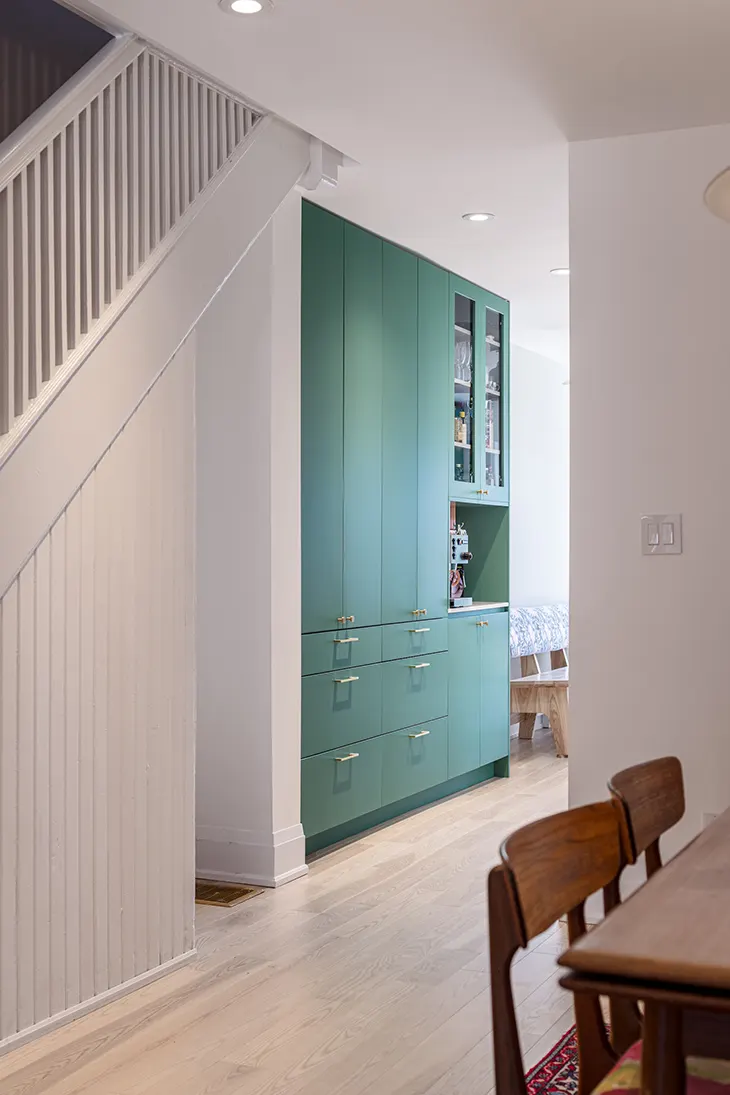
White quartz countertops introduce neutrality within the kitchen, while smaller pink accents highlight key details such as open shelving and a recessed espresso station. Custom furniture pieces further shape the interior atmosphere. The dining table and an extended kitchen bench were built from solid white ash with careful attention to comfort. The bench back reclines at a 103-degree angle, and the upholstered cushion features colorful floral fabric selected by the clients.
Elsewhere, color becomes more expressive. The ground floor powder room introduces a dramatic moment through hot pink Gucci wallpaper, demonstrating the project’s willingness to experiment within contained spaces.
During construction, demolition revealed structural weaknesses at the rear of the house. What appeared to be a former porch had been incorporated into the building using inadequate structural support. The area required complete reconstruction, which provided the opportunity to introduce a new patio door on the ground floor and a large picture window in the tatami room above.
The third floor remains intentionally minimal. Two separate bedrooms for the children provide blank canvases that allow them to shape their own spaces over time.
Through Japanese Semi, Picnic Design demonstrates how cultural references can inform everyday architecture without becoming literal reproductions. The project integrates rituals, material clarity, and bold color within a compact urban house. By reorganizing the structure and introducing adaptable spaces, the renovation transforms a fragmented dwelling into a coherent home designed for contemporary family life.