
In 1946, Philip Johnson designed a small residential commission in Bedford, New York. The Booth House, built three years before his iconic Glass House, introduced the architectural vocabulary that would define his career: restraint, transparency, material honesty, and a fundamental respect for landscape. Nearly 80 years later, that house is being restored by architect Drew Lang and builder Ravi Arps, who acquired it as the inaugural project of their new firm, RnD. The work ahead is both straightforward and impossibly complex: fix what time has broken, preserve what makes the house architecturally vital, and carry a canonical work of American modernism into another chapter of living.
RESIDENTIAL PROJECTS ON ARCHISCENE
The tension is immediate. Restoration projects are always bound by a paradox: they must honor the past while serving the present. But restoring a Philip Johnson house raises the stakes considerably. Johnson‘s work is not merely historical; it remains intellectually alive, studied in architecture schools, referenced constantly in contemporary design discourse. His residential projects, in particular, are intimate laboratories where his ideas about the relationship between domestic space and landscape were tested at their most vulnerable scale. To restore such a house is to work under an unflinching gaze, not just from preservationists and historians, but from the architectural community itself.
For Lang and Arps, this weight is neither avoided nor diminished. It is, instead, built into the project’s philosophical foundation. RnD was conceived explicitly to bring design and construction under a single accountable standard, collapsing the distance between vision and delivery. In theory, this should allow for precision and intentionality. In practice, restoring Booth House reveals how complex that accountability becomes when the client is not a person but a building whose original intentions have been clouded by decades of use, neglect, and accumulated change.
The House That Time Forgot
Booth House spent the first phase of its life as a weekend retreat for Richard and Olga Booth, the clients for whom Johnson designed it. That role lasted until 1955, when architect Sirkka Damora and photographer Robert Damora acquired the property. The Damoras‘ tenure was transformative in ways both visible and invisible. Robert Damora‘s photographs of the house became canonical images in the documentation of American modernist architecture; Sirkka‘s care extended the building’s life through thoughtful stewardship. For decades, the house was both a lived home and a meaningful artifact of the modern architectural legacy.
The original images pre-renovation:
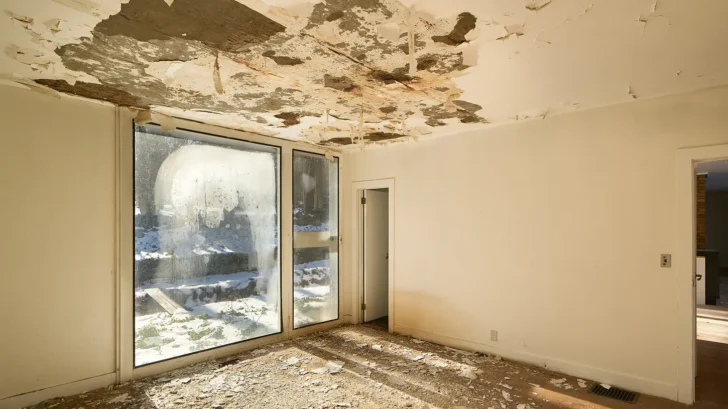
That dual role, however, left its own kind of damage. A house that is simultaneously a home and a monument occupies an unstable position. It cannot simply be inhabited; it must be performed. The careful attention that made Booth House legible as architecture also froze it in time, resistant to the small modifications that domestic life requires. When the Damoras eventually departed, the house entered a long period of decline, less through dramatic trauma than through the patient entropy of deferred maintenance, system failures, and the particular damage that comes from a building no longer being actively lived in.
The photographs reveal this plainly. The interiors Lang and Arps inherited show a house in advanced stages of deterioration: ceilings collapsed, surfaces peeling, systems failed. The architectural clarity that Johnson had achieved through material restraint remained visible beneath the decay, like a palimpsest. The brick chimneys still stood. The proportions still read. But the building had crossed a threshold where restoration could no longer be routine preservation work. It had become rescue archaeology.
Ethics of Intervention
This is where the philosophical commitment of RnD becomes consequential. The firm’s stated approach is to preserve architectural clarity while adapting for contemporary living. That formulation sounds reasonable in a press release. In practice, it requires hundreds of decisions, each one a negotiation between historical integrity and functional necessity.
Consider a degraded ceiling. Restoration could mean carefully patching and repainting, retaining evidence of the house’s age and the particular way time has marked it. Restoration could also mean complete replacement with materials that match the original specification exactly, erasing the visible history of decay. Both are defensible choices. Neither is neutral. The first preserves authenticity through weathering; the second pursues authenticity through materials and intention. Which one honors Johnson‘s work?
These questions multiply across every surface, every system, every material junction in the house. They are not merely technical problems to be solved. They are interpretive problems that require a particular kind of architectural thinking: the ability to read a building not just as a finished object but as a record of decisions, constraints, aspirations, and accidents. It requires humility about what can be known and what remains speculative.
Lang and Arps have signaled their awareness of this burden by committing to document the restoration process. This is not a typical preservation gesture. Most restoration work is invisible once complete; the house presents itself as it always was, healed of its trauma. By making the process visible, RnD is acknowledging that restoration is itself a form of authorship. The choices made during this project will shape what Booth House becomes. Transparency about those choices is a way of taking responsibility for that authorship rather than pretending to be mere custodians.
The Second Life
There is another layer to this complexity. Booth House is not being restored to become a museum or a study center. It will be returned to the market as a residential property. Someone will live there. This is where the tension between preservation and adaptation becomes not theoretical but practical and immediate.
A contemporary resident will need climate control systems that Johnson did not anticipate. They will want kitchens and bathrooms that function according to current standards. They will expect connectivity, thermal efficiency, acoustic performance. They may want to change how the spaces are used, how light enters rooms, what activities occur in what areas. The house’s original program (a weekend retreat for a specific couple in 1946) does not align with how domestic life is actually lived in 2026.
This problem is not unique to Booth House. Every adaptive reuse project faces it. But it is sharpened here by the particular authority of Johnson‘s design. His spaces were conceived with precision. The relationship between interior and exterior, the way materials meet and transition, the proportion of openings to walls, the path through the house from entry to living spaces—these were not afterthoughts. They were the point. To alter them is to diminish what makes the house architecturally significant.
Yet to preserve them exactly is to create a house that cannot be lived in comfortably by anyone but a Johnson scholar willing to accept discomfort as the price of historical fidelity. This is the real bind. And it is not solved by clever compromises or technical sophistication. It is solved by accepting that some tension is irreducible, that the best outcome is not perfect harmony but rather a careful calibration of what is essential to preserve and what can be thoughtfully adapted.
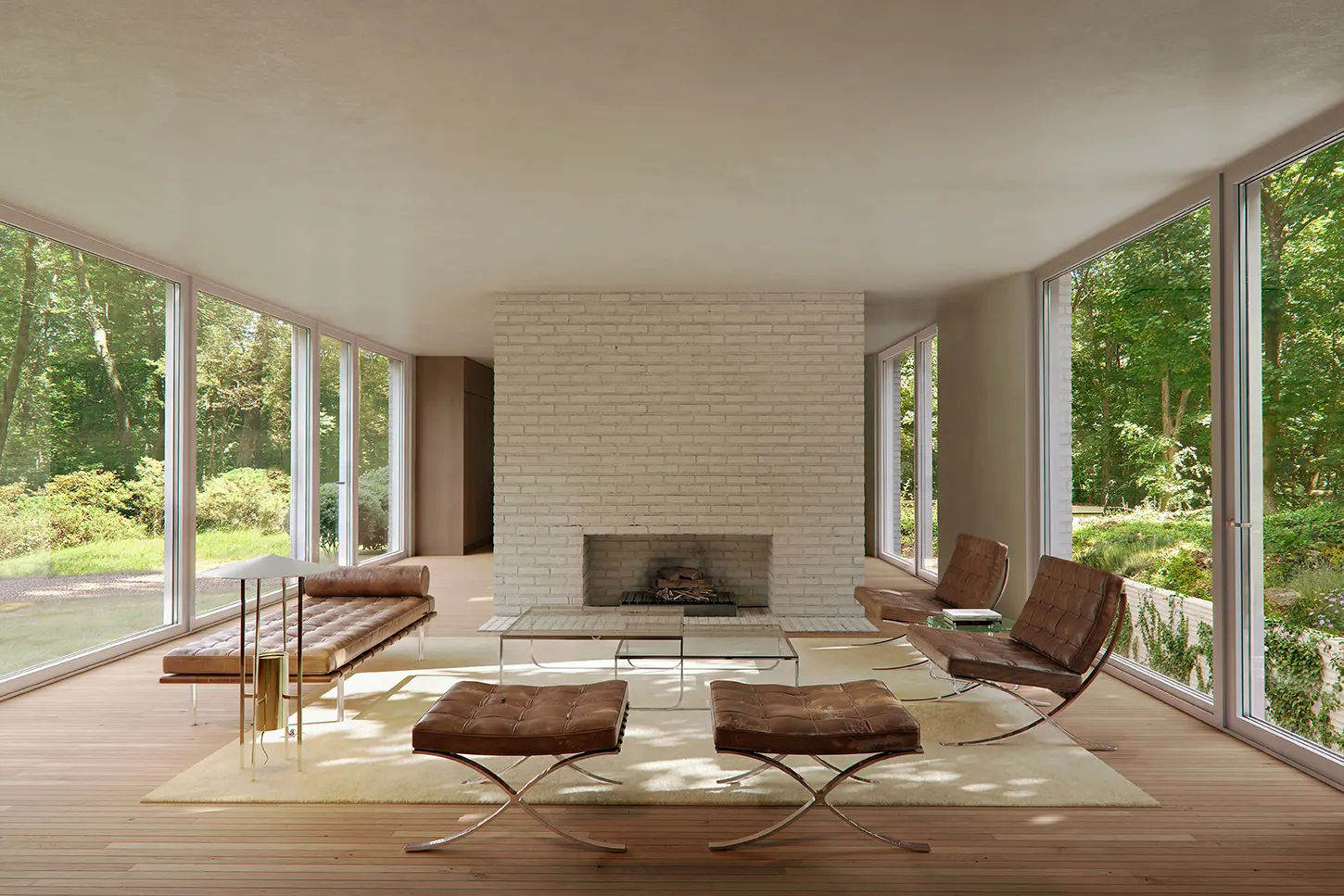
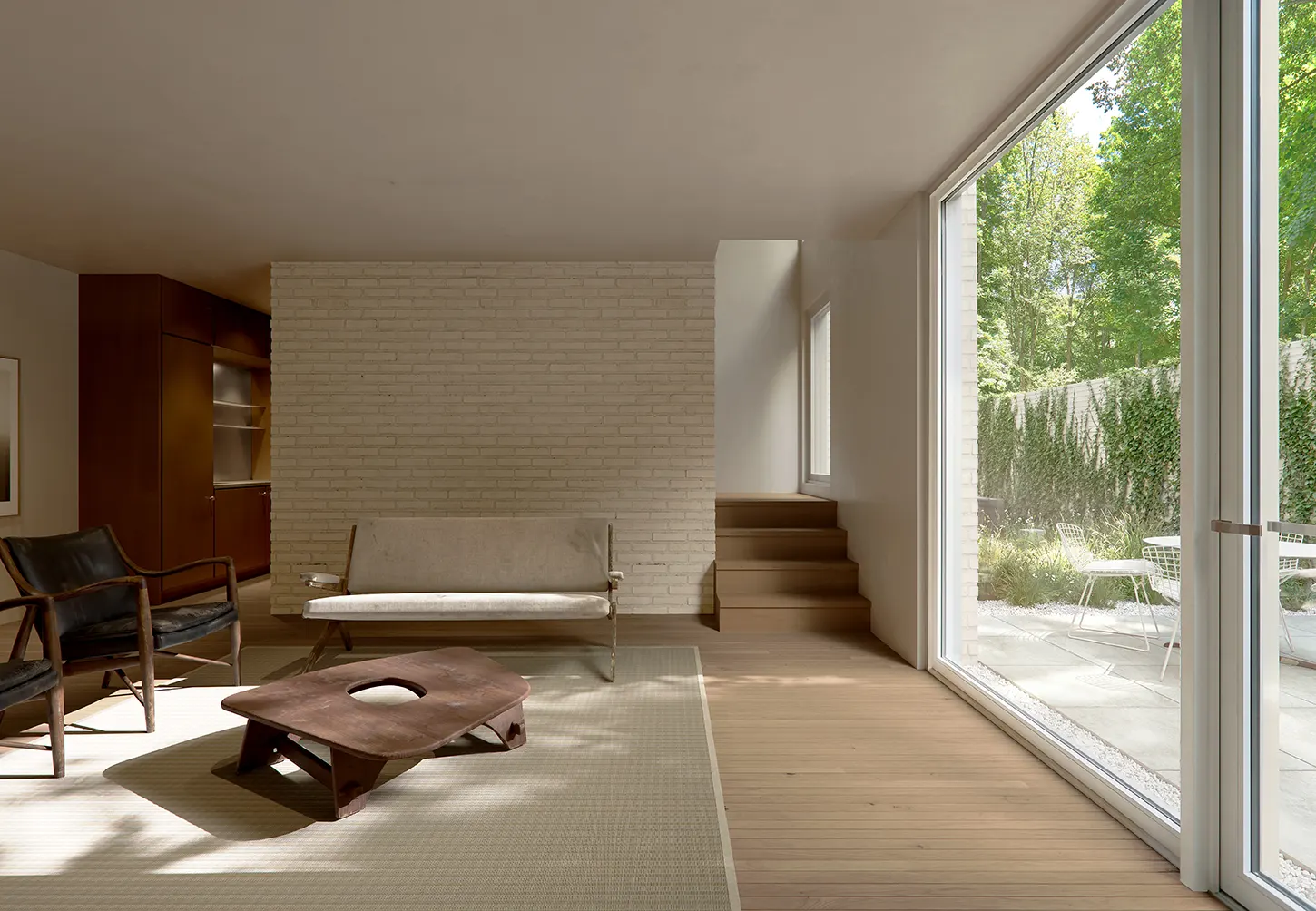
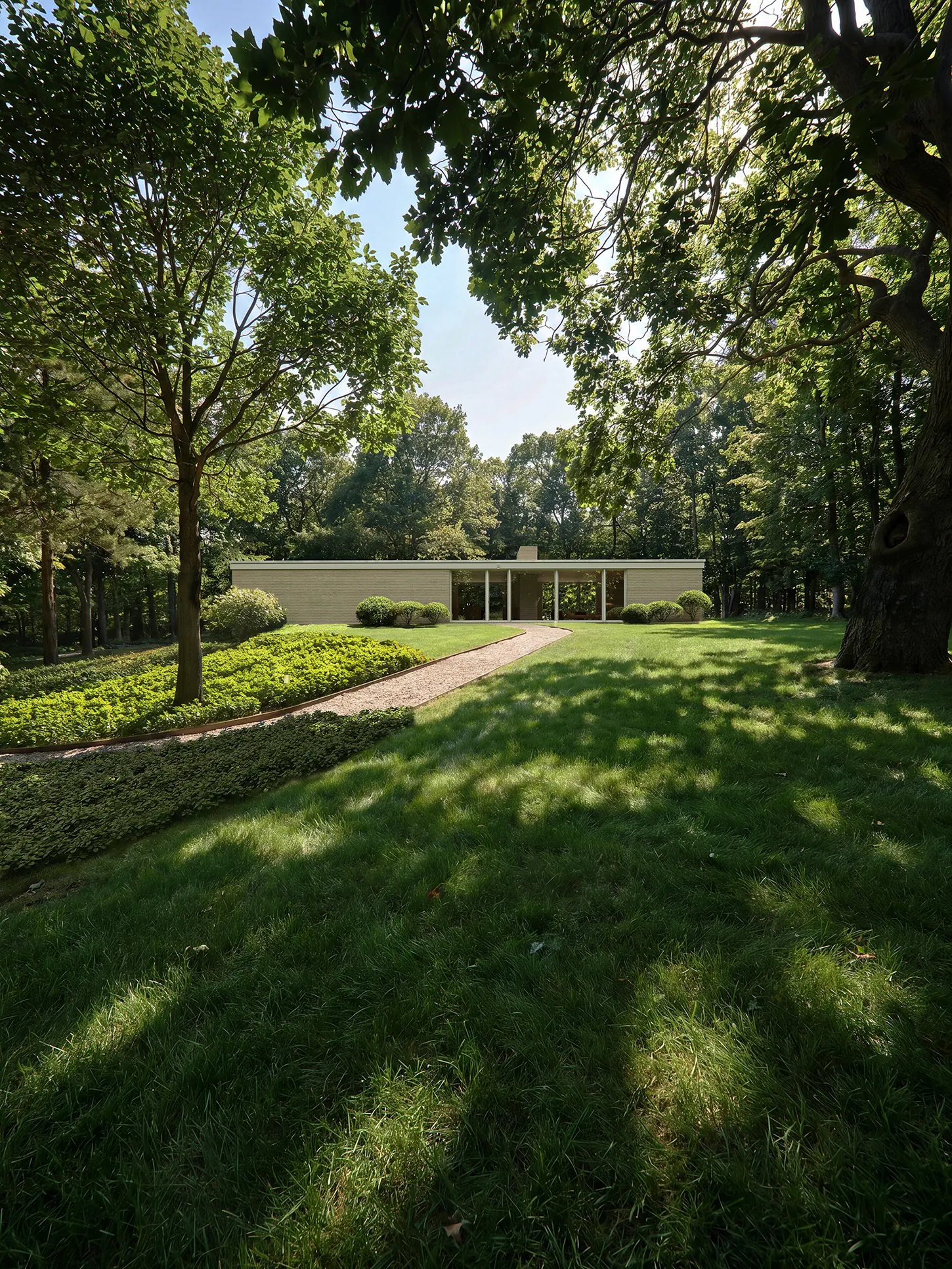
The render images offer a preview of RnD‘s approach. The restored interior spaces maintain Johnson‘s spatial and material logic: clean lines, honest materials, a strong relationship between inside and outside. The courtyard design shows how contemporary landscaping can reinforce rather than contradict the modernist clarity of the house. These are not radical reimaginings. They are conservative in the best sense: preserving the generative principles that made the house work while updating the specific means by which those principles are expressed.
What It Means to Care
At the center of this project is a question that goes beyond architecture: What does it mean to care for something you did not create and cannot fully understand? The Damoras knew. For decades, they lived with Booth House, attended to it, documented it, and through that long attention, became part of its history. Their stewardship is visible in the fact that the house, despite decades of decline, remains legible as a Johnson work. Neglect did not erase his intention.
Lang and Arps inherit this responsibility. They did not design Booth House, and they will not live in it after restoration. Their relationship to the building is professional and limited in time. Yet they have taken on the burden of its future, committing resources and attention to a project that will generate no personal reward beyond the satisfactions of craftsmanship and the knowledge that something important has been preserved.
This is the work that rarely gets celebrated in architecture. It is not the design of new buildings but the careful maintenance of existing ones. It is not innovation but stewardship. It does not result in bylines or commissions or the kind of cultural visibility that accrues to architects who build new landmarks. Yet without this work, the architectural legacy becomes a museum, a set of historical artifacts rather than a living tradition.
Booth House‘s restoration, then, is more than the repair of a specific building. It is a statement about what architects believe architecture is for, and what they believe they owe to the work that came before them.RnD‘s commitment to making the process visible suggests they understand this. They are not restoring Booth House in secret, presenting it afterward as if it had always been this way. They are inviting scrutiny, documentation, and accountability. In doing so, they are modeling a different kind of architectural practice, one where stewardship is as valued as innovation, and where respect for the past is understood not as nostalgia but as an ethical obligation to the future.
Final design of the renovated project:
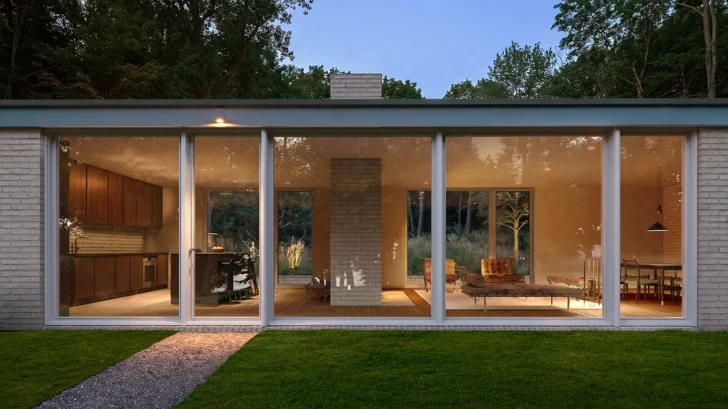
Booth House will eventually open to a new resident, carrying forward eighty years of architectural intention, photographic documentation, and careful care. When that happens, the project will have succeeded not by erasing time but by acknowledging it, not by trying to return the house to some imagined original state but by understanding that restoration is itself a creative act, one that requires both technical precision and philosophical clarity about what matters most.