
Author’s Room Hotel is conceived as a hybrid cultural destination that brings together hospitality, retail, and public life within a single architectural framework. Designed by B.L.U.E. Architecture Studio for the cultural brand IMAGINIST, the project sits in Aranya Jiulong Lake, Guangzhou, a setting defined by dense mountain forests, expansive lake views, and a slower rhythm of living. Positioned along the eastern riverside and adjacent to the community art museum and canteen, the building negotiates between collective urban activity and the calm presence of the surrounding landscape.
HOTELS
The project draws its conceptual foundation from Lingnan culture, specifically the Qi Lou typology found in Guangzhou’s historic urban fabric. Traditionally combining ground-floor commerce with residential spaces above, Qi Lou buildings are structured around continuous colonnades that support daily life, circulation, and social exchange. Author’s Room Hotel reinterprets this model through a contemporary lens, adopting the same vertical sequence of public and private functions while translating its spatial logic into a new architectural language.
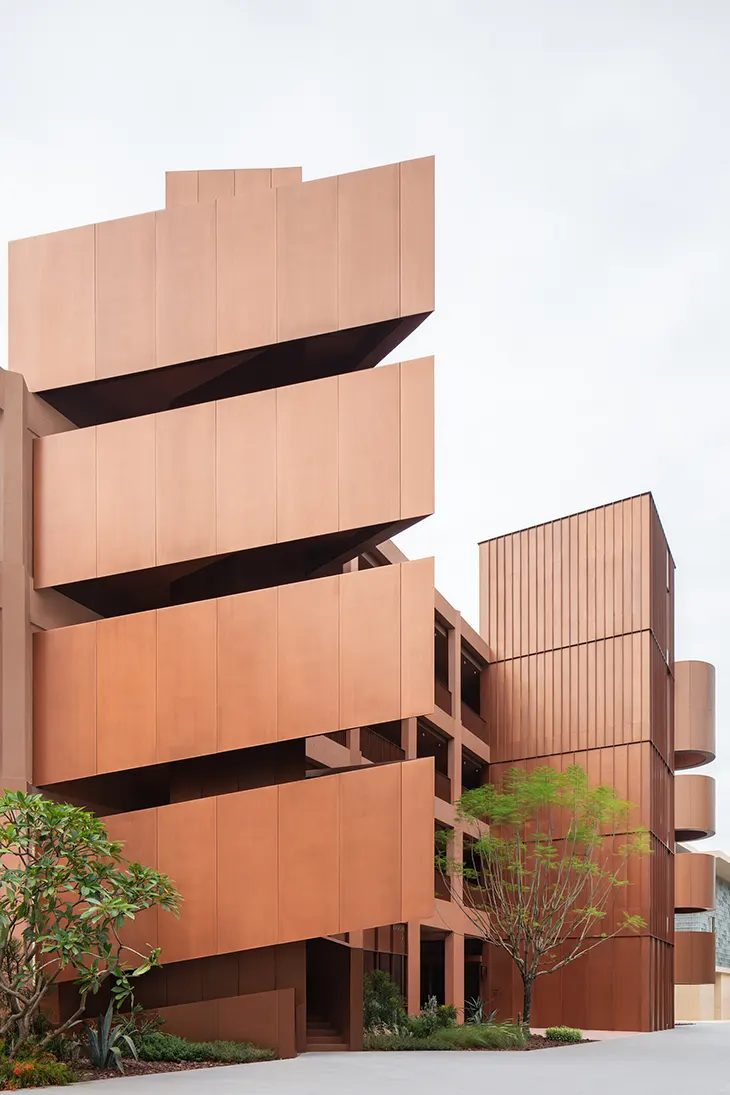
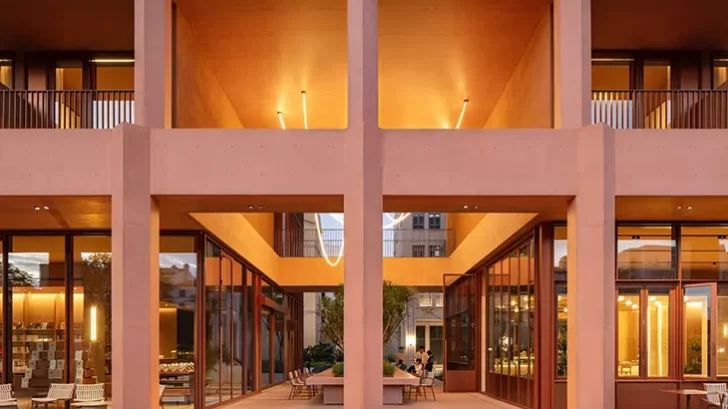
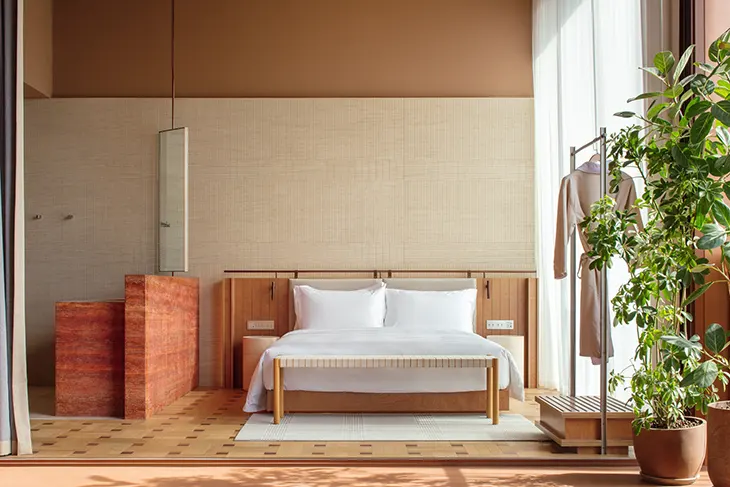
Organised across four levels, the ground floor operates as an openly accessible public realm, housing a bookstore, café, and light dining spaces. Above, Levels 2 to 4 accommodate 18 guestrooms oriented toward river views. A defining feature of the building is the continuous colonnade that wraps the structure, formed not by solid walls but by a series of polygonal columns. This semi-outdoor layer dissolves clear boundaries between inside and outside, creating a porous threshold that invites movement, air, and light through the building.
Structure plays a central role in shaping both form and experience. Columns, beams, and slabs form a clear linear grid that remains deliberately exposed, allowing the external appearance to directly express the building’s construction logic. Rather than treating structure as a hidden system, the design aligns spatial organisation and visual identity, resulting in an architecture where use, form, and structure are inseparable.
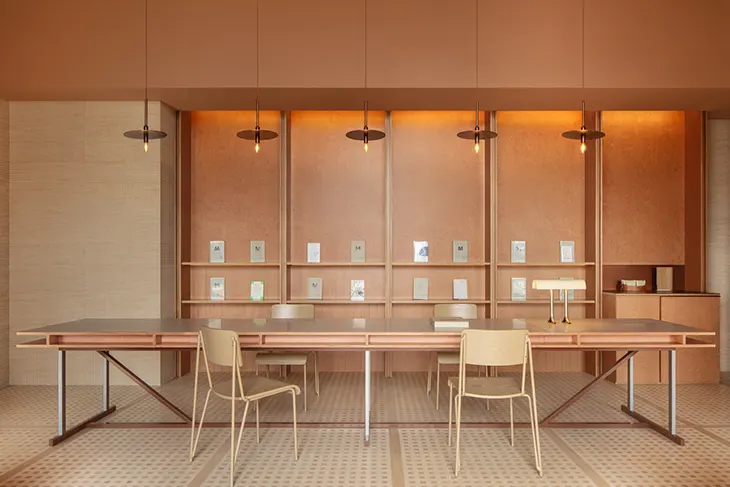
At ground level, the colonnade establishes a fluid public zone that mediates between the building and its surroundings. Retail spaces are set back, generating a sheltered pedestrian corridor that extends the street and encourages informal occupation. Sunlight and breeze pass freely through this zone, supporting seasonal change and everyday activity. Visitors drifting along the riverside are naturally drawn into the bookstore and café, reinforcing the building’s role as a cultural anchor within the community.
On the upper floors, the colonnade takes on a more intimate function. Shaded terraces beneath deep eaves allow guests to engage directly with the river and forest landscape while maintaining privacy. Acting as a secondary architectural skin, the colonnade moderates the subtropical climate by providing shade and shelter, while also filtering views from across the river. This layer balances openness with retreat, supporting a quiet, contemplative experience within the guestrooms.
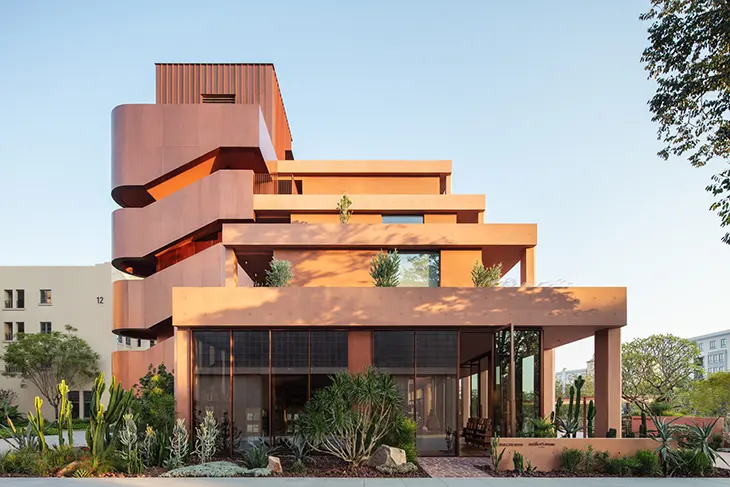
The building’s stepped, terraced massing further defines its relationship to the site. As the structure rises, each volume gradually steps back, creating a layered silhouette that shifts depending on the viewing angle. This configuration reduces the perceived scale of the building along the shoreline and establishes a more human-scaled presence, while also reinforcing the hierarchy between public, semi-public, and private spaces.
Author’s Room Hotel ultimately positions architecture as a cultural interface rather than a singular object. By reworking the Qi Lou typology and aligning structure, climate response, and program, the project creates a setting where commerce, hospitality, and daily life intersect naturally. Within the landscape of Jiulong Lake, it offers a place that feels open yet grounded, contemporary yet deeply informed by local tradition.