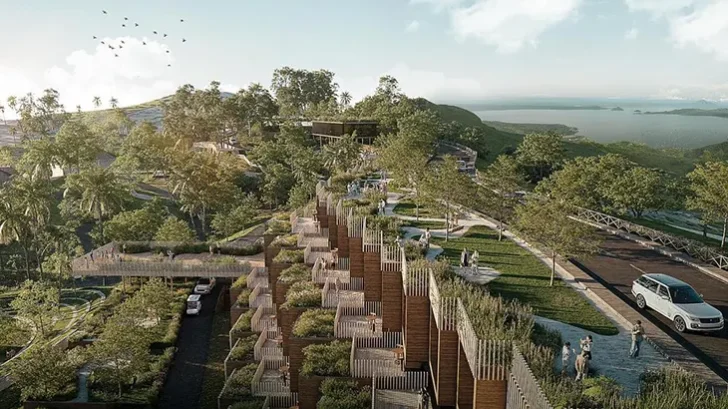

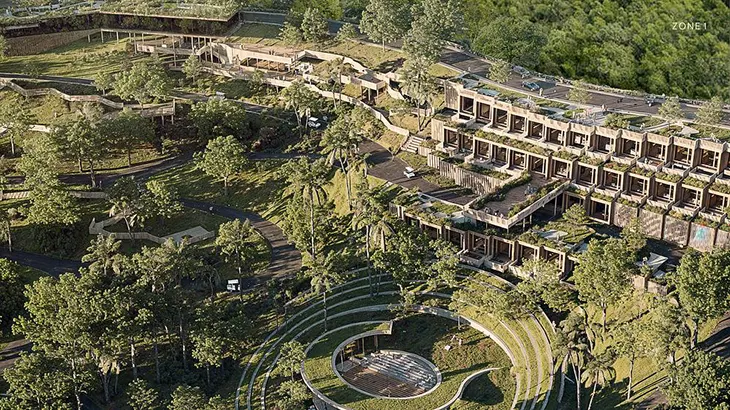
In Calaca, Batangas, Plontur Group presents a clear position on development that begins with listening. Luana Farms, awarded in the Leisure-Led Development category at the World Architecture Festival 2025, demonstrates a practice where landscape defines structure, scale, and use before architecture takes form. The project rejects imposed order in favor of systems already present on the land.
LANDSCAPE
The 10.9-hectare site sits between Mount Batulao and Taal Lake, two dominant landforms that shape the character of the region. Plontur approached the site as a living system shaped by topography, water movement, vegetation, climate, and long-standing agricultural practices. Landscape architects led the planning process, establishing parameters that guide architecture instead of responding to it later. Built form emerges as a consequence of terrain and ecology, not as a starting point.
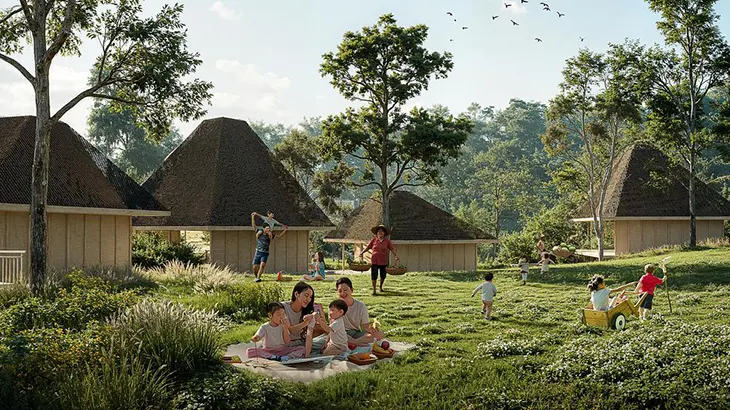
Before any construction decisions, the team documented existing conditions in detail. More than 350 native trees were mapped and preserved, and circulation routes weave carefully around them to maintain canopy continuity and ecological connections. Of the total land area, 73 percent remains unbuilt, reserved for forest buffers, ecological corridors, and productive farmland. These areas continue to operate as living infrastructure, supporting biodiversity, food production, and long-term resilience.
Spatial organization draws from the Filipino barangay, grouping structures around shared open spaces rather than isolating them as individual objects. This approach supports daily social interaction and accessibility while keeping large portions of the site flexible over time. Architecture stays secondary to landscape systems that already define how the land functions.
The masterplan unfolds through four zones shaped directly by elevation and slope. At the highest point near the main road, the arrival zone introduces the site through a restaurant, hotel, and pavilion. Open decks, green roofs, and permeable structures maintain continuity with the ground, allowing visitors to encounter landscape before architecture. Moving downslope, villas and amenities sit lightly on the terrain. Inspired by the bahay kubo, these structures lift above ground level, allowing air, light, and vegetation to circulate freely. Natural pools, rain catchment areas, and elevated walkways support both environmental performance and moments of retreat.
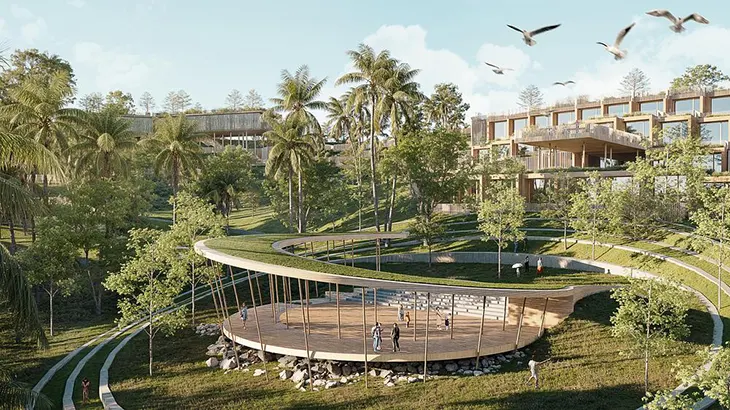
At the center of the site, a working permaculture farm anchors daily life. Guests and farmers share the same terrain through planting, harvesting, markets, and learning spaces. Hospitality, education, and livelihood intersect here without hierarchy, reinforcing agriculture as an active and visible part of the environment. On the steepest slopes, terraced agroforestry stabilizes challenging terrain using on-site materials, supporting long-term food systems while allowing the land to evolve seasonally and over generations.
Environmental and social performance guided the project from the outset. Rain catchment systems aim to supply up to 50 percent of irrigation needs, while passive cooling strategies reduce reliance on mechanical systems. Procurement focuses largely within a 50-kilometer radius, supporting local producers, craftspeople, and agricultural partners. Programs for direct trade and on-site markets aim to strengthen farmer income and embed economic exchange into the landscape itself.
Luana Farms reflects Plontur’s belief that design carries responsibility beyond form. By allowing the land to set the framework, the project creates an environment that adapts over time. The World Architecture Festival recognition affirms this approach as a method of practice, grounded in ecology, community, and restraint.