
Perched on a steep hillside overlooking the Arabian Sea in Anjarle, Maharashtra, Crest Nine introduces a community centre designed as the recreational anchor for a gated villa enclave. Designed by Sanjay Puri Architects, the project responds directly to the dramatic contours of the site, allowing the architecture to emerge gradually from the terrain instead of imposing a rigid footprint on the landscape.
HOTELS
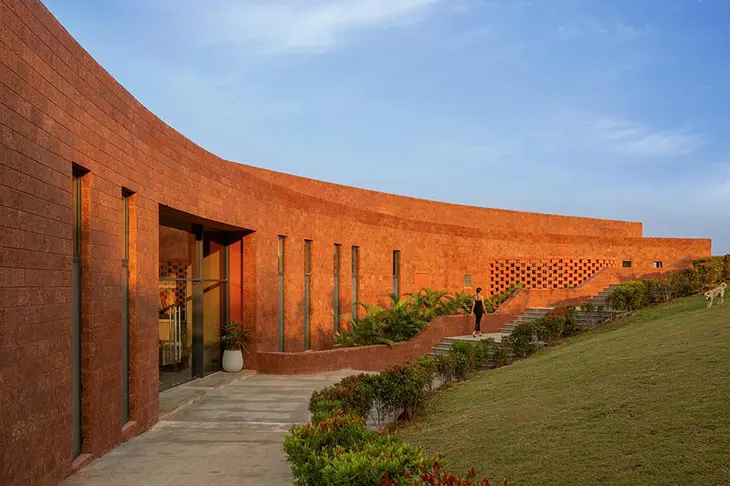
The land drops sharply from the access road, a condition that shaped the entire spatial sequence of the building. Rather than positioning the entrance at street level, the design places it six metres below the road. Visitors descend through a carefully choreographed arrival experience that includes a wide staircase and a gently curving ramp running alongside a landscaped slope. This movement leads toward the main circulation spine that stretches across the length of the structure, establishing the organisational axis of the complex.
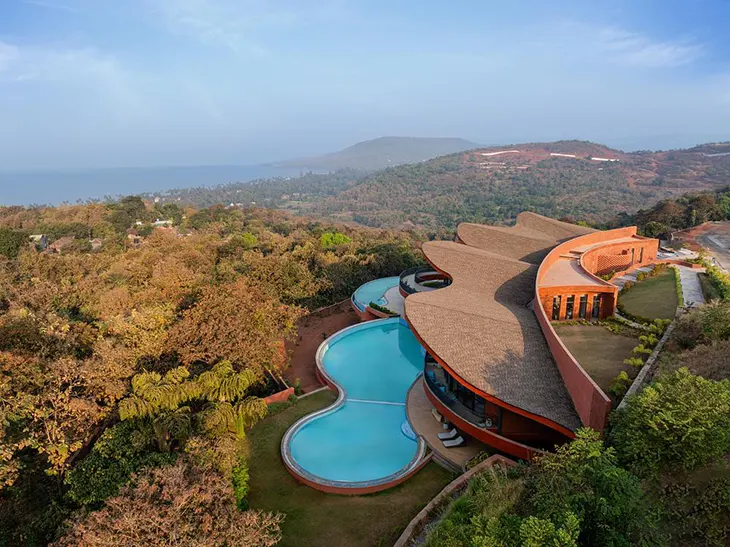
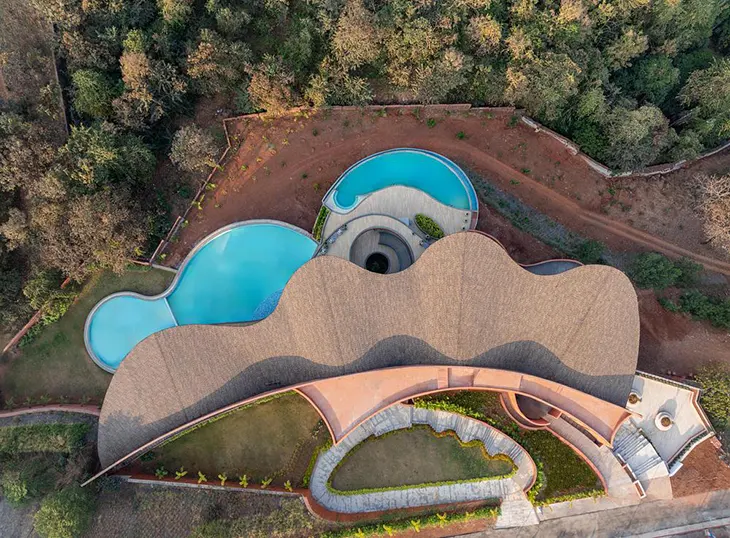
A sweeping curvilinear form defines the building’s entrance façade. From this initial gesture, the architecture transitions into a sequence of sculpted parabolic volumes that vary in height and scale. These forms create a rhythm across the hillside, punctuated by courtyards and landscaped pockets that introduce natural light and outdoor spaces between the enclosed rooms. The interplay between built volumes and open courtyards establishes a spatial cadence that shapes how visitors move through the centre.
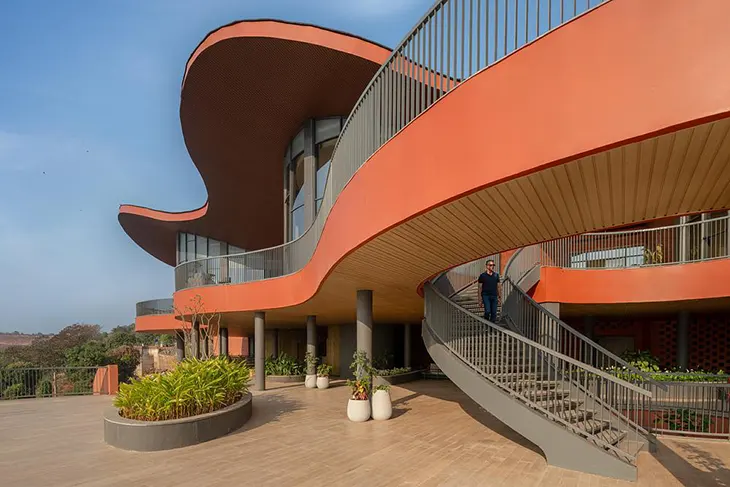
Within these curved volumes, Crest Nine accommodates a variety of recreational and social functions. The upper level houses an indoor sports room, a gymnasium, a restaurant, a bar, and four guest bedrooms. Each of these spaces opens onto broad, curvilinear decks oriented toward the west, framing expansive views of the ocean beyond the hillside.
Above the interiors, a sectionally curved roof moves across the structure in an undulating line. The roof rises above the primary volumes and dips between them to create shaded courtyard areas. Deep overhangs extend over the decks, offering protection from the intense coastal sun while also sheltering the spaces during the region’s monsoon season.
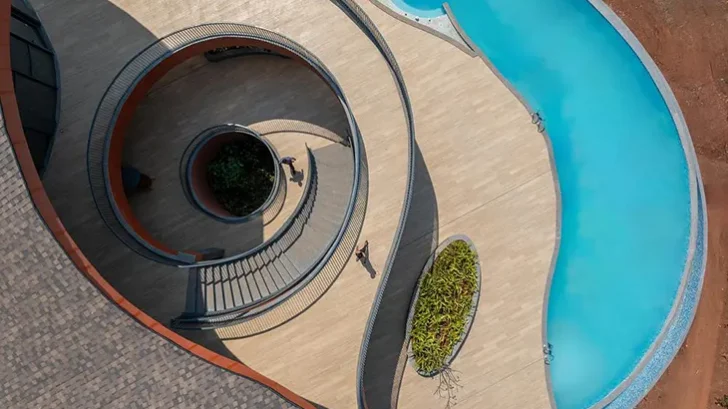
At the centre of the building, an open staircase wraps around a circular courtyard and descends toward the lower level. This vertical movement reveals another layer of the programme, where three swimming pools and a health club occupy the lowest terrace of the site. Adjacent to these pools, an open cafeteria connects to a large multifunctional deck designed to remain naturally ventilated, creating a flexible space for social gatherings and events.
Material selection reinforces the project’s relationship with its coastal context. The building uses locally sourced laterite stone for its walls, grounding the architecture visually and materially within the region. This choice also reduces the environmental impact associated with transporting construction materials over long distances.
Environmental performance formed a central consideration throughout the design process. Every interior space receives natural daylight, and nearly seventy percent of the built area operates without air conditioning through cross ventilation. The roof structure uses a metal framework finished with shingles, helping regulate heat while maintaining the sculptural form of the curved volumes.
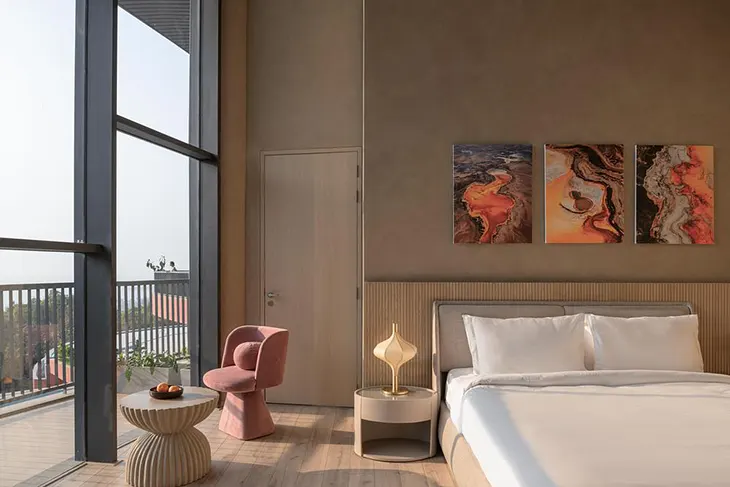
By prioritising local materials and regional labour, the project achieves a significantly lower embodied carbon footprint. Passive cooling strategies, combined with natural ventilation and daylighting, further reduce operational energy demands across the building’s lifecycle.
Rather than appearing as a single monolithic structure, Crest Nine reads as a sequence of interconnected volumes stepping along the hillside. Landscaped open areas weave between the built forms, encouraging informal gathering and social interaction among residents of the villa community. Through its careful response to terrain and climate, the project creates a recreational hub that remains closely tied to the coastal landscape surrounding it.