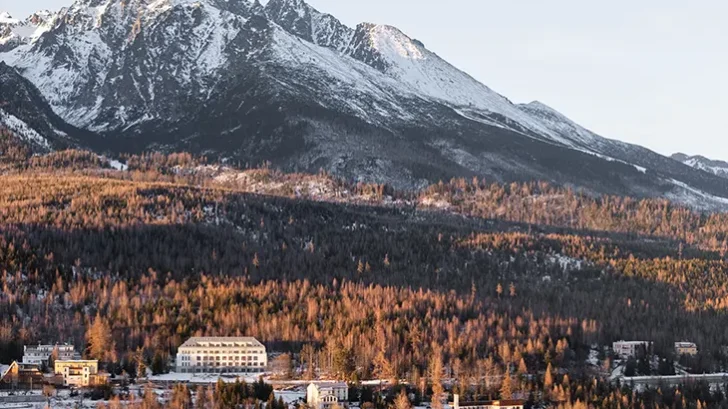

Set at the edge of the mountain forest zone in Horný Smokovec, Lebenski occupies a singular position within the High Tatras, overlooking Poprad and framed by the dramatic peaks beyond. Located in an area known as Pekná vyhliadka, or Beautiful View, the apartment building stands as a visible marker in the landscape. Rather than asserting itself through spectacle, the project adopts a measured architectural language, allowing form, proportion, and material clarity to anchor the building quietly within its surroundings.
RESIDENTIAL ARCHITECTURE
The project takes its name from the original Nový život sanatorium, built in the early 1960s and later left to deteriorate after losing its function in the 1990s. Acquired by Bukna & Laurinčík, the structure entered a new phase in 2023 through a comprehensive transformation led by Atrium Architekti. The studio approached the commission as a careful reconstruction rather than a reinvention, continuing a line of work that previously earned recognition with a CEZAAR nomination for their project in Dolný Kubín.
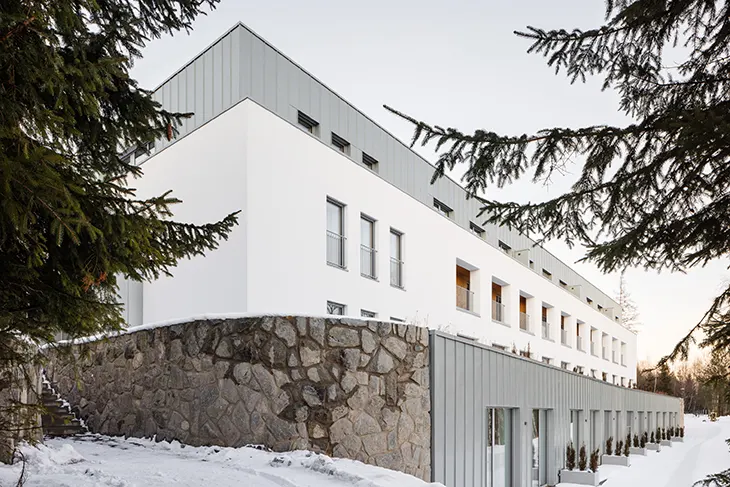
The framework for the redesign was defined by strict regulations set by the TANAP National Park and the town of Vysoké Tatry, alongside the investor’s requirement to use the building’s volume efficiently. The architects chose to preserve the original height, footprint, and silhouette while reworking the internal logic of the structure. By converting both the attic and basement into residential spaces, the accommodation capacity increased without altering the building’s established presence in the landscape. The approach draws on the legacy of Tatra mountain hotels, where purpose-driven elegance and restraint shape the architectural character.
The reconstruction process required the original reinforced concrete structure to be stripped down to its load-bearing skeleton. Structural re-engineering focused especially on the attic and basement, where new residential functions posed technical challenges. The most complex intervention involved transforming the basement into livable space beneath a newly designed terrace. Since the terrace had originally sat directly on the ground, it required lateral extension and an entirely new foundation system. The resulting apartments were designed as two-level units to maintain appropriate ceiling heights and spatial quality.
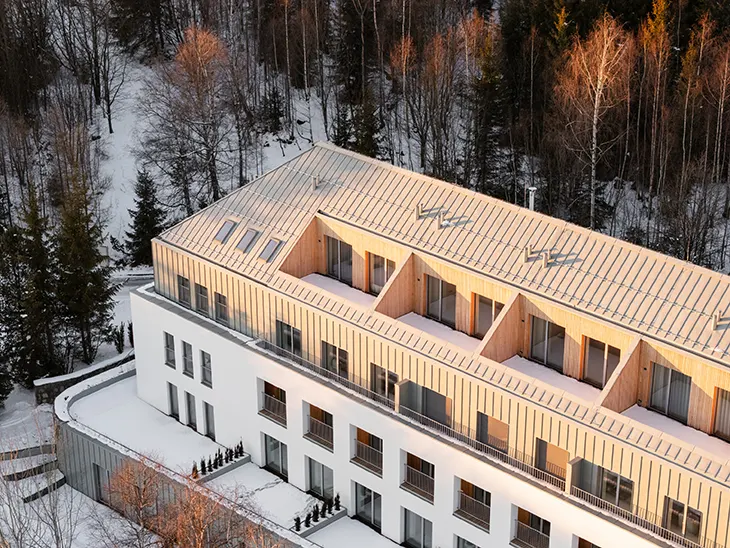
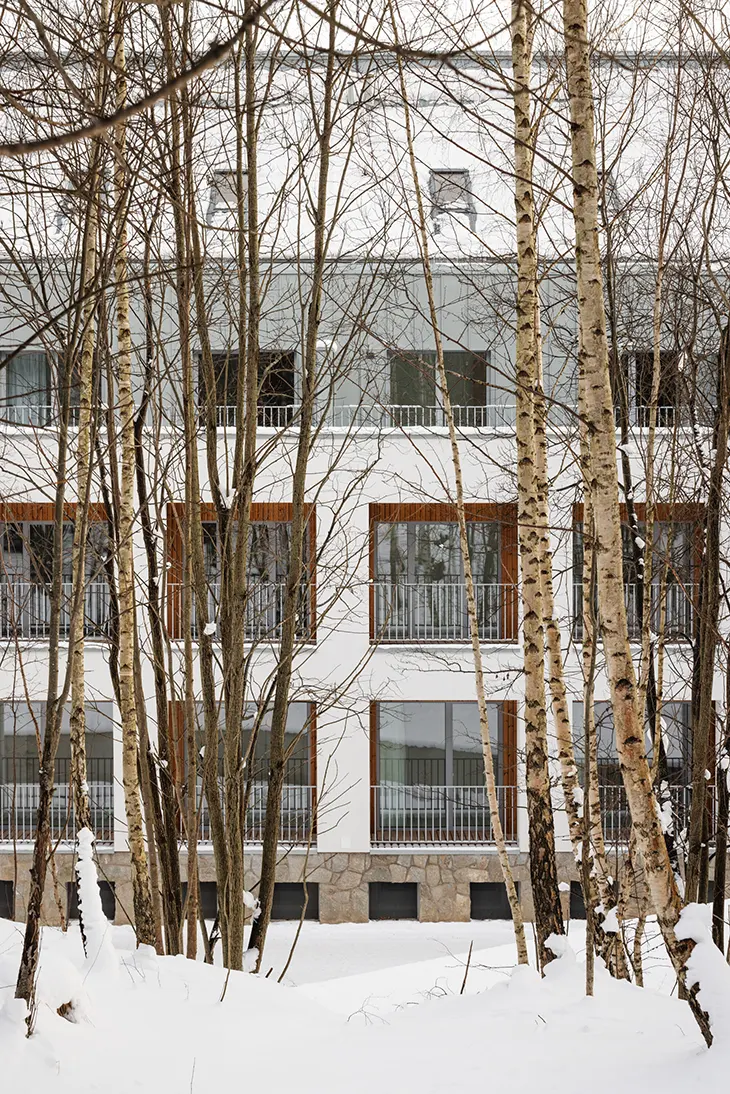
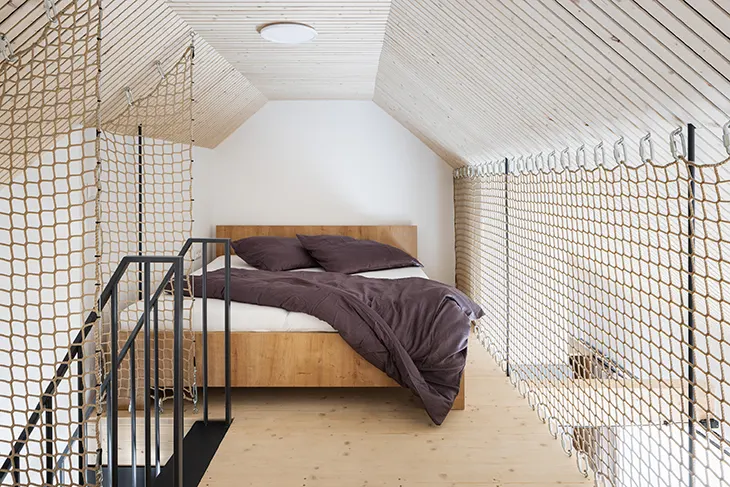
A notable shift in architectural expression comes through the roof. The original gable roof was replaced with a hip roof extension, a form closely associated with traditional mountain architecture in the region. This new roof volume houses maisonette apartments with internal galleries and recessed south-facing terraces. Around the perimeter, newly added balconies and loggias extend living spaces outward, while enlarged window openings strengthen the visual connection to the High Tatras landscape.
Material decisions reinforce the building’s renewed identity. The third floor and attic are wrapped in zinc-titanium cladding, while the lower floors retain a rendered façade. Particular care was given to the restoration of the granite plinth, composed of massive stone blocks approximately 40 centimeters deep. Despite the financial and technical complexity involved, the investor chose to dismantle and re-lay the original stonework, preserving a tactile element that anchors the building to its site and history.
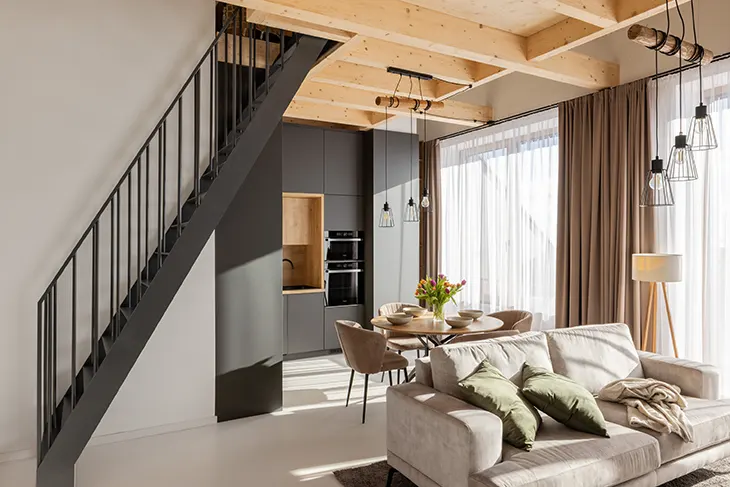
Inside, the apartments range from compact units to larger maisonettes with gallery spaces. Atrium Architekti defined the spatial organization, ceiling heights, and key material cues, opting for a neutral palette with light floors and wood accents. The final furnishing and interior expression remain open, allowing residents to shape their homes individually within a consistent architectural framework.
Mobility around the building reflects the project’s connection to its setting. Parking is resolved with grass grid paving, reducing visual impact, while alternative transport options play a central role. The Tatra Electric Railway lies less than 100 meters away, offering direct links to surrounding resorts and express connections to Poprad. Below the building, the Cesta slobody pedestrian route runs through the valley, tying Lebenski into the broader movement network of the High Tatras.