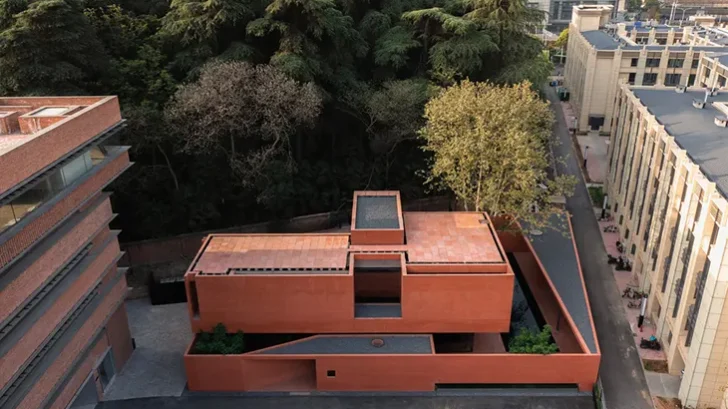

Mix Architecture completed Red Box in Nanjing as a compact commercial structure defined entirely by red concrete. The project sits within the former industrial grounds of the Nanjing Combat Machinery Factory, established in the 1950s and later integrated into Red Mountain Park. The architects approached the building as a physical response to layered meanings of red within the site. The color reflects the industrial past, the red brick factory structures, and the iron-rich soil of Red Mountain itself. Red Box translates these references into a single material expression, using concrete enriched with iron oxide to create continuity between geology, architecture, and memory.
COMMERCIAL ARCHITECTURE
The building occupies a position at the foot of Red Mountain, where its geometry establishes a clear dialogue with the surrounding terrain. A large, solid north façade faces the park, presenting a quiet rectangular volume that appears to hover above the horizontal courtyard wall. On the south side, stepped terraces recede upward, aligning with the slope of the mountain and opening views toward the landscape. This progression reduces the building’s visual weight and allows vegetation and light to shape the experience of the upper levels. A triangular incision in the courtyard wall marks the entrance, guiding visitors along a winding path that gradually reveals the interior. The entry sequence culminates in a tall vertical space defined by a six-flight stair, establishing movement as a central architectural element.
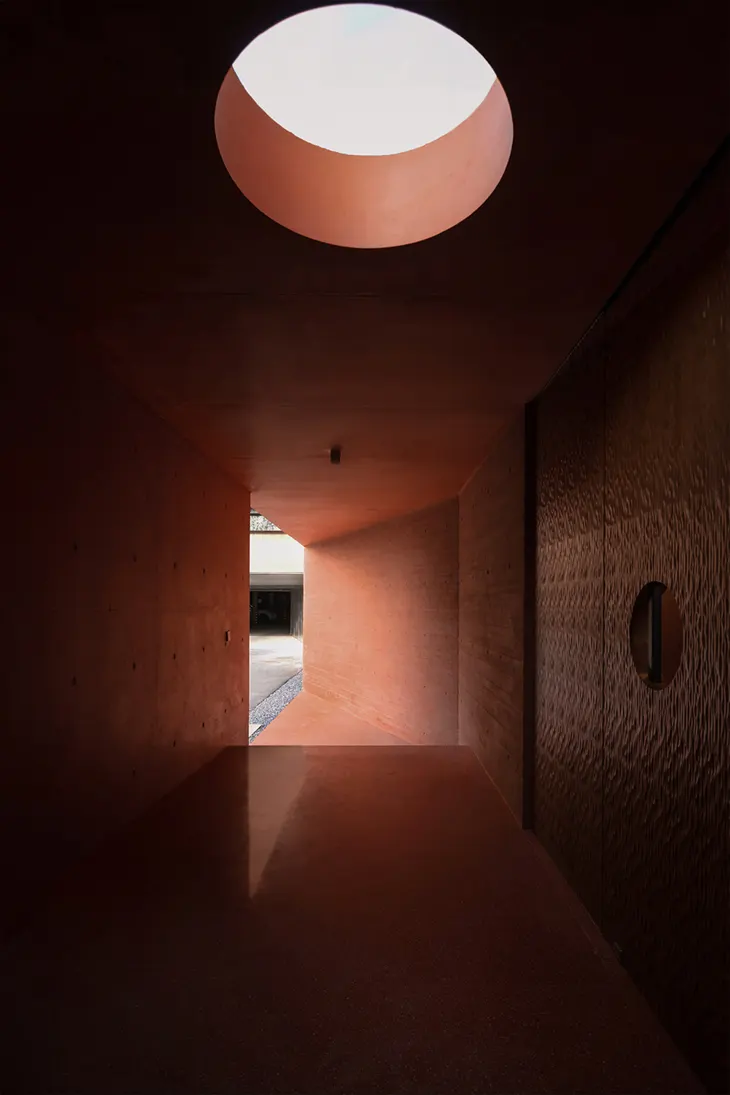
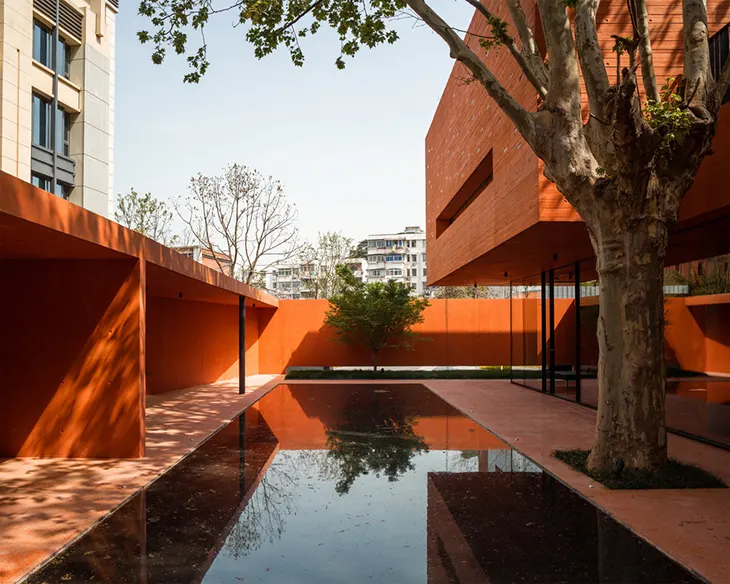
Courtyards structure the spatial organization. On the west side, the largest courtyard functions as a public zone that extends directly from adjacent outdoor areas. A mature tree remains at its center, reinforcing continuity between the site’s past and present. Corridors frame a reflecting pool, where water and foliage capture shifting reflections of Red Mountain. The east side contains more private spaces, organized around smaller outdoor areas that maintain visual contact with the landscape while controlling access and circulation. Narrow courtyards along the north façade contrast with the pine courtyard to the south, where evergreen trees introduce permanence and seasonal stability.
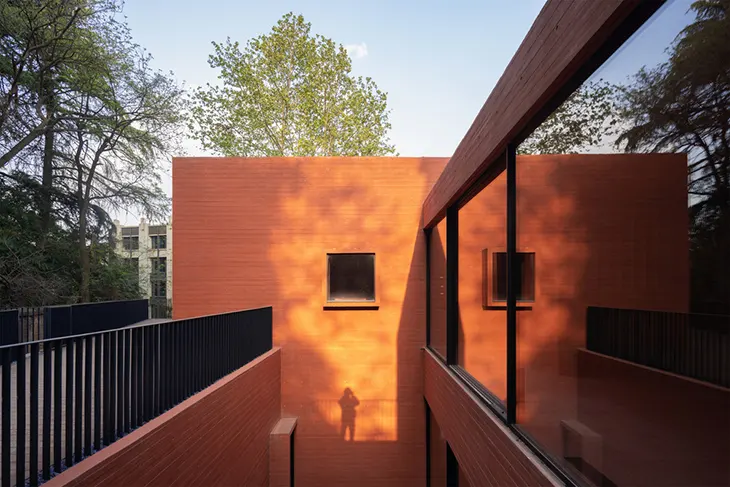
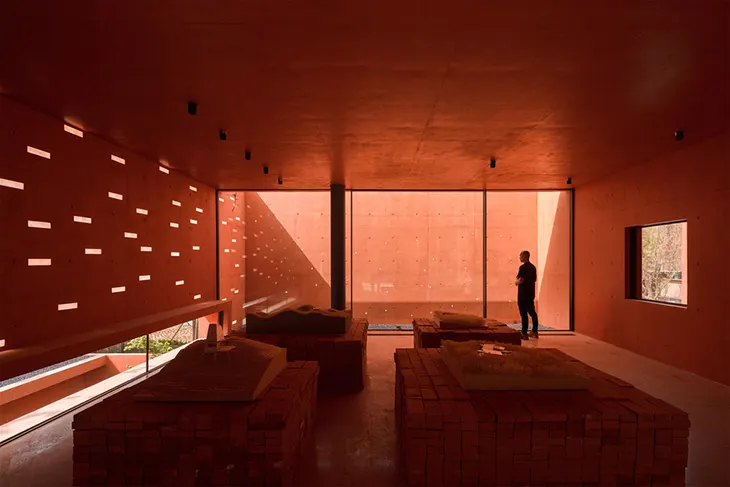
Circulation continues upward, where a corridor on the second floor connects two primary interior volumes. This elevated passage functions as a bridge, aligning movement with views toward Red Mountain. From this vantage point, the surrounding forest enters the building’s visual field, reinforcing the project’s connection to its environment. Interior walls introduce semi-permeable acrylic panels embedded within the red concrete structure. One surface uses a dotted pattern that allows filtered light to pass through, creating a constellation-like effect inside. Another wall incorporates brick-shaped perforations that reference the factory’s original masonry construction. These elements mediate light and visibility while reinforcing continuity with the site’s industrial history.
Material development required extensive experimentation. The design team conducted multiple concrete casting tests to achieve the required color and texture. Wooden formwork introduced grain patterns calibrated to match the scale of nearby brickwork, allowing the concrete to echo the rhythm of the factory buildings. During construction, digital control systems regulated the material composition to maintain consistent color across surfaces. This process ensured that the building retained a precise visual identity, avoiding variation that could disrupt its conceptual clarity.
Mix Architecture coordinated architecture, interiors, and landscape as a unified system. The team collaborated with manufacturers responsible for concrete production, façade systems, windows, lighting, and mechanical infrastructure to align every component with the architectural concept. This integrated approach treated the building as a single constructed object rather than a collection of separate systems. Red Box operates simultaneously as architecture, landscape frame, and material artifact, linking Nanjing’s industrial past with its present urban and ecological context through a focused and deliberate spatial language.