
Located in Montreal’s Peter-McGill district, Centre Sanaaq introduces a new type of cultural and civic space defined less by monumentality and more by participation. Designed through a close collaboration between Pelletier de Fontenay, Architecture49, and Atelier Zébulon Perron, the project occupies the podium of a residential development on the former site of the Montreal Children’s Hospital. From the outset, the building positions itself as an extension of the city rather than a closed institutional object.
INSTITUTIONAL ARCHITECTURE
The design takes advantage of an inherited structure that is both generous and complex. Instead of masking these conditions, the architects and designers use them to shape a spatial experience that unfolds like an urban interior. Circulation remains fluid, sightlines remain open, and thresholds remain deliberately porous. Transparency and accessibility guide the project’s organization, reinforcing Centre Sanaaq’s role as a public framework shaped by everyday use.
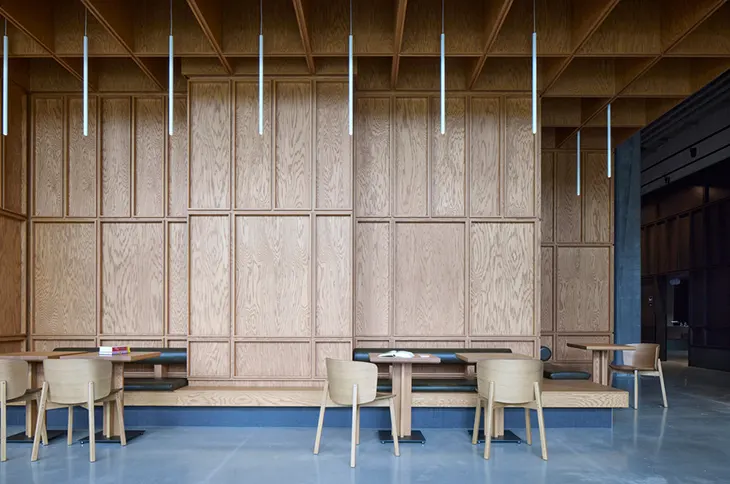
The Centre’s name draws from Inuktitut, where sana refers to creating, working, or sculpting. This idea of collective production defines the project’s ambition. Centre Sanaaq functions as a platform where culture is made rather than merely displayed, accommodating learning, experimentation, performance, and informal exchange. The space remains open to different forms of engagement, allowing both structured programming and spontaneous activity to coexist.
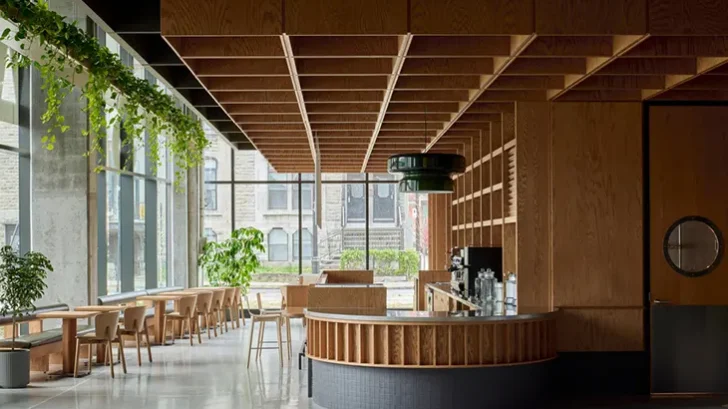
Spatially, the interior is organized as an archipelago of interconnected zones. Each “island” carries its own atmosphere and purpose while remaining visually and physically linked to the whole. At ground level, a central agora anchors the plan, surrounded by a café, performance hall, multi-purpose room, and express library. These programs encourage overlap and encounter, creating a lively base that connects directly to the surrounding neighborhood.
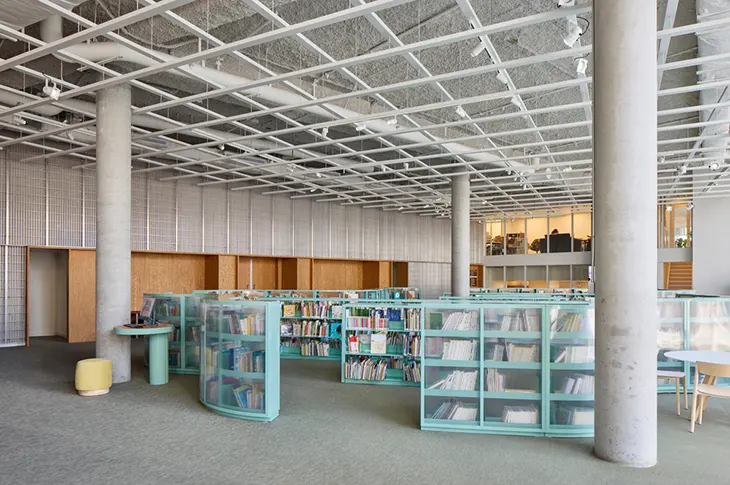
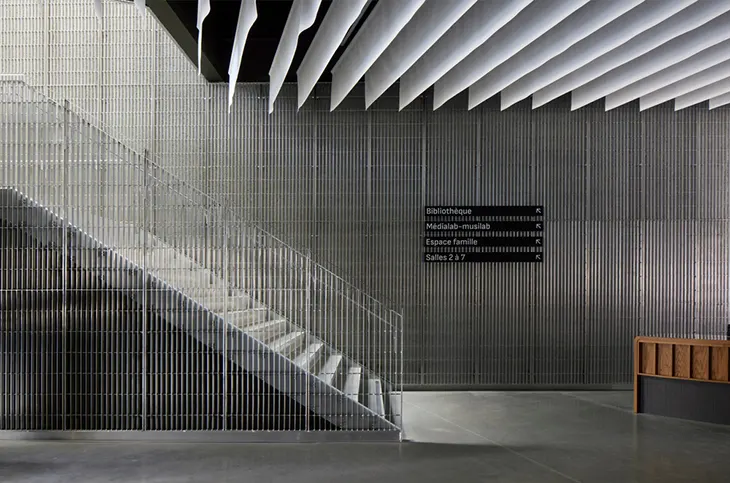
A broad, naturally lit staircase becomes a key architectural gesture, linking the ground floor to the upper level. Above, the library wraps around a central mezzanine, organizing collections for adults and youth alongside reading areas, study zones, multipurpose rooms, and a children’s play space. The balance between openness and retreat allows users to shift easily between social and focused modes of occupation.
Materially, Centre Sanaaq adopts a collage-like language. Aluminium grating, glass, wood paneling, polished concrete, sprayed cellulose, and textiles coexist without hierarchy. Rather than enforcing a singular aesthetic, the palette supports variety and adaptation, reflecting the diversity of activities and communities the Centre serves. This layered approach reinforces the idea of the building as a shared construct shaped by many voices.
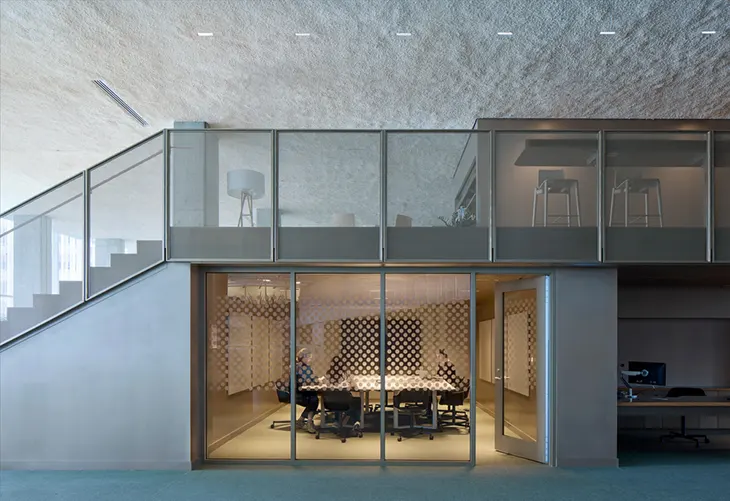
Acoustic performance plays a central role in shaping comfort across large open volumes. Coffered wood ceilings, suspended fabrics, and exposed sprayed cellulose help modulate sound, allowing performances, conversations, and quiet reading to take place simultaneously without conflict. Integrated vegetation further softens the interior, contributing to a calm and welcoming atmosphere.
Centre Sanaaq ultimately operates as a system rather than a static architectural object. Its design prioritizes generosity, adaptability, and use, allowing the building to evolve through occupation. By aligning architecture, interior design, and scenography within a single civic framework, the project outlines a contemporary model for cultural infrastructure rooted in openness, collective authorship, and everyday life.