
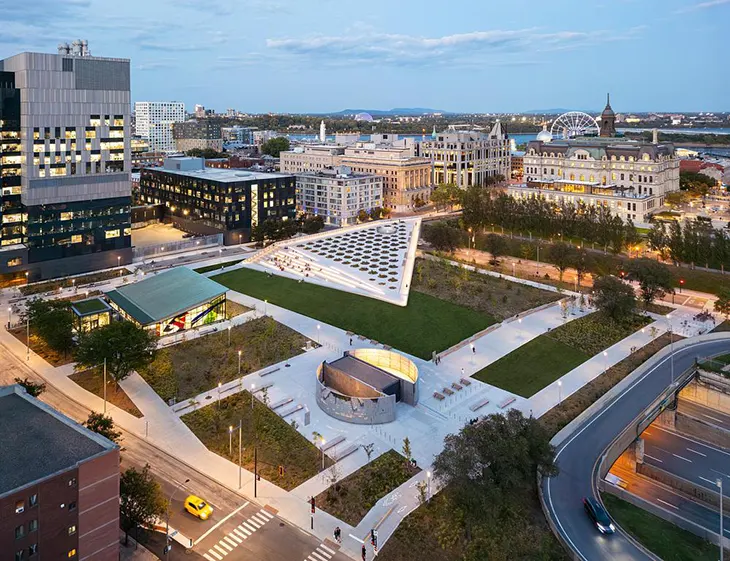
Place des Montréalaises introduces a major civic intervention in the centre of Montreal, transforming a former infrastructure barrier into a public landscape dedicated to memory, movement, and gathering. Designed by Lemay in collaboration with artist Angela Silver and engineering teams from AtkinsRéalis, the project covers a sunken expressway with a new esplanade that reconnects Old Montreal with the downtown core. The intervention reshapes a fragmented urban condition while inscribing the stories of influential women directly into the city’s spatial fabric.
LANDSCAPE
The project emerged from an international multidisciplinary landscape architecture competition launched by the City of Montreal in 2017. Lemay approached the site through a layered architectural strategy that converts a physical scar in the urban environment into an accessible civic destination. The plaza operates as a memorial landscape, a pedestrian connection between neighbourhoods, and a new ecological surface within the city centre.
Place des Montréalaises addresses a long-standing imbalance in urban commemoration. Women remain significantly underrepresented in Montreal’s toponymy. The plaza honours twenty-one women selected by the Conseil des Montréalaises. Fourteen of the names commemorate the victims of the 1989 École Polytechnique femicide, while seven recognise pioneers who shaped Montreal’s scientific, cultural, and social history.
The memorial dimension extends into the surrounding urban fabric. The project establishes visual connections with La verrière, the stained glass installation by artist Marcelle Ferron that covers three facades of the nearby Champ-de-Mars metro station. The plaza also relates to Place Marie-Josèphe-Angélique, redesigned in 2025 as part of the broader intervention.
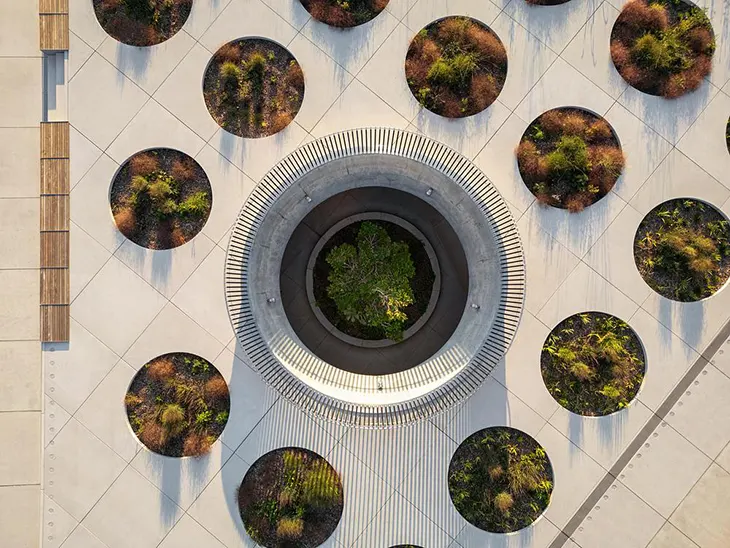
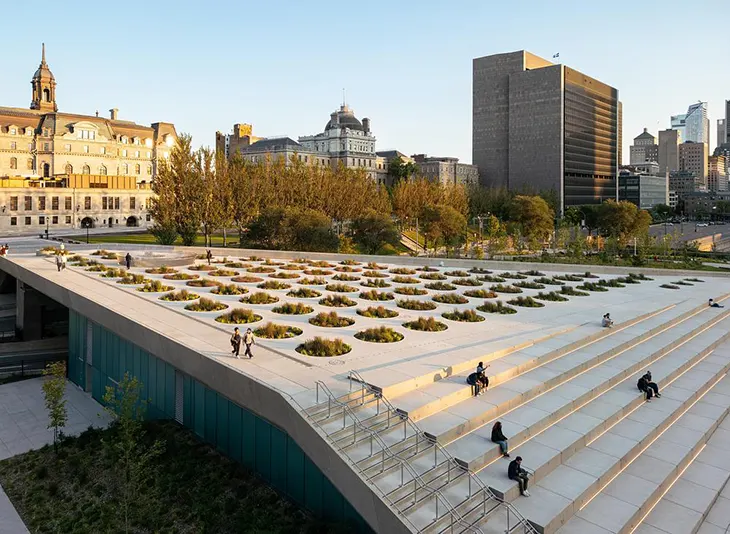
A floating inclined plane defines the central architectural gesture. This suspended landscape supports a flowering meadow composed of twenty-one plant species organised into eighty-six clusters that evolve through the seasons. The planting scheme reflects the women honoured by the project while strengthening ecological diversity within the city centre.
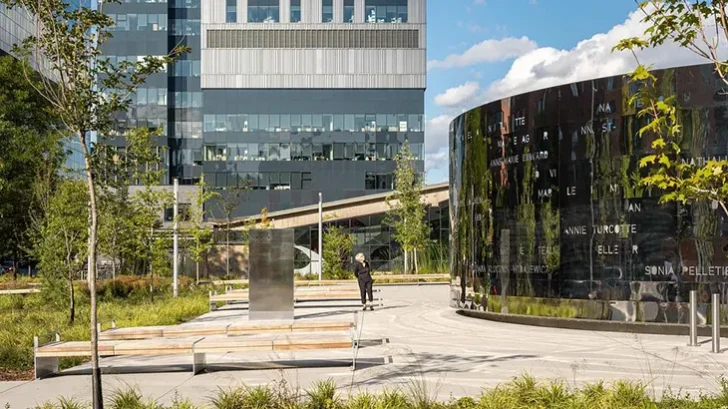
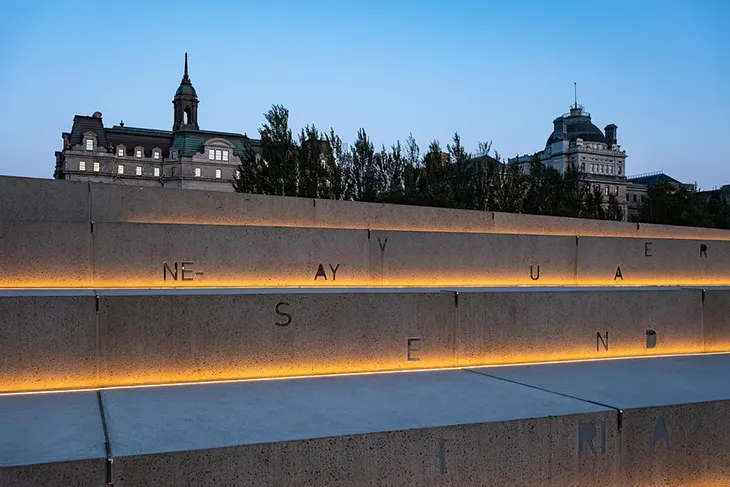
Near the metro entrance, a cylindrical mirror introduces the plaza’s most recognisable sculptural element. The names of the commemorated women appear engraved across its reflective surface. Letters extend outward from the mirror and scatter across the adjacent staircase, inviting visitors to rearrange them into new combinations of names.
The staircase leading to the meadow functions as both circulation and seating. Its stepped form encourages people to pause and observe the surrounding city. From this vantage point visitors see the stained glass panels of the metro station, the flowering meadow above, and the activity of the plaza below, where performances, gatherings, and cultural events have taken place since the site opened in spring 2025.
An urban forest planted to the north of the plaza demonstrates the project’s ecological strategy. Designers introduced trees above railway tunnels and dense infrastructure while selecting species suited to shallow soil depths. Through this approach more than half of the site now supports vegetation.
An oculus cut through the suspended meadow reveals another key design decision. The opening preserves an existing elm planted at street level while reducing structural load on the deck above. This gesture transforms a technical constraint into a spatial feature within the elevated landscape.
Since opening, Place des Montréalaises has quickly become a new destination in Montreal’s civic life. The plaza reconnects neighbourhoods, invites movement and gathering, and establishes a permanent urban tribute to women whose contributions shaped the city.