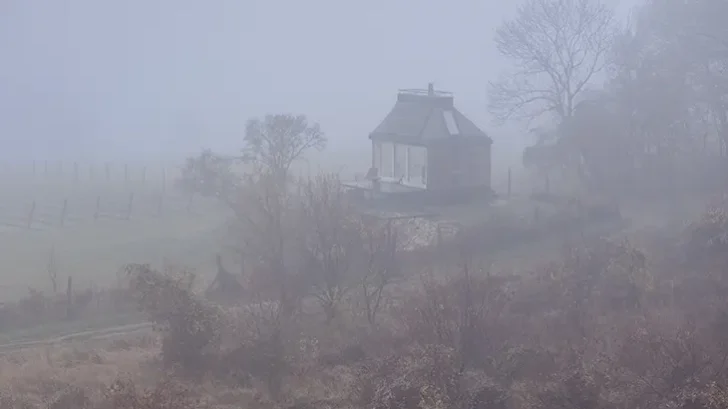

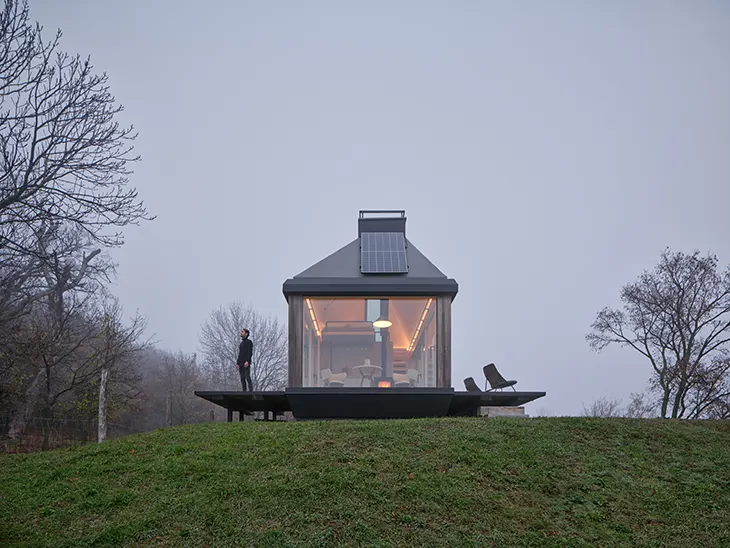
Cabin Devín, designed by Ark-shelter and ARCHEKTA, occupies a dramatic site above the Zlatý Roh vineyards near Devín Castle. Positioned roughly three kilometers above the ECK restaurant, the cabin overlooks rows of vines stretching toward the horizon, where sunsets fade behind the distant Austrian Alps. The architects approached the project with a clear challenge: to create a fully functional weekend dwelling within a footprint of only twenty square meters while achieving comfort, spatial openness, and complete energy independence.
The small scale of the cabin required a careful architectural strategy. Instead of relying on internal expansion, the design focuses on dissolving the boundary between interior and landscape. Two sides of the structure unfold into fold-down terraces. Once lowered, these platforms expose sliding glass walls that transform the cabin into an open pavilion facing the view. Shading systems protect the full-height glazing along the front façade, allowing the interior to remain comfortable during periods of strong sunlight.
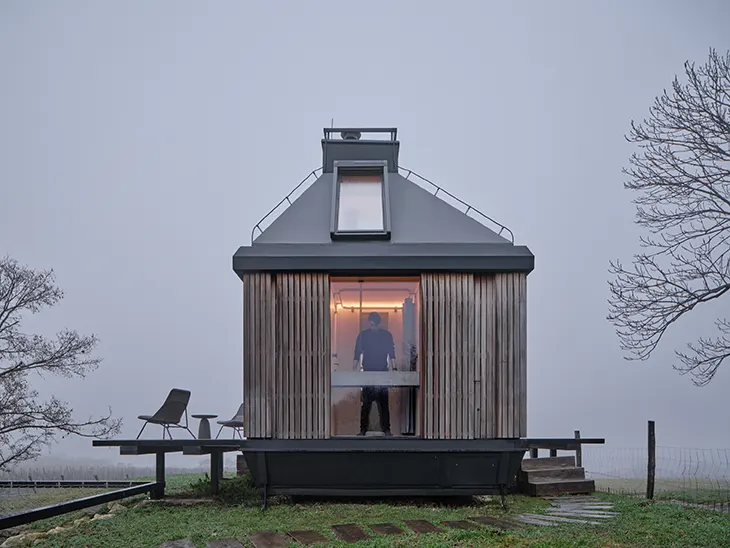
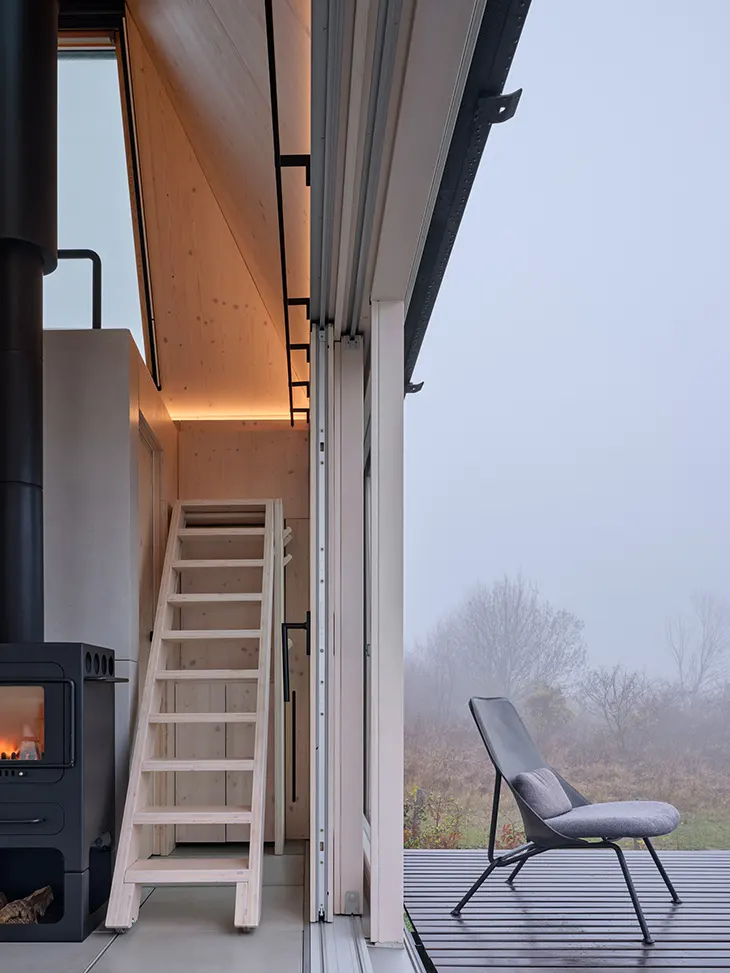
The terraces extend daily life outward, effectively multiplying the usable living area. When the openings remain fully deployed, the living space flows directly into the outdoor platforms, creating a continuous environment where interior and exterior operate as a single spatial experience. The architecture frames the surrounding vineyards while maintaining the sense of protection expected from a shelter positioned within an exposed hillside landscape.
Inside, the layout organizes functions in a compact yet clear sequence. The main living area occupies the central portion of the cabin, positioned to capture the strongest views. Behind this space sits a small kitchenette, followed by a bathroom equipped with a shower. One of the most deliberate design gestures appears in the bathroom, where a custom concrete sink sits directly within the window frame. The placement directs the user’s gaze toward the surrounding forest, turning an everyday routine into a moment of pause and reflection.
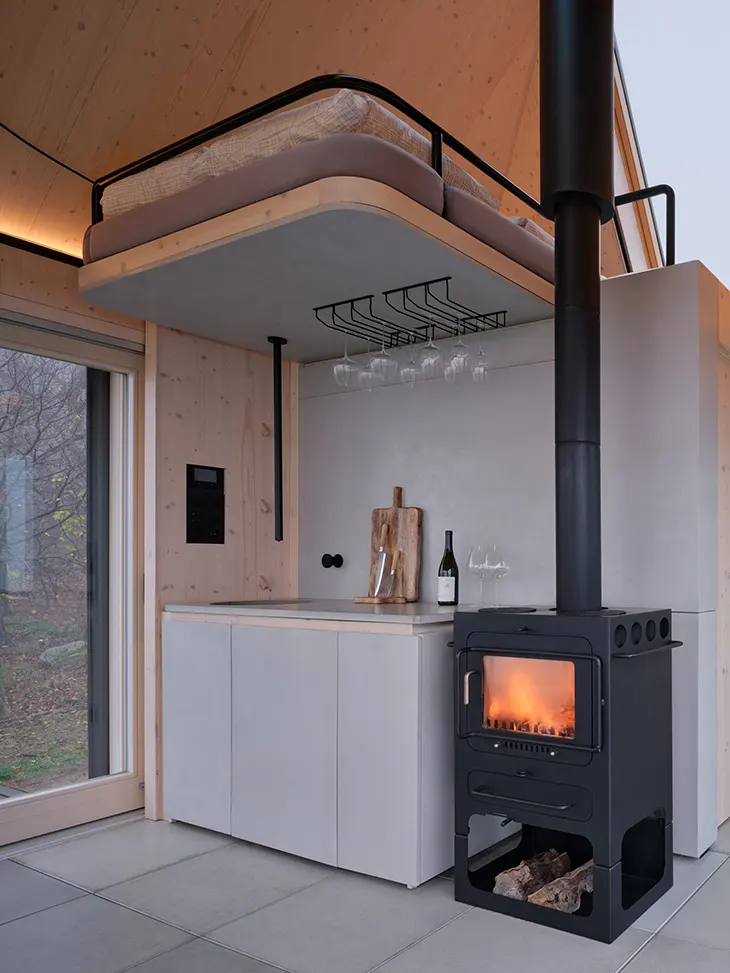
The spatial character changes as the cabin transitions into night mode. Suspended from the loft above, a pendant lamp hangs on a long cable. When pulled downward, the mechanism lifts the lamp upward and reveals a sleeping platform concealed during the day. This transformable element allows the interior to remain visually open while maintaining a discreet sleeping area. A retractable ladder integrated within the cabinetry provides access only when needed, eliminating the presence of a permanent staircase.
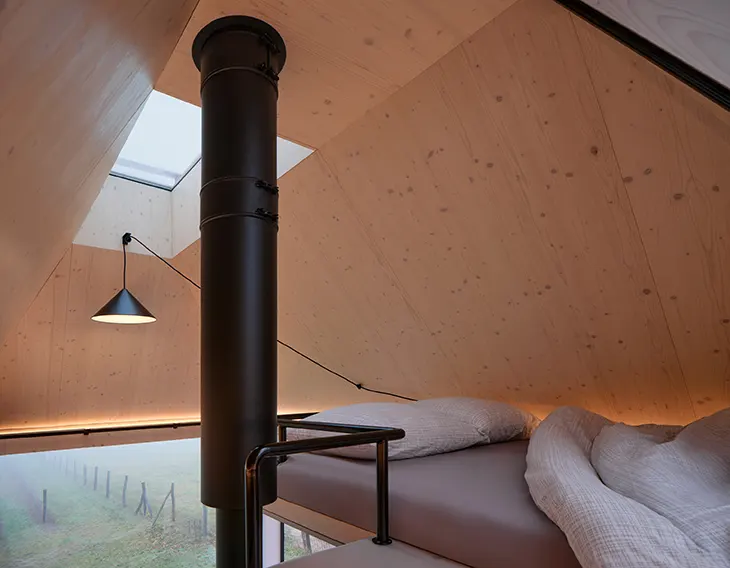
The loft introduces a different spatial atmosphere from the transparent ground floor. While the lower level remains defined by glass walls and open views, the sleeping area sits within a solid roof envelope that creates a sense of enclosure. A single skylight punctures this surface, framing the night sky and allowing occupants to observe the stars while lying in bed.
Cabin Devín operates as a fully off-grid structure throughout all seasons. Achieving energy autonomy within the regional climate required a carefully balanced technical system. Photovoltaic panels generate electricity that is stored in battery units, while a gas-powered backup system ensures reliability during periods of limited solar energy. Hybrid appliances shift automatically between electricity and gas depending on available battery capacity, allowing the system to prioritize electrical power for lighting and small devices.
Water infrastructure remains equally self-contained. A concealed reservoir beneath the raised floor stores service water, while a separate tank manages wastewater. The architects also developed strategies to control internal temperature throughout the year. During summer months, the cabin draws cooler air from beneath the northern side of the floor and expels warmer air through a heat recovery unit placed beneath the skylight. In winter, the airflow reverses direction, with CO₂ and humidity sensors regulating ventilation to maintain stable interior conditions.
Despite its limited dimensions, Cabin Devín offers a spatial experience that extends beyond its compact footprint. Through the integration of movable terraces, adaptable interiors, and autonomous infrastructure, Ark-shelter and ARCHEKTA transform a small structure into a complete retreat embedded within the landscape. The result functions as a compressed architecture of experience where minimal volume supports a rich connection with place, climate, and daily ritual.