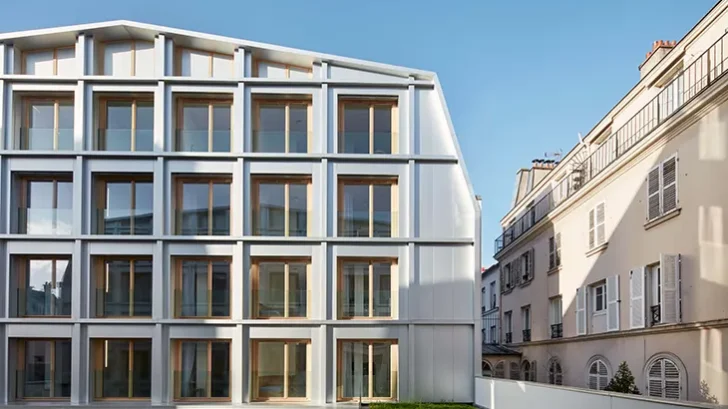

In Paris’s 17th arrondissement, NZI Architectes have completed the transformation of an obsolete car park into a social housing residence at 29 rue Nollet, delivering 83 housing units for the Régie Immobilière de la Ville de Paris (RIVP). Completed in December 2025, the project reconsiders the future of urban infrastructure by working within the constraints of an existing structure rather than erasing it, turning a nearly century-old garage into a dense yet humane residential environment.
RESIDENTIAL
The site occupies a highly constrained urban block at the corner of rue Nollet and rue de la Condamine. Originally built in the 1930s, the former car park extended along the plot boundaries over four above-ground levels, with translucent façades bringing daylight into the parking decks. The concrete structure of the lower levels remained in good condition, while the upper floors featured a steel framework with generous ceiling heights. Surrounded on all sides by neighboring buildings and adjoining eight co-owned properties, the plot offered little visual depth and limited solar exposure. A conventional demolition-and-rebuild approach would have resulted in restrictive layouts governed by setbacks, increased overlooking, predominantly north-facing dwellings, and a significant environmental cost in waste and disruption.
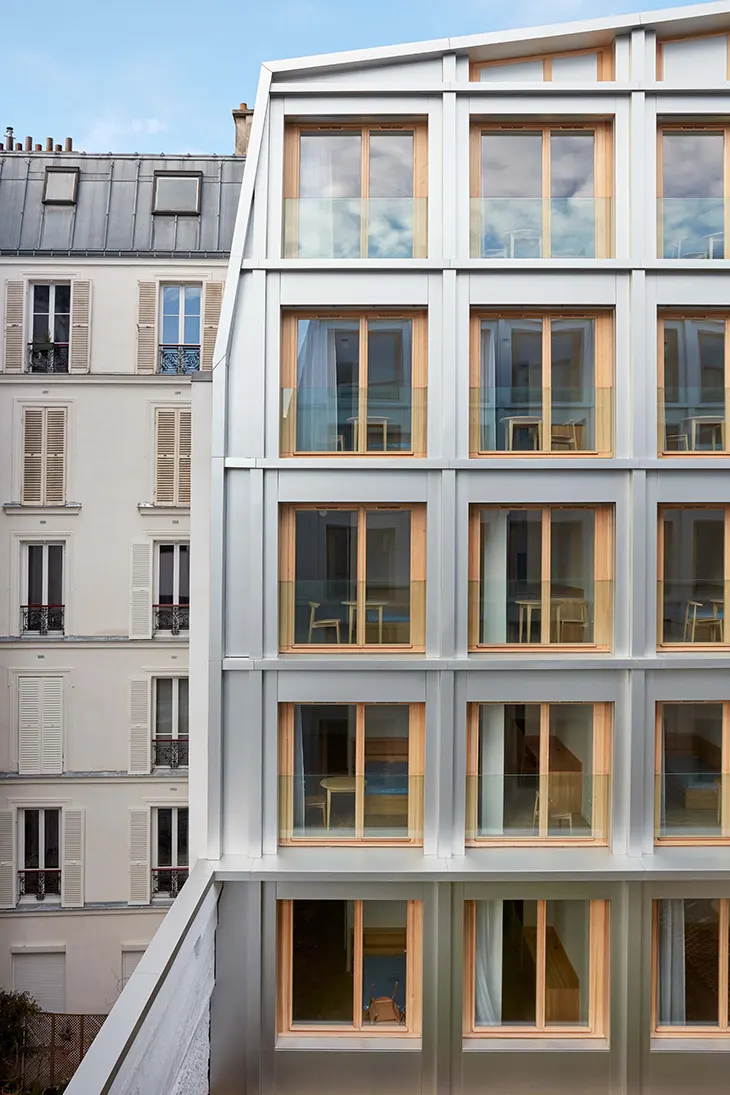
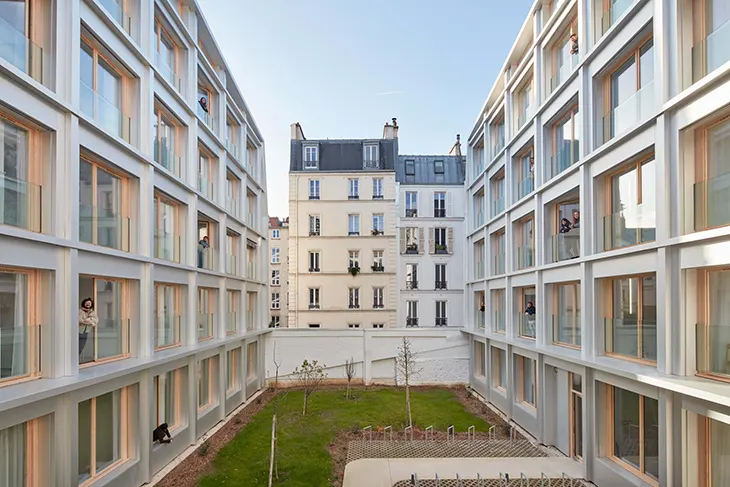
Instead, NZI Architectes adopted a strategy of selective demolition and careful insertion. By removing an entire structural bay along a north–south axis, the architects split the former garage into two distinct residential volumes and introduced direct sunlight deep into the heart of the block. This decisive move created a newly landscaped courtyard at ground level, restoring soil conditions and establishing a shared garden around which the life of the residence is organised. Circulation routes, common rooms, bicycle storage, and staff offices all open onto this courtyard, ensuring that collective spaces benefit from natural light and visual connection to greenery.
Within the retained envelope, the project inserts two new residential buildings in addition to the street-facing structure, accommodating 83 studio-type units (T1, T1 bis, and T1’). The two inner buildings are set more than 14 metres apart, improving daylight access and privacy while offering residents views across the planted courtyard. Importantly, the intervention also benefits neighboring properties: the new north–south opening creates deeper visual corridors within a previously enclosed block, all without exceeding the existing R+4 height.
Material and structural choices reinforce the project’s logic of reuse and continuity. The original garage structure and steel trusses were preserved, maintaining a tangible memory of the site’s former use. New volumes follow the rhythm of the existing framework rather than competing with it. The street-facing building, by contrast, was fully reconstructed using CLT timber panels for walls and partitions, insulated with wood fibre, and fitted with timber window frames. Its roof was renewed with standing-seam metal, replacing the original tiles and giving the façade a quieter, contemporary presence.
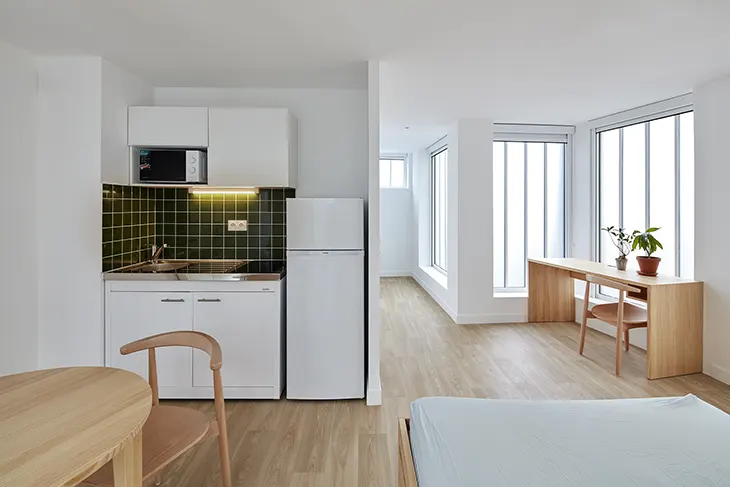
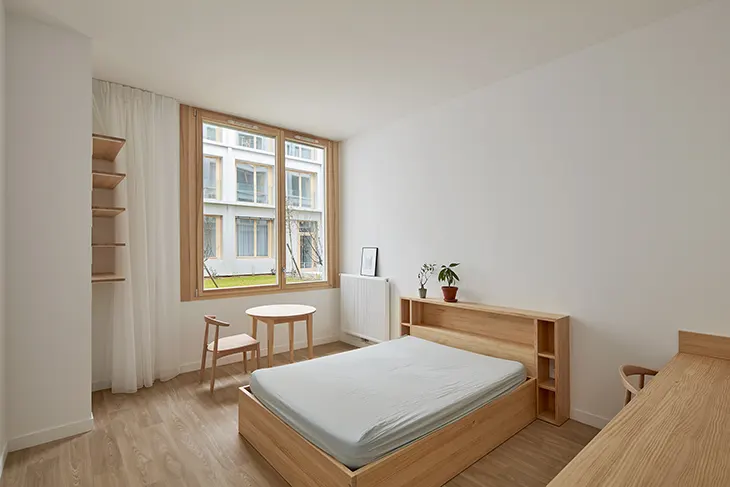
Housing layouts are deliberately straightforward, prioritising clarity and comfort. All units are oriented east–west, facing the courtyard, and none are exposed to a purely north-facing orientation. Despite compact sizes—ranging from approximately 18 to 33 square metres, the apartments benefit from generous daylight, controlled views, and efficient plans. Five percent of the units are designed for accessibility at ground level, integrated seamlessly into the overall scheme.
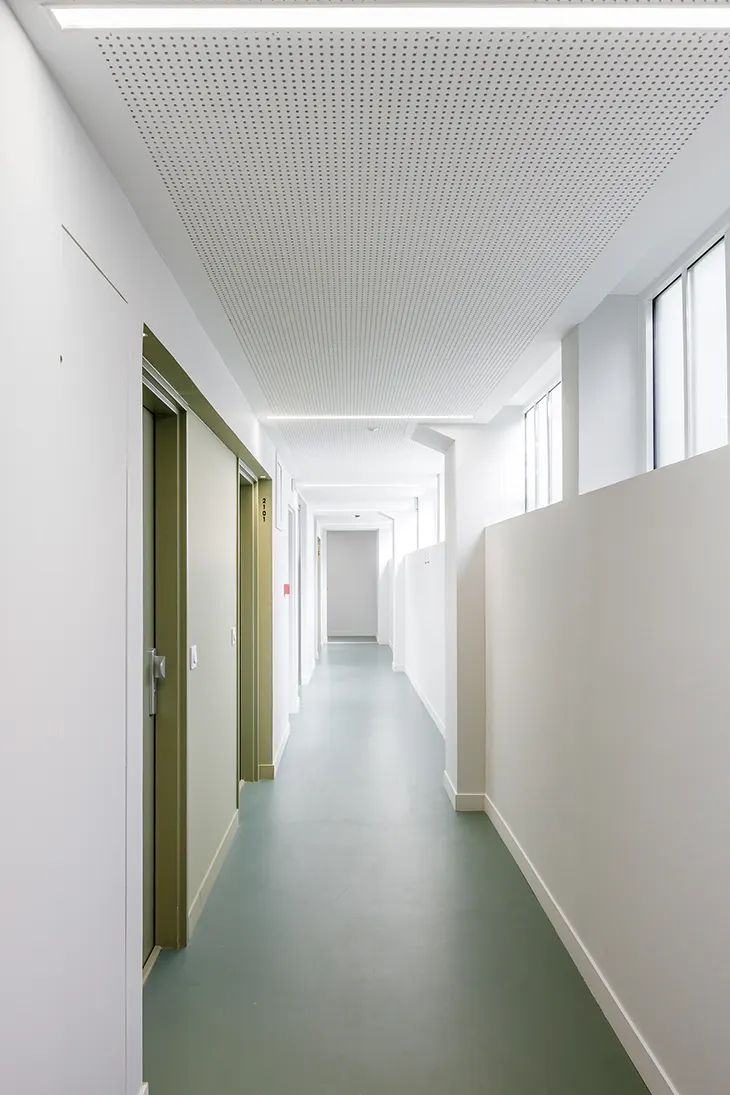
Circulation plays a central architectural role. Entrances to the residential programme and the ground-floor activity space are clearly separated along rue Nollet, while the entrance hall offers a visual axis through to the courtyard beyond, immediately revealing the depth of the site. All circulation spaces are naturally lit, reinforcing a sense of openness uncommon in high-density social housing. Shared amenities are positioned along daily routes: the laundry room, considered a key social space, receives daylight; waste storage aligns with exit paths; and the common room remains easily accessible from the entrance hall. Each building is served by a naturally lit stairwell and elevator, while the renovated basement accommodates technical rooms, storage, and changing facilities.
By working within the existing structure and envelope, the project achieves strong environmental performance, earning NF Habitat HQE Effinergie Rénovation, E3C1, and a Bio-based Building Label Level 1, while meeting BIM Level 2 standards. With a budget of €9 million, the conversion demonstrates how adaptive reuse can address housing needs while reducing environmental impact.
Rather than treating the former car park as an obstacle, NZI Architectes positions it as an opportunity. The project at rue Nollet shows how careful subtraction, structural intelligence, and attention to shared space can turn an obsolete piece of urban infrastructure into a livable, light-filled social housing environment, one that improves not only life within its walls, but also the spatial quality of the surrounding block.