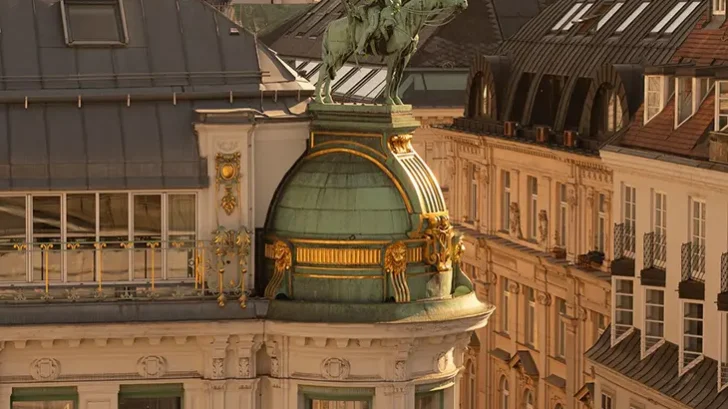

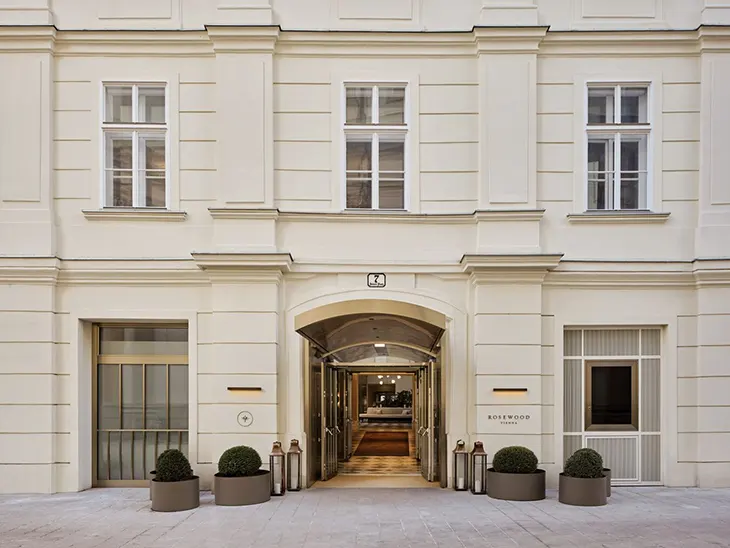
Rosewood Vienna occupies a restored 19th-century structure in the city’s Old Town, where the project approaches architecture as a process of recalibration rather than replacement. Designed by Viennese firm BEHF Architects, led by Armin Ebner, Susi Hasenauer, and Stephan Ferenczy, the development brings together four historic buildings into a single, continuous system. Completed in 2022, the project preserves the original Neoclassical façades while reorganizing the interior to support a contemporary spatial program.
HOTELS
Inside, the project organizes space through a sequence of rooms that shift in scale and atmosphere, moving from public areas toward more contained environments. This progression relies on surface treatment and object placement rather than structural excess. In Salon Aurelie, a hand-painted mural defines the perimeter, creating a continuous visual field that directs attention across the room. Crystal chandeliers by Lobmeyr distribute light with precision, while Backhausen textiles introduce texture without disrupting spatial coherence. A ceramic installation references the Danube, embedding geographic context directly into the interior language.
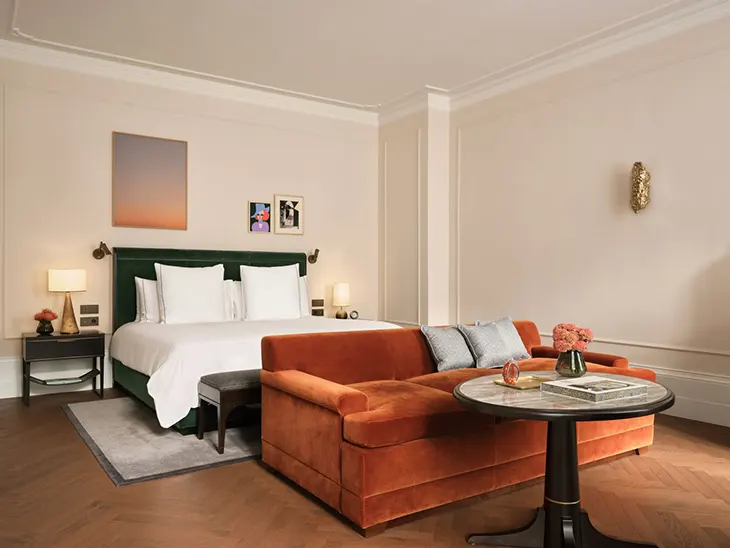
Material selection anchors the design. Rather than relying on contrast, the project builds continuity through repetition and variation within a controlled palette. Textiles, glass, and ceramic elements operate as carriers of local identity, each integrated into the architecture rather than applied as decoration. This approach allows the interior to maintain a clear structure, where objects reinforce spatial definition instead of competing for attention.
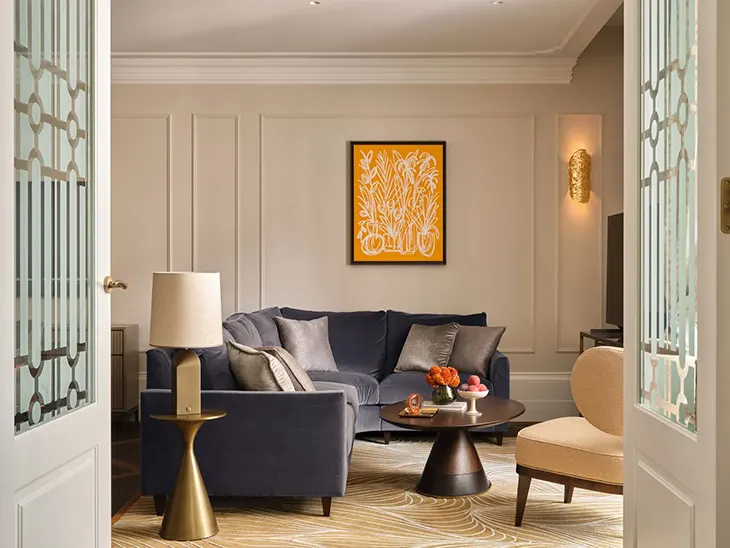
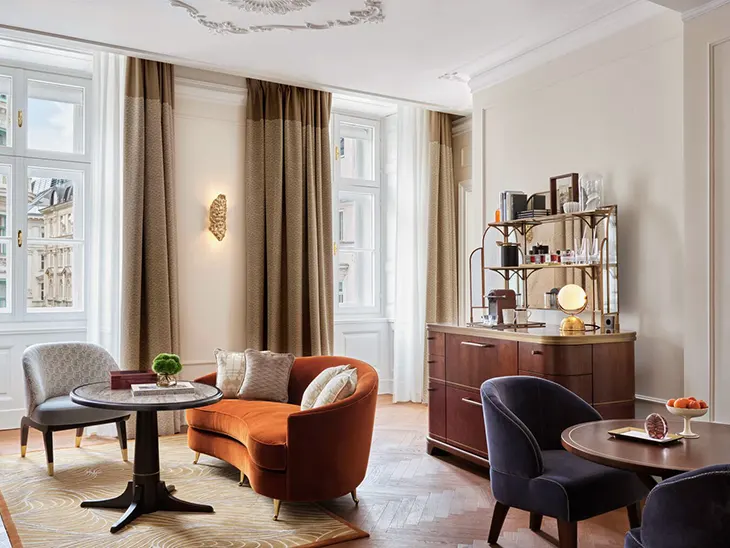
The layout of rooms and suites extends this logic into private space. Each unit follows a measured arrangement that prioritizes proportion and circulation, allowing movement to define how the space is read. Furniture placement aligns with architectural lines, reinforcing a sense of order that connects back to the building’s original geometry. The design avoids fragmentation, maintaining continuity across thresholds and transitions.
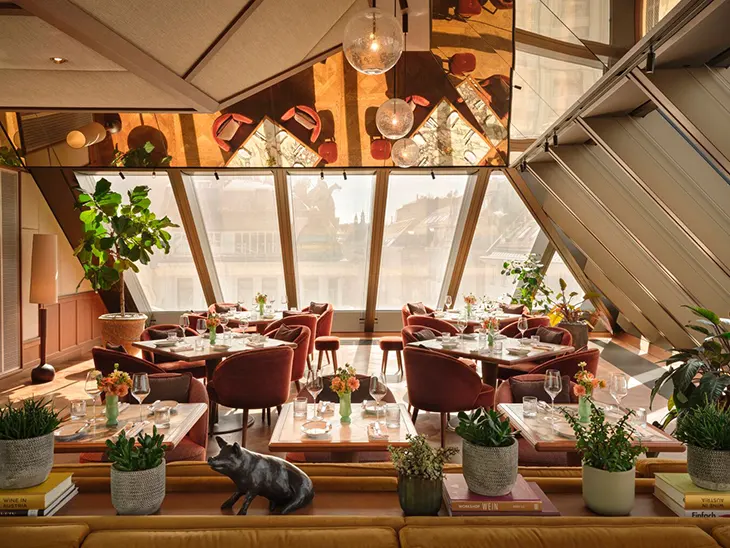
Vertical movement through the building leads to a series of upper-level spaces where architecture engages directly with the city. A rooftop garden and restaurant introduce open views across Vienna, positioning the project within its broader urban context. These spaces extend the interior sequence upward, where boundaries between inside and outside shift through framing, elevation, and light.
Wellness and event areas continue the project’s focus on controlled environments and defined atmospheres. The spa introduces enclosed, low-stimulus spaces that prioritize sensory calibration through light, material, and proportion. Event spaces such as The Pavilion and Salon Aurelie maintain flexibility while preserving architectural identity, allowing the layout to adapt without losing clarity. The Garden Room and its adjoining terrace extend this framework outward, linking interior composition with external space through a measured transition.