
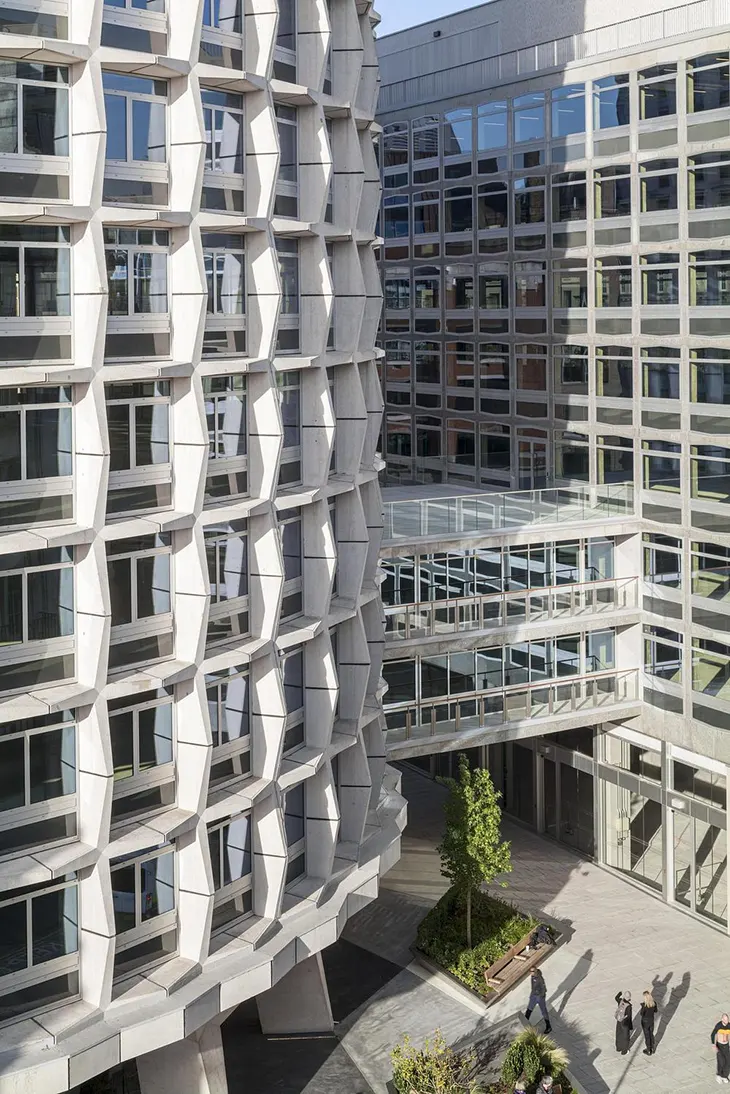
Space House stands as one of London’s most recognisable expressions of postwar commercial architecture. Designed in 1968 by Richard Seifert and Partners, the Grade II–listed complex occupies a prominent site in Covent Garden, defined by its cylindrical tower set on Y-shaped columns, an adjoining rectilinear block, and a connecting bridge. Now, following a major retrofit and extension by Squire & Partners for Seaforth Land and QuadReal, the building re-enters the city as a contemporary workplace anchored in its original architectural identity.
OFFICES
For more than five decades, Space House served a single occupant, the Civil Aviation Authority, before being vacated in 2019. Previous refurbishments had layered new interventions over the original structure. Squire & Partners approached the project by carefully removing those later accretions, allowing the clarity of Seifert’s design to re-emerge while introducing new additions calibrated to current patterns of work, access, and public use.
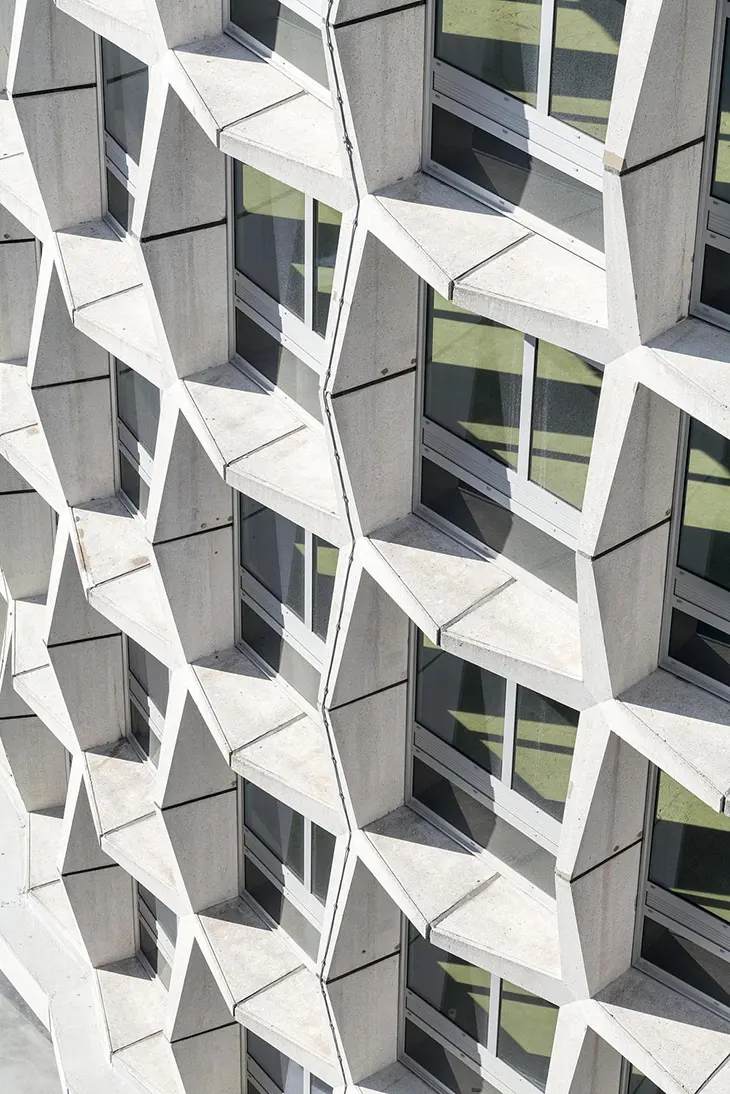
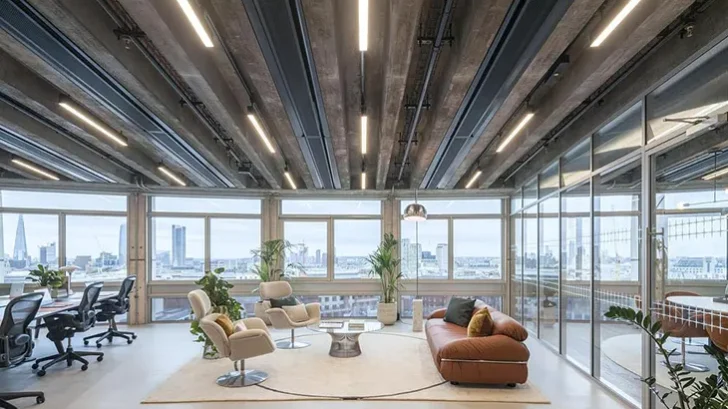
The reimagined Space House delivers approximately 255,000 square feet of office accommodation alongside flexible retail space at ground level and a transformed public realm. The intervention extends both principal elements of the complex. Two additional office floors were added to the cylindrical tower, now rising to seventeen storeys, while a single-storey extension enhances the rectilinear block. The tower extension resolves previously exposed rooftop plant and reinstates the original intention of a recessed top floor, now paired with a 3,600-square-foot roof terrace. In the block, a new eighth floor introduces shared meeting spaces and a tenant clubhouse with a bar and a 5,000-square-foot terrace.
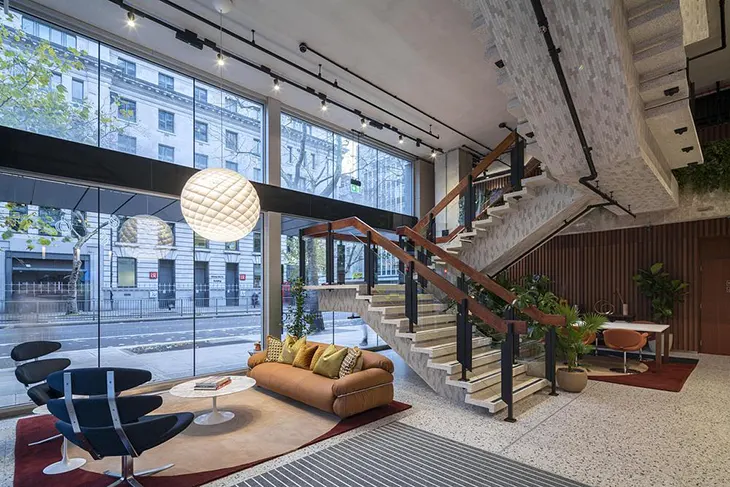
Arrival sequences reinforce the building’s civic presence. The tower opens into a double-height lobby that sets the tone for the circular, column-free office floors above, each spanning roughly 10,000 square feet. Abundant daylight fills these spaces, with the upper levels offering uninterrupted 360-degree views across London. Within the block, a more intimate lobby leads to eight levels of workspace. A sky bridge links the two buildings on the first and second floors, forming continuous work environments, while a landscaped terrace occupies the third.
Internally, the workplace strategy emphasizes visual connectivity and flexibility. Long sightlines support collaborative working, while loft-style interiors feature polished concrete floors within office spaces. Common areas introduce new terrazzo finishes, paired with carefully restored original mosaic tiling in the stair cores. These material decisions maintain a clear dialogue between the building’s mid-century origins and its renewed function.
A significant part of the transformation addresses the building’s relationship to mobility. Originally designed in an era shaped by car use, Space House now redirects that infrastructure toward contemporary needs. One of the original basement ramps has been retained to provide cycle access, while the former car park now accommodates storage for approximately 600 bicycles alongside showers, lockers, drying rooms, and changing facilities. A void introduced into the two-storey basement creates 16,500 square feet of flexible double-height event space.
Environmental performance forms a central pillar of the project. Space House has achieved BREEAM Outstanding, making it the largest Grade II–listed building in the UK to do so. The existing façade’s deep articulation supports passive shading, while envelope upgrades bring thermal performance to current standards. New building services rely on air source heat pumps, with bespoke chilled beams integrated seamlessly into the existing radial ceiling coffers. The building also holds Fitwel 2-star and WiredScore Platinum certifications, supporting both occupant wellbeing and digital connectivity.
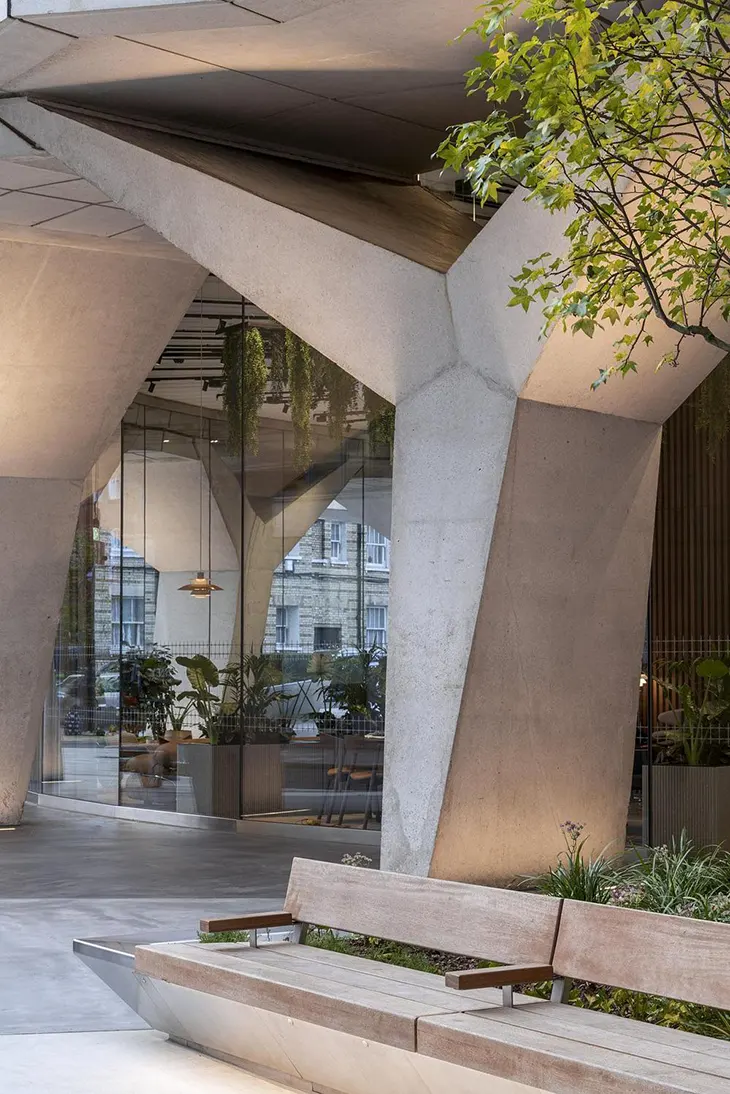
At street level, the project reclaims previously private space for public use. A former car park between the two buildings now connects ground-floor retail units, while an existing petrol station canopy has been enclosed to form The Filling Station café, opening the base of the tower to everyday activity.
Through careful restoration and calibrated extension, Space House demonstrates how a robust brutalist structure can adapt to contemporary demands without losing its architectural clarity. The project positions reuse as a civic and environmental strategy, extending the life of a significant twentieth-century building while redefining its role within London’s evolving workplace culture.