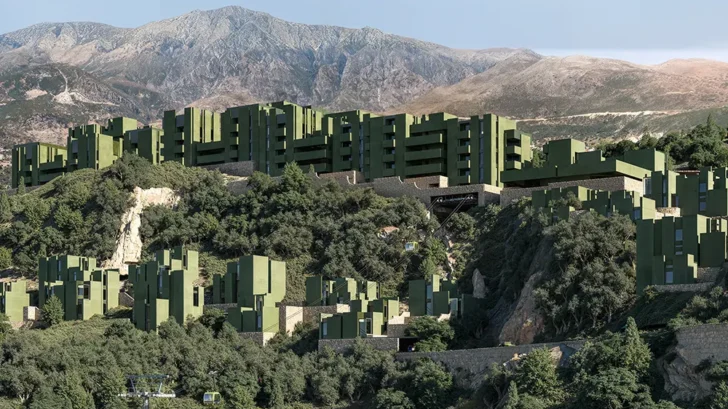

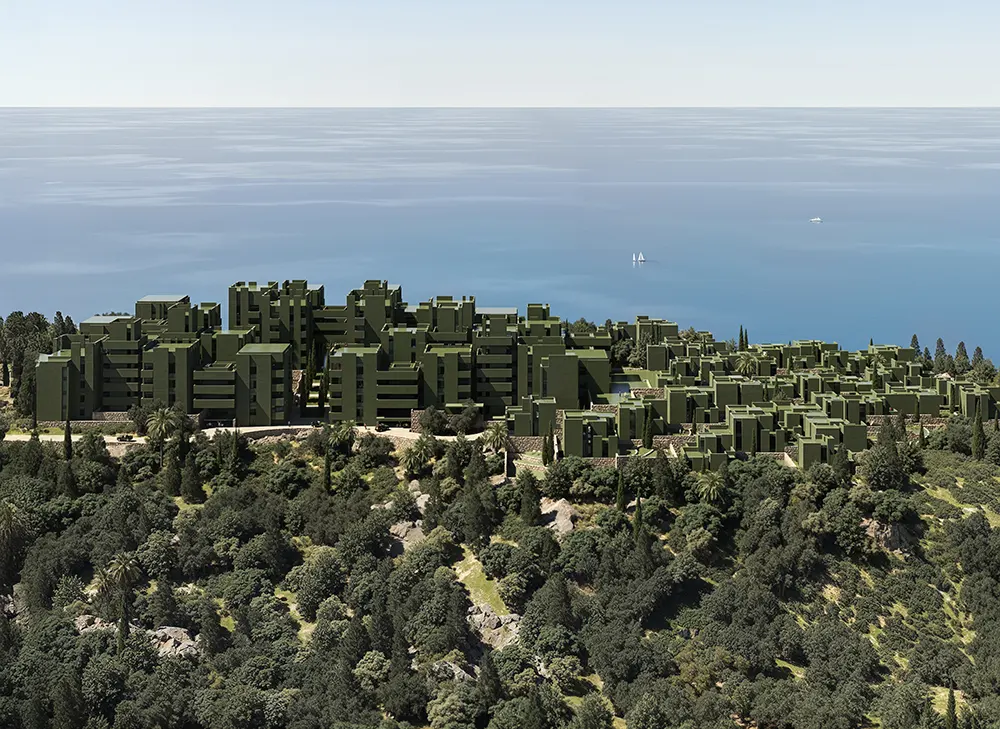
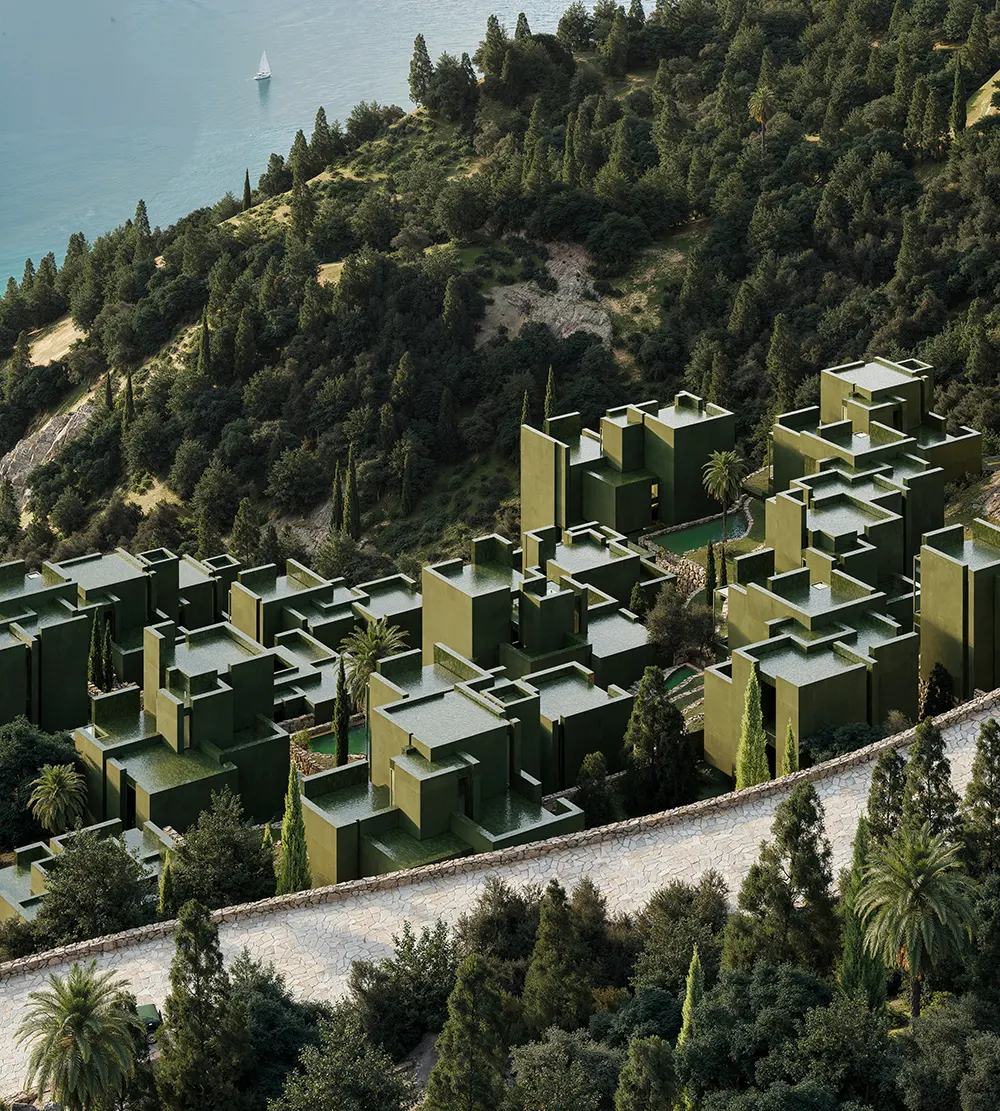
The Veil introduces a large residential program into the forested coastline of Dhërmi, where development has remained limited due to steep terrain and dense vegetation. Bofill Taller de Arquitectura approaches the site with a distributed strategy that avoids concentration. Instead of consolidating volume, the project disperses 366 apartments and 77 villas across two plots, organizing them into sixteen typologies that align with the natural contours.
This approach defines the project’s spatial structure. Buildings sit on platforms that respond to the slope, reducing the need for excavation and allowing the ground to remain largely intact. The architecture does not attempt to flatten or reshape the site. It adapts to it, producing a fragmented composition that maintains continuity with the landscape. The idea of a “veil” emerges through this distribution, where built form appears lightly placed across the terrain.
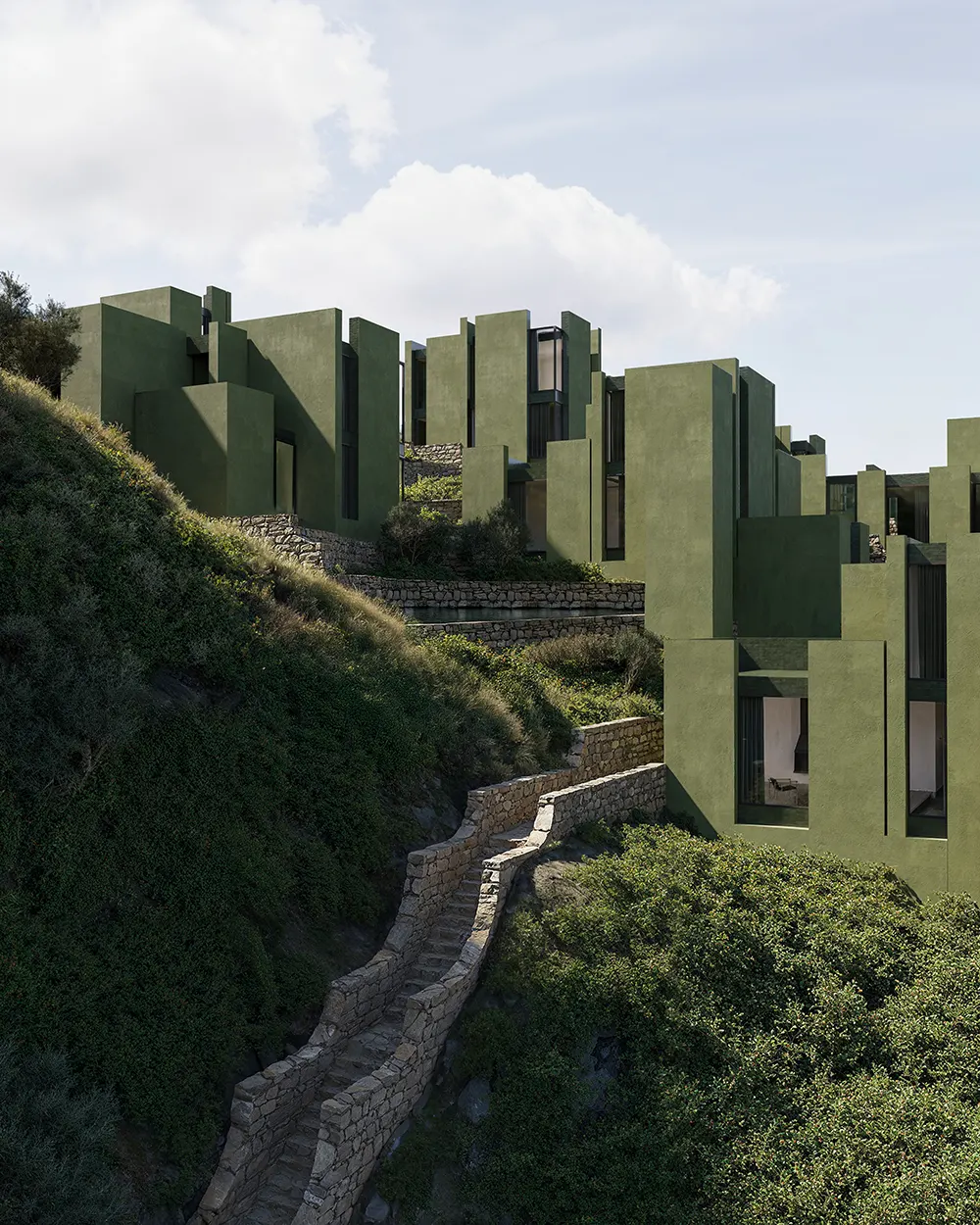
Circulation reinforces this reading. A network of paths and stairs constructed from locally sourced stone connects the development. These routes step with the land, establishing a clear movement system without introducing large infrastructural elements. The material palette draws from the immediate environment, with four tones selected through direct sampling. This decision anchors the project visually, allowing circulation to integrate with the terrain rather than stand apart from it.
The relationship with vegetation remains central. Existing trees guide the placement of buildings, while other plant life remains largely untouched. This produces a layered spatial condition where architecture and landscape operate simultaneously. Residential units rise within the forest, positioned to capture views of the Adriatic while maintaining permeability at ground level. Openings, terraces, and pools extend outward, ensuring that interior spaces remain connected to the surrounding environment.
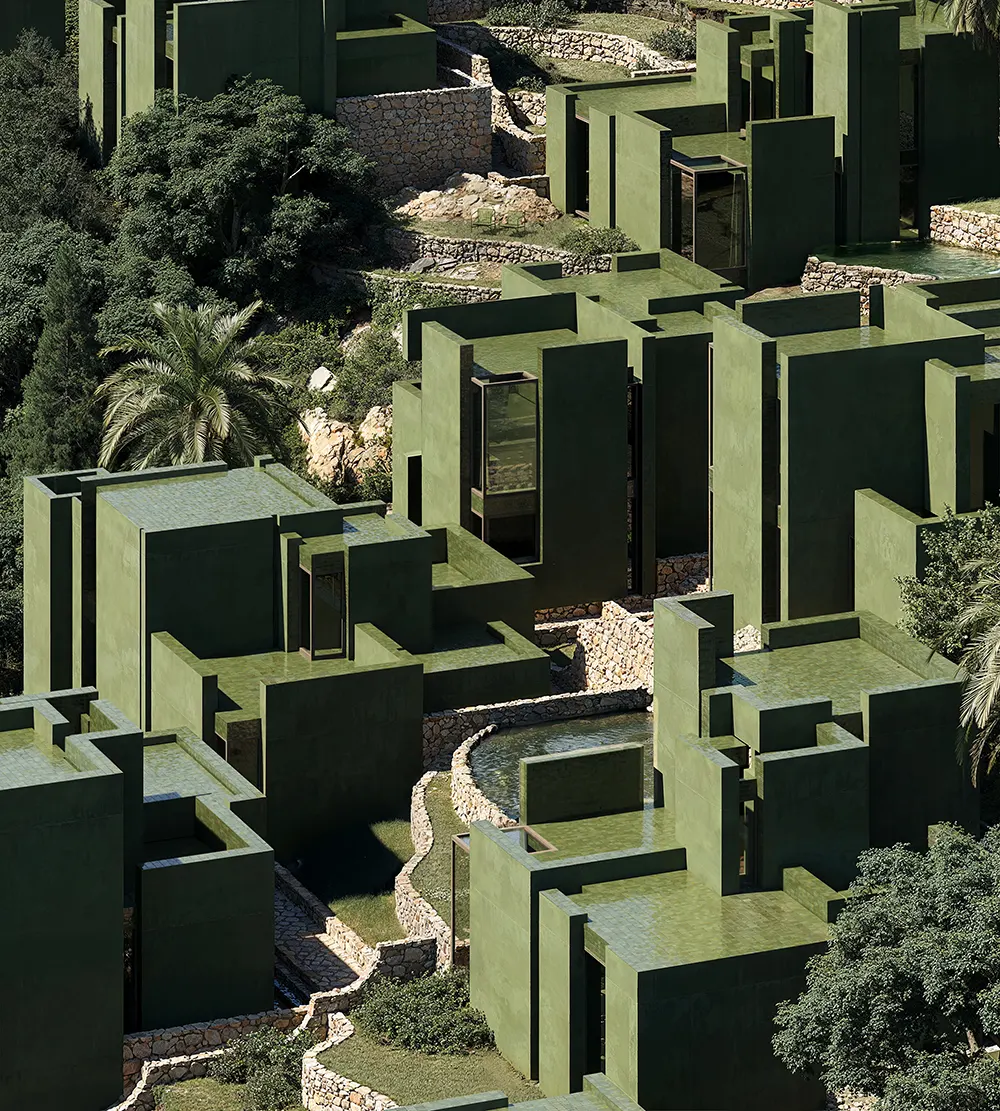
Facade treatment supports this integration. Concrete and glazed ceramic tiles define the exterior surfaces, introducing controlled variations in light reflection. The buildings shift in appearance throughout the day, responding to changing conditions rather than presenting a fixed image. This strategy reduces visual contrast and allows the development to recede within its context.
A central communal structure organizes shared functions, including social and recreational spaces. Its courtyard introduces a curved geometry that contrasts with the orthogonal layout of the residential volumes. The form adjusts around a group of existing trees, placing them at the center of the space. This moment clarifies the project’s priorities, where the landscape dictates the configuration of architecture.
Led by Pablo Bofill with design principals Hernán Cortés and Alborz Mohammadi, the project maintains a consistent framework across its scale. Landscape design by Vivian Rotie and technical development by Bàrbara Gimeno support a coordinated approach where each element aligns with site conditions. The involvement of an extensive team reflects the complexity of the development, yet the outcome remains controlled.
The Veil operates through calibration rather than assertion. It introduces density into a sensitive environment while attempting to maintain the structure of the forest. Its effectiveness depends on execution, where the balance between built form and landscape must remain precise. The project sets a clear direction, relying on distribution, material alignment, and measured intervention to define its architectural position.