
SPECTACLE Bureau for Architecture and Urbanism has developed the Museum of Aboriginal Peoples’ Art and Artifacts, or MOAPAA, for the Portage College campus in Lac La Biche, Alberta. The 1,630-square-meter project will house the most extensive collection devoted to the complete group of artists associated with Professional Native Indian Artists Inc. (PNIAI), founded in Winnipeg in 1973. The museum remains in schematic design and fundraising, with completion anticipated for 2030.
CULTURAL
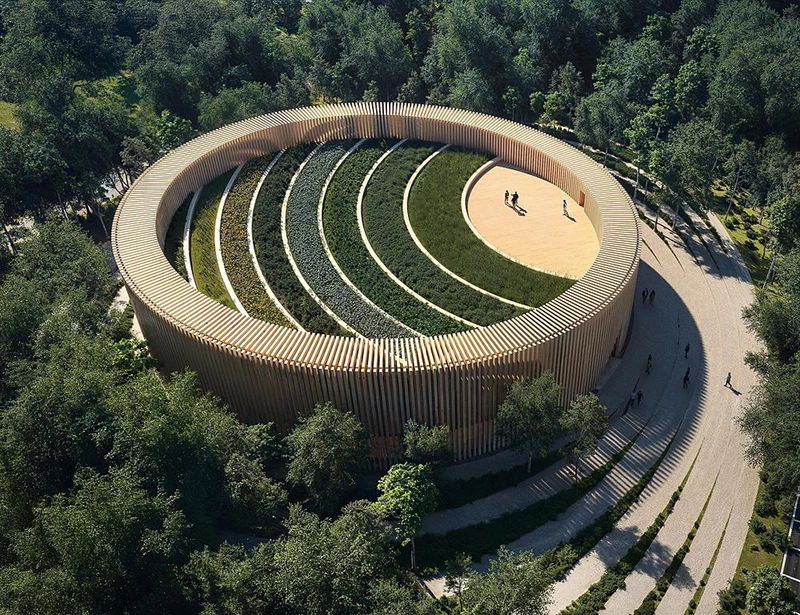
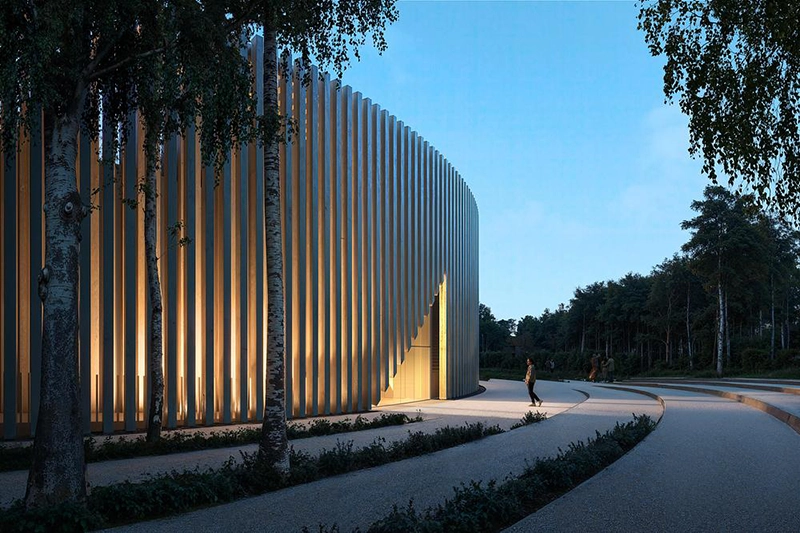
The design begins with the site and its relationship to the seven historic members of PNIAI: Jackson Beardy, Eddy Cobiness, Alex Janvier, Norval Morrisseau, Daphne Odjig, Carl Ray and Joseph M. Sánchez. Seven nested elliptical paths surround the building, with each path corresponding to one artist. Their paths intersect at public areas near the entrance and sculpture garden, while sculptures by Indigenous artists will mark each route. SPECTACLE also proposes extensive planting of Trembling Aspen trees to restore local biodiversity.
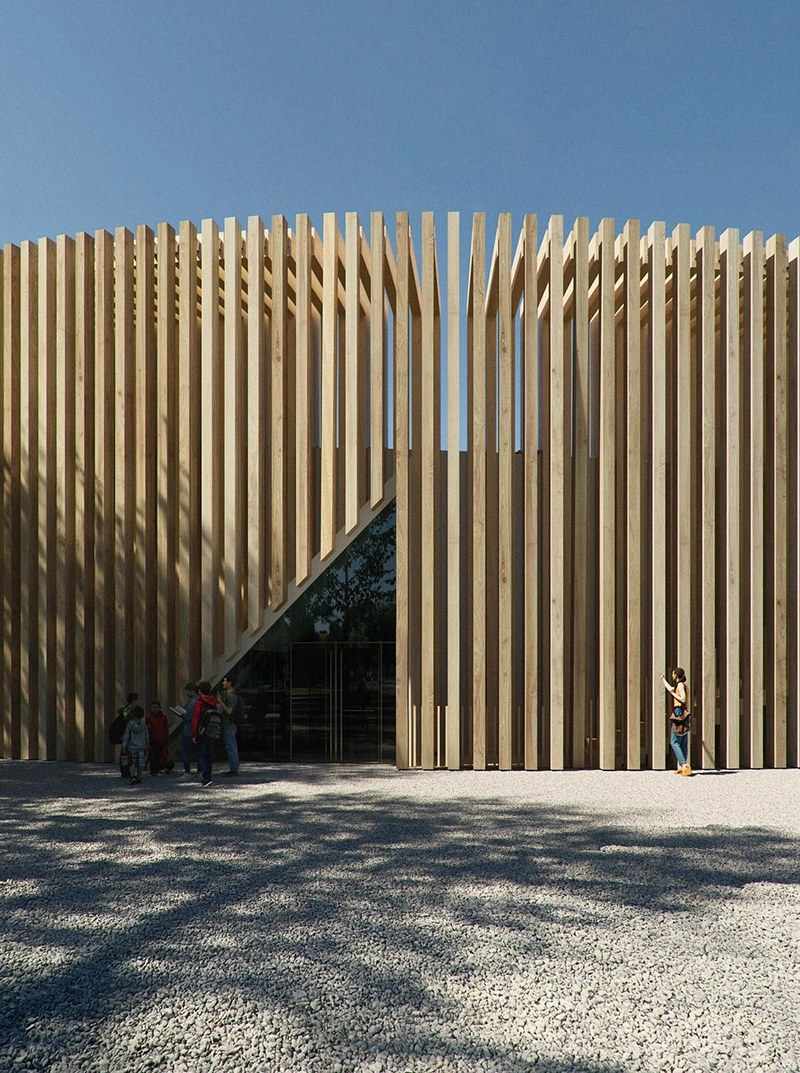
The building extends this relationship between art and the natural setting through its exterior envelope. A kinetic timber screen wraps the museum with slender vertical elements hinged from above. Wind causes the slats to sway, creating changing light conditions along the perimeter while visually relating the facade to the Aspen trees planted throughout the site. Behind the screen, a ramp rises toward a roof garden planted with sage, sweetgrass, prairie flowers and other healing and ceremonial species. A timber deck at roof level provides gathering space for up to 60 people.
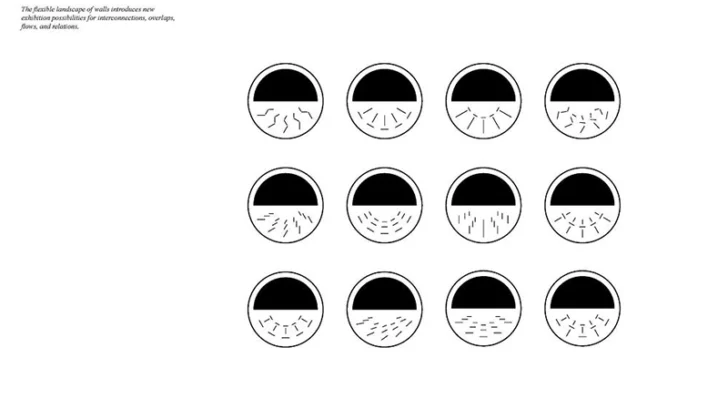
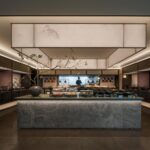
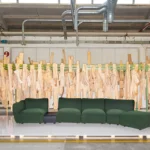
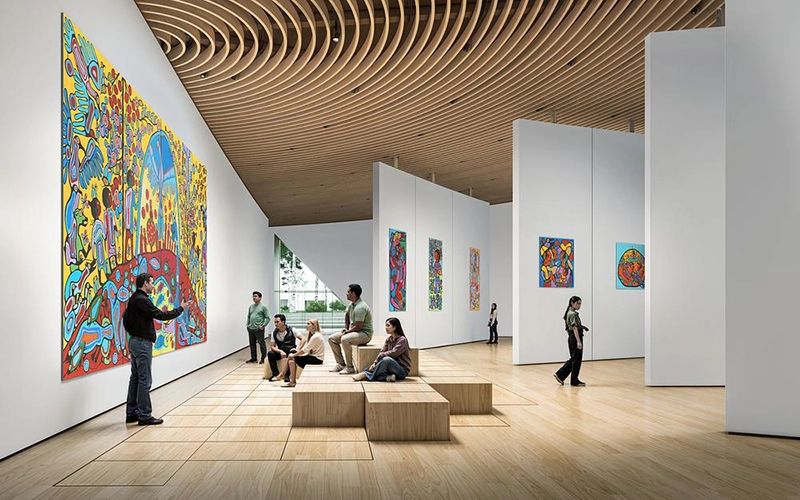
Inside, the architects reject the conventional fixed gallery in favor of an adaptable exhibition system. A retractable platform can operate as raked auditorium seating, individual benches or sculptural plinths before disappearing into the floor when exhibitions require an open gallery. Rotating and freestanding walls allow curators to reshape circulation and establish changing relationships between works. The auditorium extends directly from the foyer into the museum, while the absence of a conventional reception desk aims to reduce separation between visitors and staff.
Curved surfaces give the interior its spatial character. Variations in roof and ceiling height define galleries without relying on rigid room sequences, while retaining walls follow the slope of the planted roof above. The exterior ramp also uses changing views, light and shadow to connect circulation with the wider site. These elements support a museum model based on flexible use, informal gathering and varied approaches to viewing art.
Environmental performance forms another major part of the proposal. SPECTACLE specifies a superstructure constructed predominantly from locally and sustainably sourced mass timber. The building will use full electrification, heat recovery, ground-source heat exchangers and radiant heating to maintain stable environmental conditions with reduced emissions. The architects have also designed the collection-storage vault to survive a catastrophic forest fire even if fire destroys the primary timber structure, addressing an increasingly serious regional climate risk.
MOAPAA also reflects an Indigenous-led collaborative process. Artist and PNIAI founding member Joseph M. Sánchez serves as Chief Museum Curator, alongside Museum Director Donna Feledichuk and Portage College Elder and Pipe Holder Ruby Sweetman on the core client team. The proposal received a 2025 Canadian Architect Award of Excellence.
Through adaptable galleries, Indigenous planting, kinetic timber elements and resilient environmental systems, MOAPAA proposes a museum closely connected to the artists whose work it will preserve and present. Its architecture treats exhibition, gathering, education and the surrounding prairie as parts of one cultural institution shaped by the specific history and community of Lac La Biche.