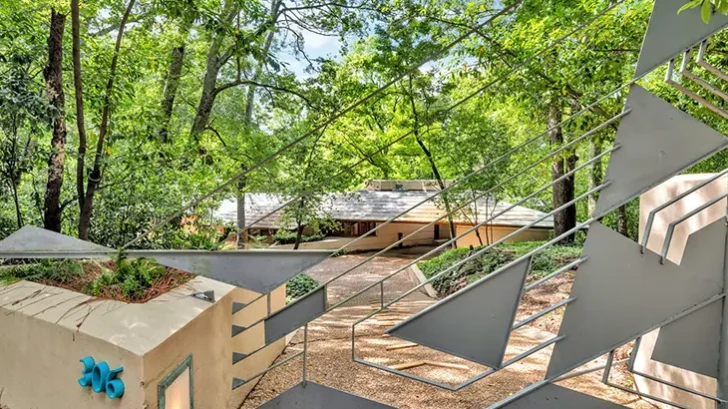

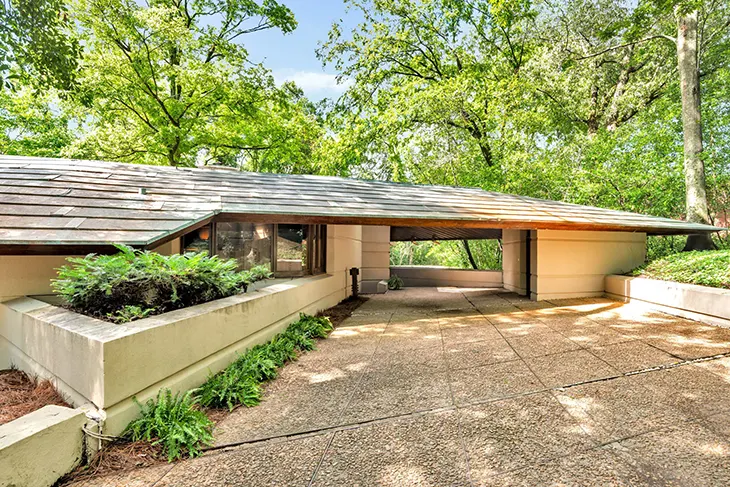
Set into the wooded slope of Jackson’s Fondren neighborhood, Fountainhead stands as one of the most disciplined and site-responsive houses in Frank Lloyd Wright’s late residential work. Designed in 1948 and completed in 1954 for J. Willis Hughes, the house belongs to Wright’s Usonian lineage, yet it departs from the notion of repetition or standardization. Fountainhead is a singular architectural composition, shaped entirely by its terrain, geometry, and material logic.
ARCHITECTURAL LANDMARKS
In November 2025, the Mississippi Museum of Art confirmed its purchase of Fountainhead, securing the future of the house after decades of private ownership. While the acquisition marks a significant institutional moment, the architectural value of the property remains rooted in the house itself: a fully realized Wright interior preserved largely intact. Under the Museum’s stewardship, the house will transition from private residence to public site, allowing direct engagement with a rare example of Wright’s late-career domestic architecture.
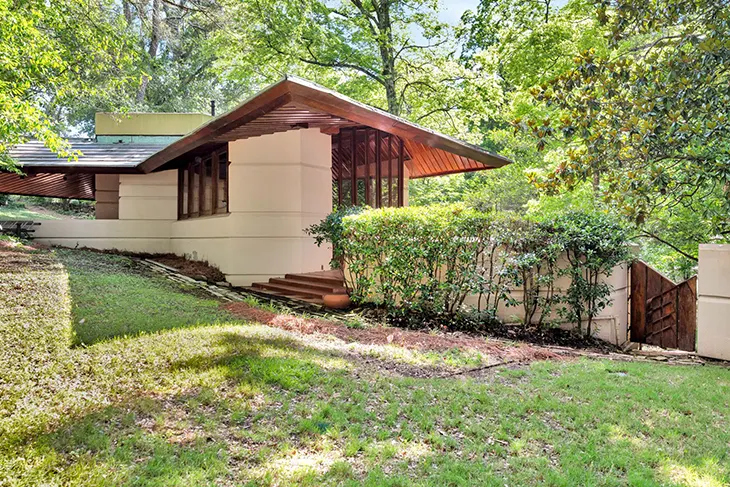
The design unfolds along a steep hillside, which determines both plan and section. Wright employed a parallelogram-based module that follows the contours of the land, embedding the house into the slope rather than flattening it. This geometry governs the placement of walls, ceilings, and circulation paths, producing interiors that expand and compress in measured sequence. Movement through the house follows diagonal lines, creating spatial shifts that feel calibrated and intentional rather than dramatic.
Material restraint defines the interior experience. Walls and ceilings are constructed entirely of Heart Tidewater Red Cypress, used without stud walls, paint, sheetrock, or applied finishes. Structure and surface merge into a continuous architectural envelope, reinforcing Wright’s pursuit of spatial unity. Large windows frame views of the surrounding trees, filtering daylight across the wood grain and allowing the interior atmosphere to shift subtly throughout the day.
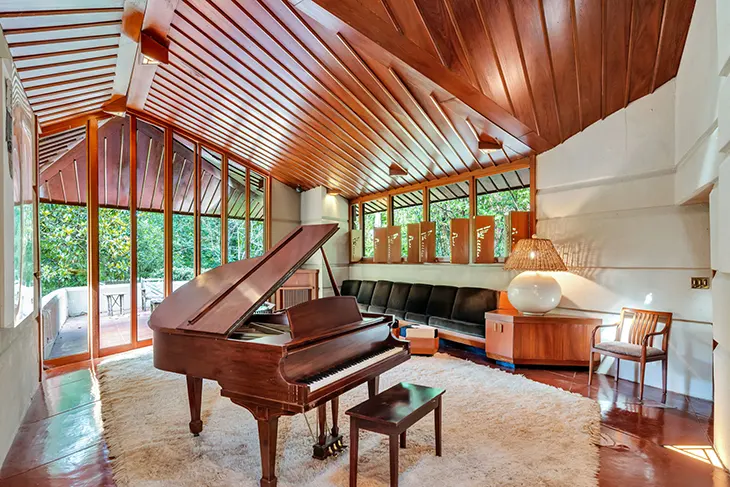
Built-in furniture further anchors daily life within the architecture. Seating, storage, shelving, and lighting were designed as fixed elements, eliminating visual clutter and reinforcing the house’s internal order. Fireplaces punctuate key spaces, while skylights introduce controlled shafts of light from above. The original copper-sheeted roof, wooden shutters, terraces, and carport extend the architectural language outward, maintaining coherence across the entire site.
One of Fountainhead’s most distinctive features emerges where architecture meets landscape. Wright extended the bedroom wing into the hillside, terminating it with a fountain that feeds into a swimming pool and then into a natural stream below. This sequence establishes water as a spatial and environmental element, reinforcing the house’s relationship to gravity, topography, and movement. The feature also contributed to the house’s alternate name, though its architectural clarity stands independently of literary associations.
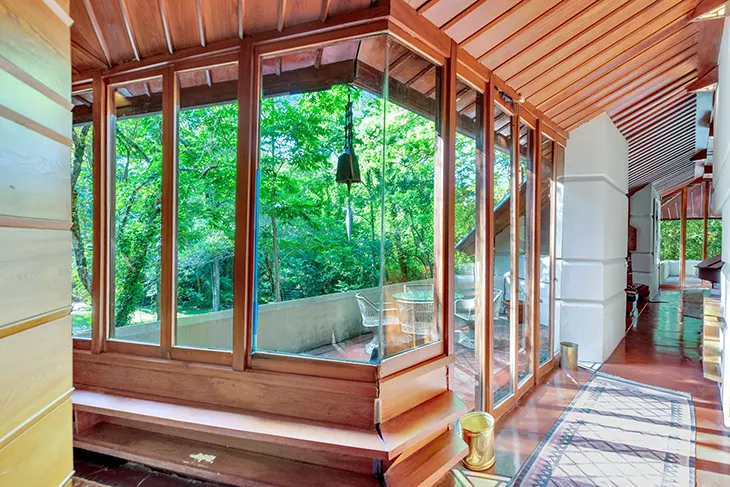
After the Hughes family, the house was acquired by architect Robert Parker Adams, who undertook a careful restoration that respected Wright’s original design while stabilizing the structure for long-term preservation. Listed on the National Register of Historic Places since 1980, Fountainhead has retained its material integrity and spatial precision, qualities that make it particularly instructive within Wright’s broader body of work.
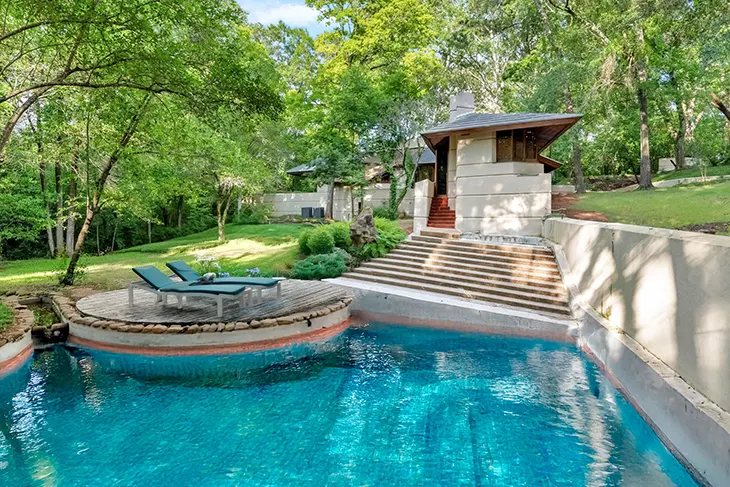
With its recent acquisition, the Mississippi Museum of Art positions Fountainhead as a public architectural resource, expanding access to a house long experienced only privately. The purchase supports future restoration and programming, yet the building itself remains the central focus: a late-career Wright house defined by geometry, material discipline, and a sustained dialogue with its landscape. As Fountainhead enters this new chapter, its architectural lessons remain intact, quietly reinforcing Wright’s ability to shape domestic space through clarity and control.