
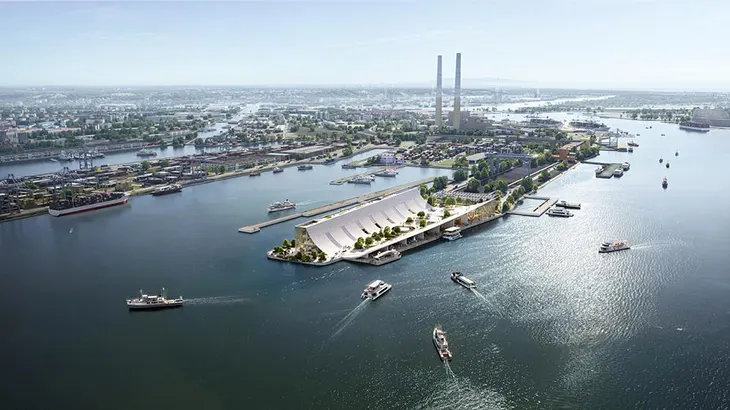
The Brise-Vent Havre Harbor Museum proposes a new civic role for an existing industrial structure along the historic waterfront of Le Havre. Developed by LYT-X Studio, the project approaches adaptive reuse as an active urban strategy, repositioning former port infrastructure as a public cultural facility embedded in the daily life of the city.
MUSEUMS
Rather than preserving the harbor structure as a static artifact, the project treats it as a spatial and infrastructural framework capable of supporting contemporary cultural use. The existing building remains the primary historical layer, while new architectural interventions extend its capacity for public access, circulation, and programmatic flexibility. Old and new are kept legible as distinct components, allowing the site’s industrial past to coexist with its proposed civic future.
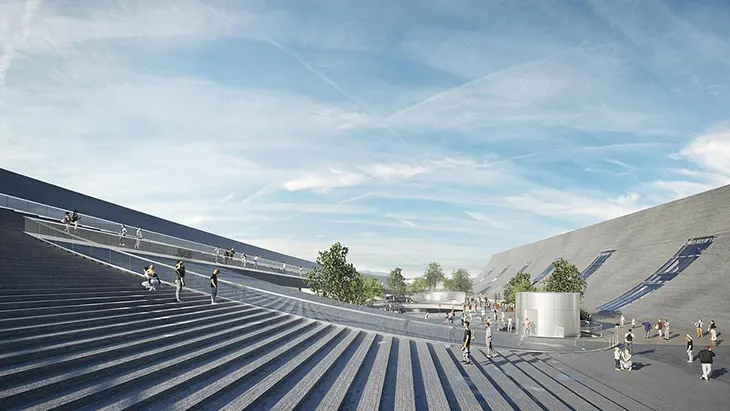
The museum is conceived as part of a continuous urban sequence connecting the city, the waterfront, and the harbor. Circulation routes cut across and through the structure, encouraging movement rather than containment. In this configuration, the project resists the idea of the museum as an isolated object and instead positions it as an extension of the waterfront’s public realm, accommodating both programmed cultural activities and informal everyday use.
A key architectural gesture is the extension of the existing curved roof into a long canopy running along the waterfront edge. This intervention organizes circulation, introduces shaded outdoor zones, and establishes a gradual transition between urban pathways and harbor activity. Beneath the canopy, semi-open public spaces and a sheltered courtyard allow access from both the city promenade and the water, reinforcing the museum’s role as a connective civic environment.
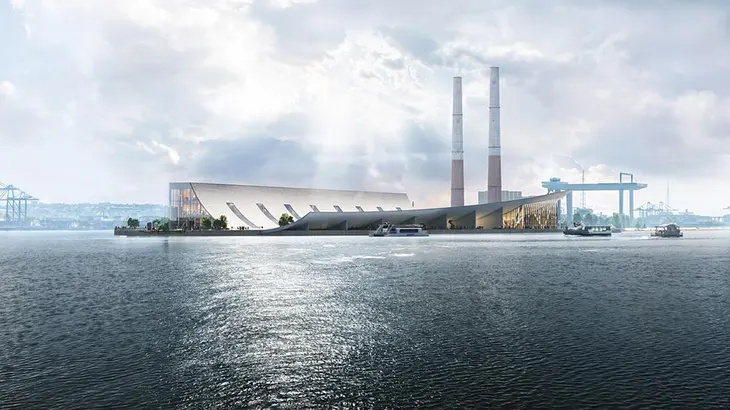
Public accessibility shapes the project’s spatial logic. The central courtyard remains open beyond museum hours, enabling the site to function as a public space independent of exhibitions or events. Interior and exterior thresholds rely on spatial continuity rather than visual transparency alone, allowing exhibition halls, performance spaces, and circulation areas to overlap with the rhythms of daily urban movement.
The program includes permanent and temporary exhibition halls, a performance hall, flexible event spaces, a public plaza, and direct connections to the waterfront dock. Interior layouts emphasize clear orientation and visual links to the harbor, maintaining a constant relationship between cultural activity and the maritime context that defines the site.
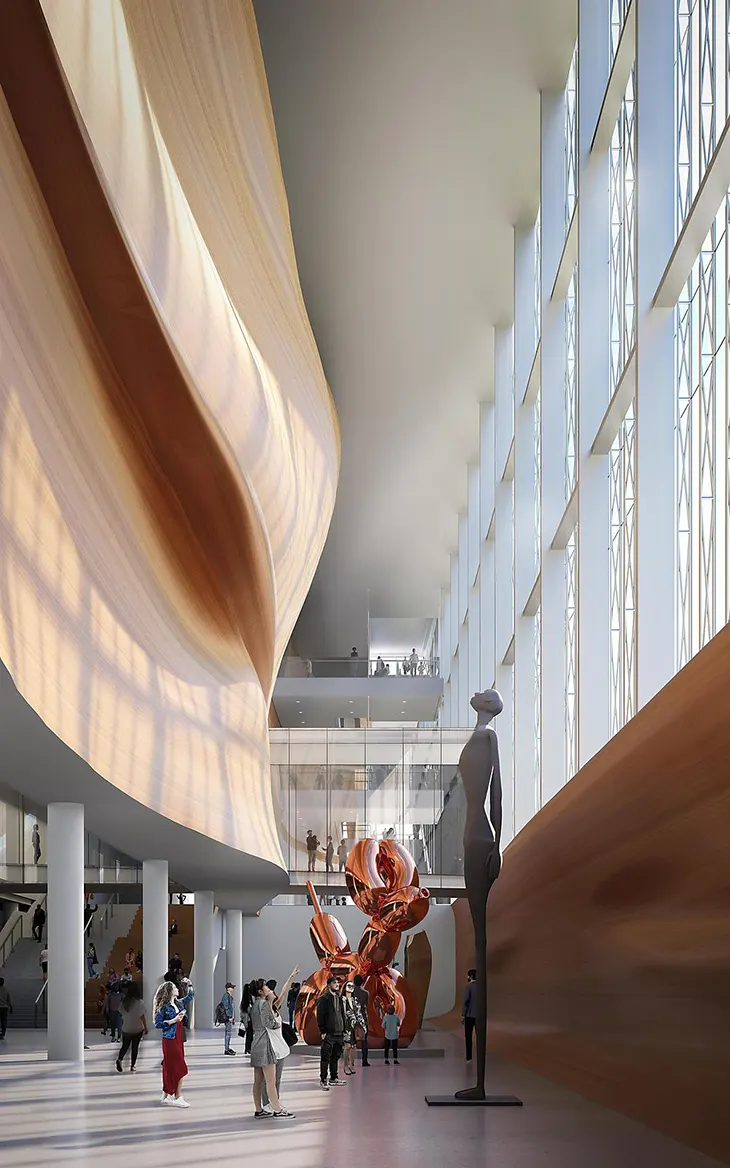
Environmental strategies are embedded through the reuse of the existing structure and a reduction in new construction. The extended roof canopy provides passive shading and helps moderate microclimatic conditions along the waterfront. Courtyards and roof openings introduce daylight, while ventilation strategies draw on coastal air movement to support interior comfort and long-term operational efficiency.
Currently at the concept stage, the Brise-Vent Havre Harbor Museum outlines an approach to industrial heritage that prioritizes public access, adaptability, and urban integration. The project demonstrates how former harbor infrastructure can be reconfigured as a flexible cultural framework, capable of evolving alongside the city while remaining grounded in its maritime history.