
Set on an 8.5-acre family property in Wentworth-Nord, Quebec, Laurentian Forest House reflects a long-standing relationship between its owners and the land. Designed by Montreal-based studio RobitailleCurtis, the project draws directly from memory and site character. For years, the family’s children camped at the summit of the property, forming personal ties to the highest point. Instead of occupying that ground, the architects preserved it as an untouched family landmark and positioned the house below, allowing the summit to remain intact.
HOUSING
This decision defines the project’s spatial logic. By building around and beneath the high point, the house protects long views while embedding itself within the hillside. The L-shaped plan follows the terrain and preserves mature maple, spruce, birch, hemlock, and beech trees. From its carefully considered position, the home maintains expansive views toward Lac Notre-Dame and the Laurentian mountains. Each room opens directly onto the surrounding forest, reinforcing a continuous visual and physical connection to the landscape.
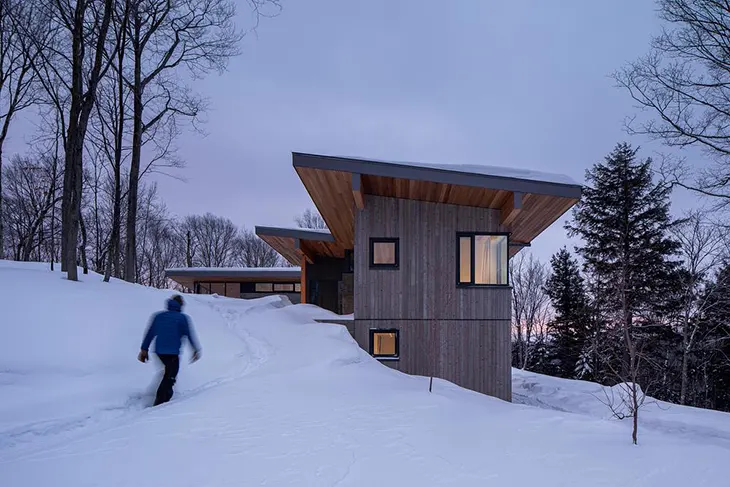
The arrival sequence reinforces immersion in nature. A winding driveway ascends gradually through dense woods, establishing a slow transition from road to retreat. At the parking court, the house opens to the south, while a freestanding two-car garage anchors the northern edge. A stone stair integrates with exposed weathered rock, guiding visitors to an entry walk framed by birch trees and native ferns. Inside, the program organizes itself into two primary volumes: a single-storey living bar to the south and a two-storey sleeping bar extending west and north.
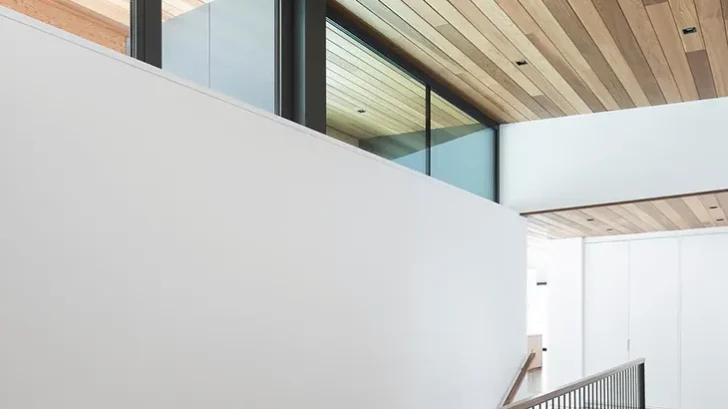
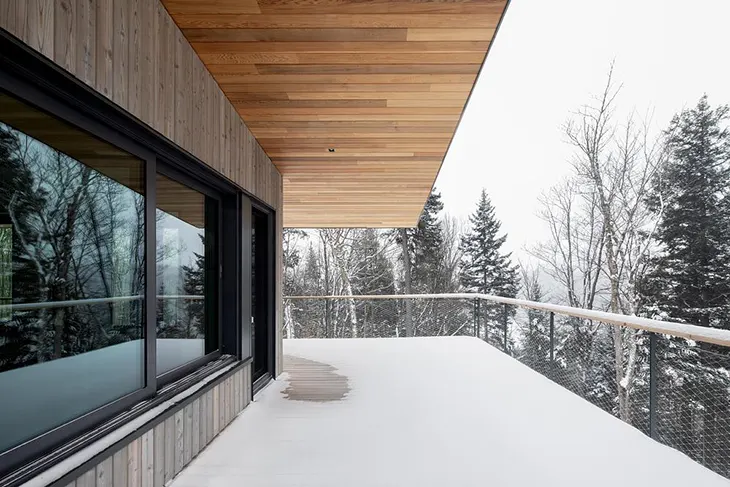
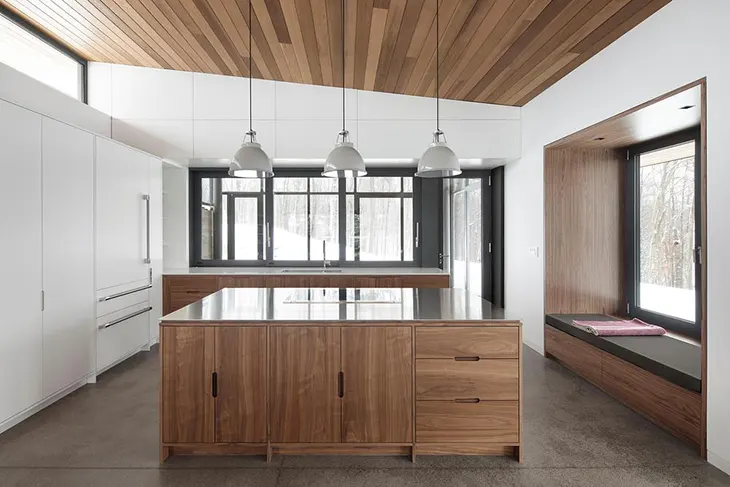
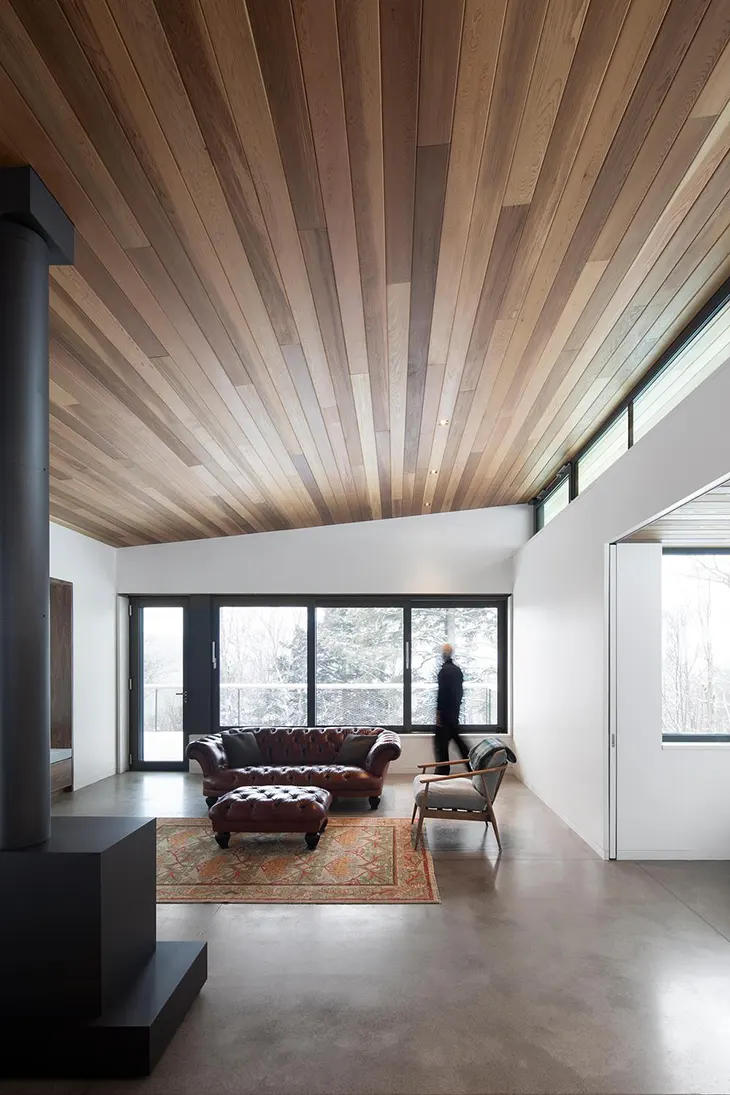
Material restraint shapes the interior atmosphere. A continuous cedar ceiling runs throughout the home, establishing warmth and unity, while custom walnut built-ins provide storage and architectural continuity. Polished concrete floors introduce durability and thermal mass. Generous roof overhangs shield glazing and outdoor areas, and a broad cedar deck extends daily life into the forest canopy. The living bar houses an open-plan kitchen, dining, and living area alongside a screened dining porch. The sleeping bar accommodates three bedrooms, two bathrooms, a private study, and a lower-level living area connected to an entry and mudroom.
Environmental performance drives the technical strategy. The building envelope surpasses Quebec energy code requirements. Designers addressed thermal bridging through careful detailing and layered insulation. Low-VOC spray foam insulates interior wall and ceiling surfaces, while mineral wool cavity insulation wraps the exterior vertical sheathing. This assembly achieves an R-63 roof and R-47 exterior walls. Triple-glazed windows enhance thermal efficiency and occupant comfort throughout the year.
Passive systems guide heating and cooling. Operable clerestory windows and extensive glazing enable cross-ventilation and allow accumulated heat to escape during warmer months. Motorized blinds regulate solar gain. An electric heat pump works in tandem with radiant concrete floor heating to deliver efficient, low-carbon comfort. All mechanical systems operate on electricity, supporting a future transition to on-site renewable energy.
Water management also remains on-site. The project handles drinking water, stormwater, and sewage independently, while wetlands identification and setback strategies protect surrounding ecosystems. Completed in January 2026, Laurentian Forest House demonstrates how architecture and landscape architecture can operate as a unified discipline. Through calibrated siting, durable materials, and high-performance construction, RobitailleCurtis shapes a residence that responds precisely to terrain, climate, and family history without disturbing the summit that inspired it.