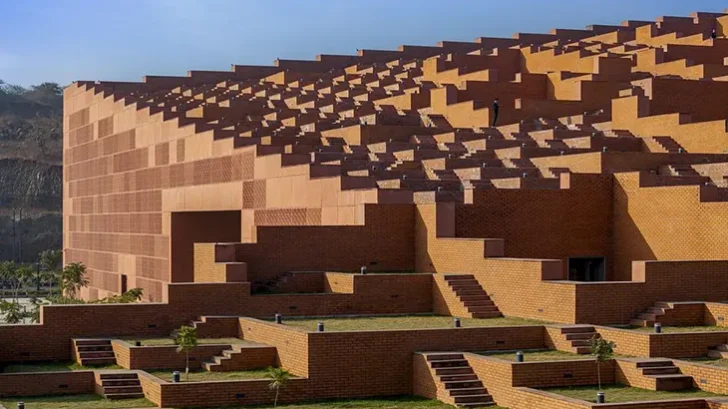

Prestige University in Indore introduces a large academic and civic structure within a 32-acre campus, designed by Sanjay Puri Architects. The building consolidates the university’s administration offices, auditorium, seminar halls, library, cafeteria, and classrooms into a single institutional complex. Completed in January 2026, the project extends across 30,843 square meters and rises five levels above ground. The design responds directly to climate, circulation, and social interaction, establishing a continuous sequence of open and enclosed spaces connected through landscape and section.
EDUCATIONAL
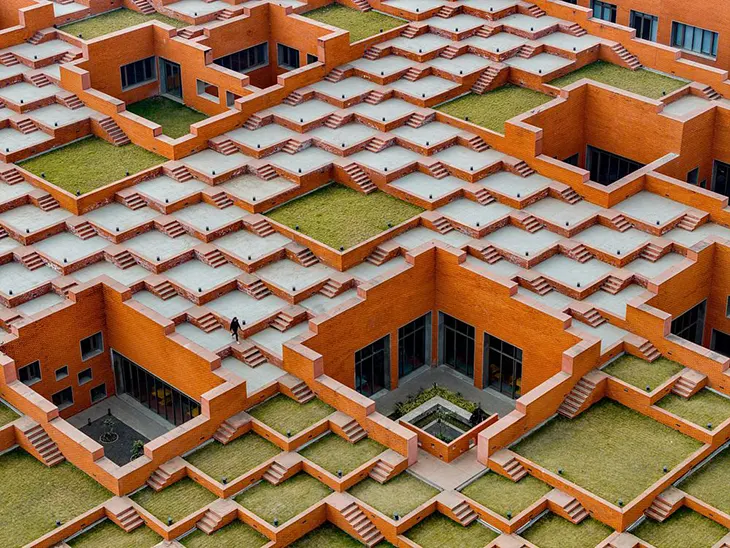
The building avoids the presence of a singular vertical mass. Instead, its profile rises gradually from the approach, stepping diagonally upward from the northern edge. This strategy reduces the perceived height of the 28-meter structure while introducing a layered spatial experience. Each terrace remains accessible, transforming the roof into a continuous public surface. These stepped platforms operate collectively as an open-air auditorium, capable of seating up to 9,000 students. In total, 463 platforms form a rooftop garden measuring approximately 9,000 square meters, extending usable campus space vertically while maintaining accessibility, including wheelchair-accessible routes.
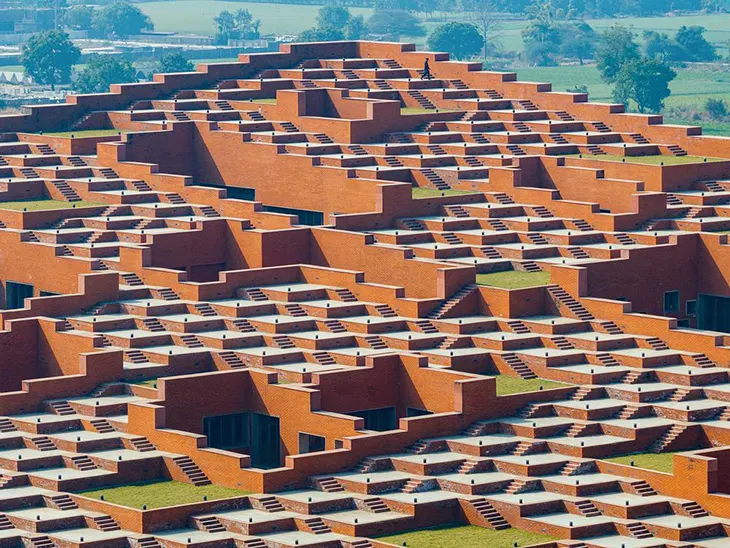
This stepped configuration draws from the spatial logic of historic Indian stepwells, structures that historically served as water reservoirs and gathering spaces. The project translates this principle into an academic setting, where terraces act as informal classrooms, event venues, and social zones. The building becomes both infrastructure and public stage, accommodating large gatherings alongside individual study or informal interaction.
Interior organization follows a clear functional hierarchy. The ground floor contains the most public facilities, including administrative offices, the auditorium, and food court, allowing direct access from campus circulation routes. The first floor houses the library, where bridges cross a diagonal indoor street that cuts through the building’s section. Classrooms occupy the second and third levels, including tiered lecture spaces that draw light and air from adjacent courts. The fourth floor accommodates faculty and administrative functions, completing the institutional program while maintaining visual and spatial continuity with the terraces above.
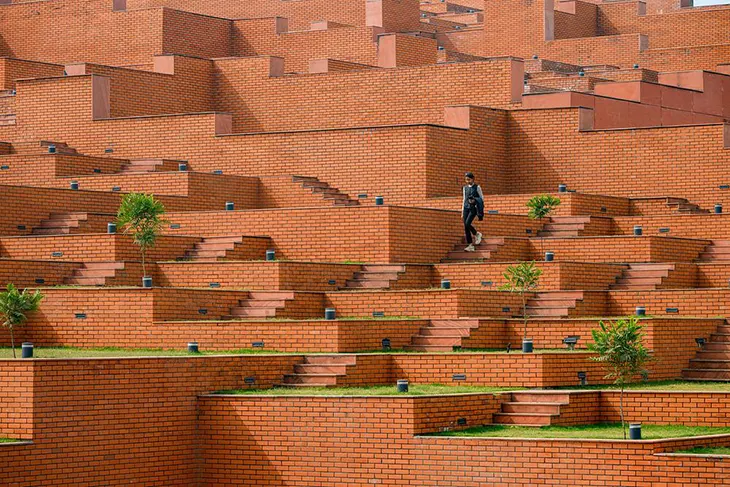
Natural light and ventilation shape the internal environment. Landscaped courtyards punctuate each level, introducing indirect daylight into interior spaces and reducing dependence on artificial lighting. A continuous diagonal circulation spine connects these courts and promotes airflow across the building’s depth. This strategy reflects climatic adaptation to Indore’s extended periods of high temperatures, which range between 30 and 40 degrees Celsius for much of the year. Ventilated GFRC screens wrap the east, west, and south facades, filtering sunlight and reducing heat gain while maintaining air movement.
Landscape integrates directly into the building’s section and circulation. Open courts function as spillover zones for recreation and informal gathering. Terraces support planting that cools exposed surfaces and expands outdoor study areas. The combination of shaded interior courts, ventilated facades, and accessible rooftops establishes a layered environmental response that reduces reliance on mechanical cooling.
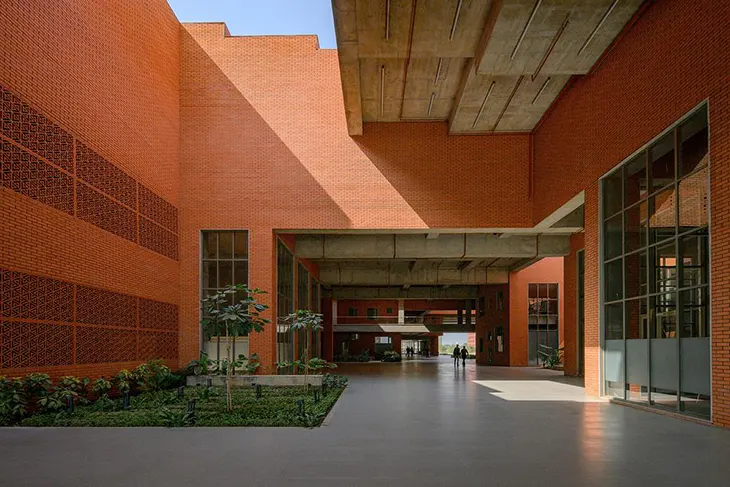
Prestige University operates simultaneously as an academic facility and shared civic environment. Its stepped form supports movement, gathering, and observation across multiple levels, transforming circulation into inhabitable space. Through its integration of terraces, courtyards, and shaded envelopes, the project adapts architectural form to climate while reinforcing the university’s role as a collective social framework.