
In Milan, the most convincing rooms are the ones that feel like they have a pulse, as if you have arrived mid-story, not at a staged reveal. For the fourth edition of Artemest’s L’Appartamento, David Rockwell brings that exact instinct to Palazzo Donizetti’s oval dining room with Bacchanalia: A Ritual in Pleasure, a theatrical installation that frames the space as “the moment after a feast.”
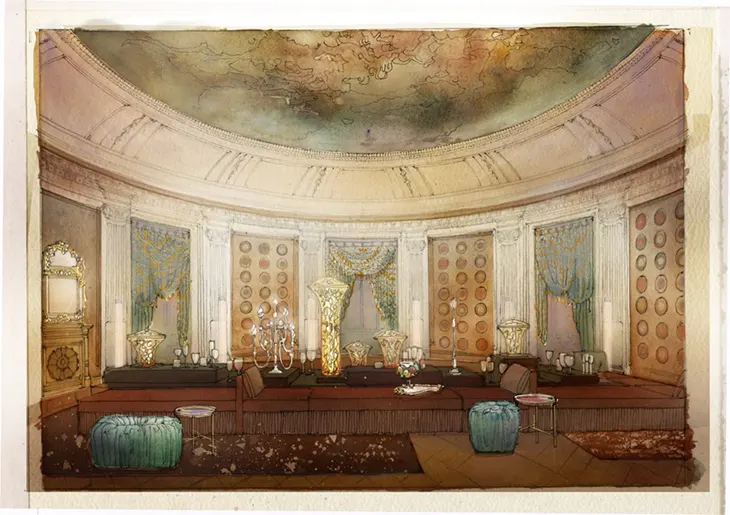
Rather than treating the palazzo’s boiserie, frescoed ceiling, and carved marble fireplace as a backdrop to compete with, Rockwell Group builds from the ground up, translating the ancient Roman triclinium into a contemporary lounge-dining landscape of daybeds, poufs, sculptural seating, and layered tables.
In conversation with ARCHISCENE’s Editor in Chief ZARKO DAVINIC, David Rockwell unpacks how a “post-feast” atmosphere can be designed without becoming a literal set, why the studio’s lack of a signature style is a strategic advantage, and how Italian craftsmanship, through Artemest’s network of artisans, turns a dining room into a ritual where design, performance, and pleasure converge.
Bacchanalia: A Ritual in Pleasure frames the room as “the moment after a feast.” What did you want visitors to feel in the first 30 seconds, and what’s the one detail that carries that emotion? – As guests to the Palazzo [Donizetti] enter the dining room, we hope the scene will invite questions and conversation about what appears to be a post-feast moment, where evidence of indulgence remains and the energy of the gathering is still palpable. Traces of the feast appear in unexpected ways, such as a carpet that suggests wine spilled long ago, layered table settings left deliberately askew, and surfaces that invite closer inspection. The dining table is the centrepiece of our concept. It allows guests to circulate and experience the room from all angles, providing guests with new points of views from different locations.
LATEST FROM MILAN DESIGN WEEK
You cite the triclinium as a key reference. How did you translate an ancient Roman dining ritual into a contemporary Milan Design Week experience without turning it into a literal set? – The conceptual heart of our design was inspired by the triclinium, an ancient Roman dining room structured by three couches (lecti) arranged in a U-shape around low tables (mensae), where guests reclined to eat, collapsing distinctions between architecture, ritual, and leisure. We translated this ritual into a low lounge dining environment, where sculptural seating, daybeds, poufs, and layered tables encourage guests to recline, linger, and engage. Our design is an abstraction, which keeps it from taking on any literal translation. This is supported by the other objects in the room and our palette.
“At Rockwell Group, we don’t have a signature style, so that helps us avoid cliches and trends from the beginning. There’s an incredible amount of energy at our studio and we have a strong sense of curiosity which drives us to explore ideas, to take creative risks, and to hopefully create something new and meaningful for our clients each and every time.”
Leaning into Naples as “raw and refined, sacred and playful.” Which specific Neapolitan cues did you use (materials, color, iconography, behavior), and which clichés did you actively avoid? – Naples’s volcanic spirit also infuses the room. Vesuvius is an ever-present force shaping the city’s psyche and serves as a reminder of beauty entwined with danger. This tension is reflected in the palette and materials, drawing from ornate interiors, the treasures of the Tesoro di San Gennaro, and the dramatic chiaroscuro of Caravaggio. Gold-toned metals, warm marbles, deep mineral hues, and oceanic blues play against one another, creating a heightened contrast of light and shadow. White marble elements glow against darker, enveloping surfaces, while embellished drapery frames views like theatrical curtains.
At Rockwell Group, we don’t have a signature style, so that helps us avoid cliches and trends from the beginning. There’s an incredible amount of energy at our studio and we have a strong sense of curiosity which drives us to explore ideas, to take creative risks, and to hopefully create something new and meaningful for our clients each and every time. We begin each project with an enormous amount of research: into the client, the location, the typology, the local culture and precedents, the climate – this project, and our research into Naples, was no different. All of this builds a foundation for a specific narrative and story that is unique to each project.
Given the historical context of the room, we did not suspend any elements from above, allowing the artwork to remain unobstructed, so we focused on designing from the ground up.
The room preserves major historic elements, boiserie, frescoed ceiling, marble fireplace. What was the biggest negotiation between the existing architecture and your new layer, and where did you decide to “stay quiet”? – Set within Palazzo Donizetti, the dining room’s historic architecture, boiserie, frescoed ceiling, carved marble fireplace, and luminous proportions remain intact. The scene will invite questions and conversation about what appears to be a post-feast moment, where traces of indulgence remain and the energy of the gathering is still palpable. We wanted the dining room to invite guests to slow down and take a moment of pause and encourage them to examine every detail of the space. Given the historical context of the room, we did not suspend any elements from above, allowing the artwork to remain unobstructed, so we focused on designing from the ground up. The central dining table allows guests to circulate and experience the room from all angles, providing guests with new points of views from different locations. We layered furniture around the table and styled the table to draw the eye upward. Decorative lighting and candlelight, and uplighting around the perimeter work together to create depth and drama.
One of the things we love about Italian design is that it is created to evoke emotion, tell a story, and embody “la dolce vita,” making these elements more than just functional items.
You blur art and function, plates as wall art, framed pieces as trays, drinkware as towers. What’s your rule of thumb for when an object can safely cross that line and still read as usable, not just decorative? – In this case, we had the freedom to not think solely about function in the same way we might at, say, a restaurant. The Artemest L’Appartamento is all about suspending belief and entering a world full of discoveries and providing guests an opportunity to be exposed to incredible craft and artistry. One of the things we love about Italian design is that it is created to evoke emotion, tell a story, and embody “la dolce vita,” making these elements more than just functional items. Because we were dipping into the myth-making of the city of Naples and the lore of the place, we felt we had license to lean into a bit of surrealism and play.
Lighting is described as theatrical, including “inverted chandeliers” and oil-lamp-like glow. How did you choreograph light to support the narrative of aftermath and conviviality, and what time of-day mood were you aiming for? – We wanted to create a dining environment that does not look overly precious or perfectly aligned, so the lighting is designed to destabilise expectations. An inverted chandelier that sits on the dining table appears as if it has fallen from the ceiling. Candlesticks hold florals, while uplighting along the perimeter of the room and concealed light sources that recall ancient oil lamps, bathe the room in a sensual, atmospheric glow. The result is a dining room that exists between realism and surrealism, order and improvisation.
Italian craftsmanship is unique because of the way it blends centuries-old tradition and innovation. The ability to marry tradition with modernity is what truly makes Italian craftsmanship unique in today’s global design landscape.
Zooming out, what do you hope this dining room says about Italian craftsmanship today, and how does collaborating with Artemest change the way you design compared to a typical hospitality or cultural project? – Italian craftsmanship is unique because of the way it blends centuries-old tradition and innovation. The ability to marry tradition with modernity is what truly makes Italian craftsmanship unique in today’s global design landscape. Having access to Artemest’s network of artisans means access to rare craftsmanship, skills, authenticity, and the opportunity to play a role in cultural preservation. Through Artemest’s extraordinary craftsmanship and a contemporary lens, the room becomes a ritual of pleasure, where dining, art, and performance converge.
Address: L’Appartamentoby Artemest, Palazzo Donizetti, Via Gaetano Donizetti, 48, 20122 Milano
Public Opening: April 21-22 (10am–6pm) & April 23-26 (10am–7pm)