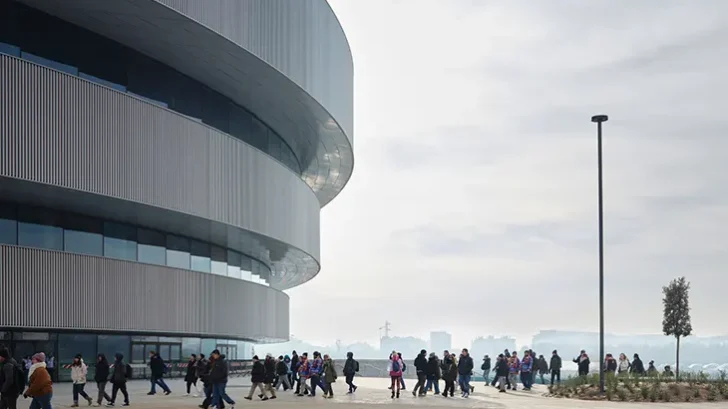

The redevelopment of Milano Santa Giulia introduces a new civic anchor to the south-east of Milan, positioning architecture as both infrastructure and shared space. At the centre of this emerging neighbourhood stands a large-scale arena designed through a collaboration between Arup and David Chipperfield Architects. Conceived to host sports, concerts, festivals, and major cultural events, the arena accommodates up to 16,000 visitors and forms the spatial and social core of the wider masterplan.
SPORTS VENUES
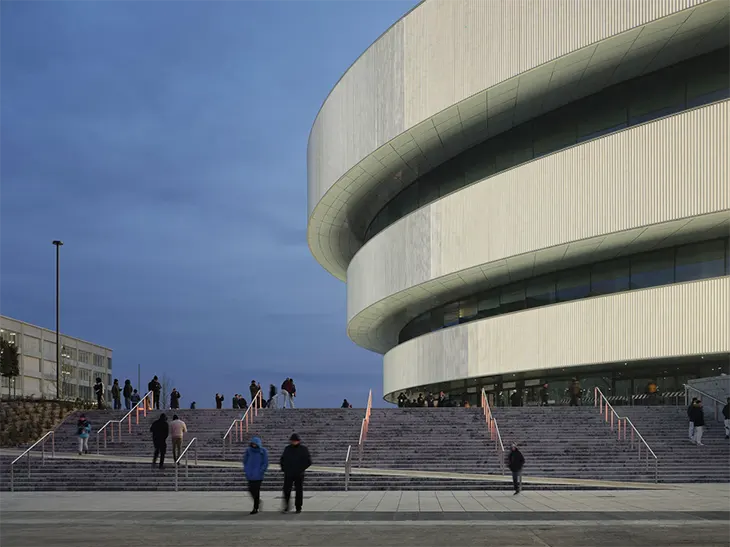
The building’s form draws on a familiar historical reference while translating it into a contemporary language. Echoing the elliptical geometry of Roman amphitheatres, the arena reinterprets this archetype through clarity of structure and urban presence. Its orientation and placement at the southern edge of the site establish a clear point of arrival. Slightly rotated, the building addresses visitors approaching from the west, guiding them upward along a broad flight of steps that leads to a raised podium occupying almost the entire plot.
This podium operates as more than a base. It functions as an elevated public ground, hosting a piazza of over 10,000 square metres that extends the life of the arena beyond programmed events. The space offers flexibility for outdoor gatherings and informal use, allowing the building to remain active even when the arena itself is not in operation. In this way, the project positions collective space as a primary architectural element rather than a secondary condition.
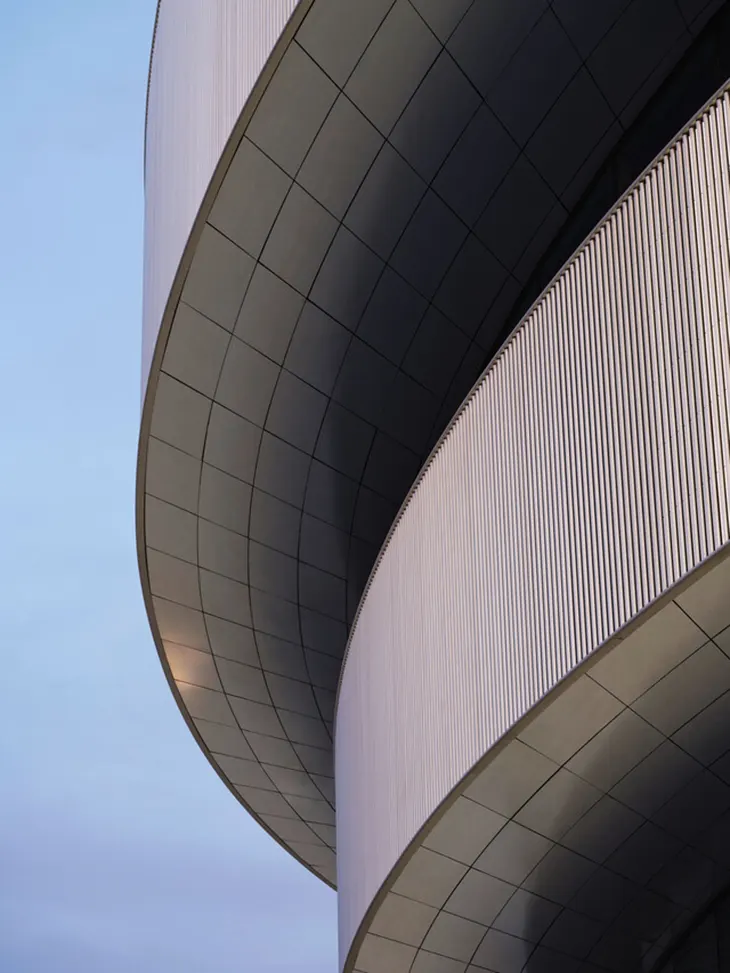
Rising from the podium, three concentric rings of increasing height wrap around the structure, creating the arena’s distinctive profile. These elements appear to hover above one another, lending the building a sense of lightness despite its scale. Their metallic surface is composed of aluminium tubes that respond to daylight with subtle shifts in reflection. At night, integrated LED systems transform the rings into a luminous presence, reinforcing the arena’s role as a landmark within the district.
The material contrast between podium and superstructure plays a key role in the project’s spatial character. The solid, monolithic base grounds the building, while the layered rings introduce movement and visual rhythm. This firmness is softened by the integration of green spaces. Trees and planted areas cascade down the staircase, forming a sloped, park-like landscape that connects the elevated piazza with ground level and invites lingering rather than simple passage.
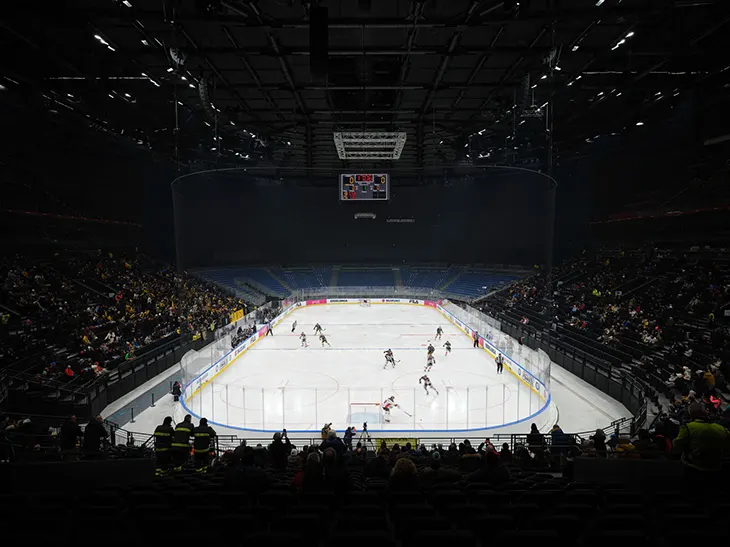
Inside, the arena is organised for clarity and accessibility. Two seating tiers rise above the parterre, complemented by an upper level housing lounges and sky boxes. Circulation occurs through generous lobbies on each level, ensuring direct access to seating, catering, and services without congestion. Parking is integrated discreetly within the podium and supported by a separate multi-storey facility to the north, maintaining the continuity of public space across the site.
Environmental performance forms an integral part of the design strategy. Measures aimed at reducing resource use and CO₂ emissions are embedded within the building systems, while photovoltaic installations on the roof contribute significantly to on-site energy demand. The arena’s role as a venue for the Winter Olympic Games in early 2026 adds further weight to its ambition, positioning the project as both a functional event space and a long-term civic investment for Milan.
Through its balance of scale, public accessibility, and formal restraint, the Milano Santa Giulia arena presents architecture as a framework for shared experience. The collaboration between Arup and David Chipperfield Architects results in a building that anchors a new district while offering Milan a contemporary space for collective gathering, rooted in history yet oriented firmly toward the future.