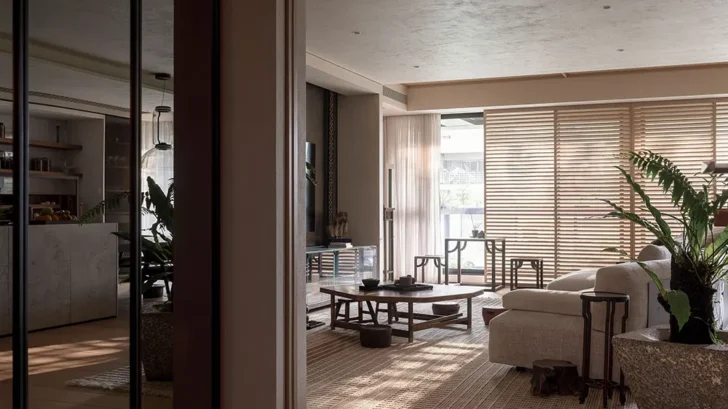

Taipei Collector’s Home by Chih-Da Jason Lin transforms a family residence into a deeply personal study of art, memory and daily life. Located on Qingtian Street in Taipei’s Da’an District, the project combines two adjacent apartments into a 350 square meter three-bedroom home for the architect’s parents. Rather than treating the residence as a private gallery, Lin creates a lived environment where museum objects, auction pieces and family heirlooms become part of everyday domestic rhythm.
INTERIOR DESIGN
The project takes shape around two key ideas: fluid circulation and non-interference. Lin removes existing partitions and reorganizes the plan into an open, continuous interior where movement, light and sightlines connect different areas without forcing them together. The common spaces encourage gathering, while private rooms sit along the perimeter, discreetly defined by thresholds and concealed doors. This arrangement allows solitude and family life to coexist without disturbance.
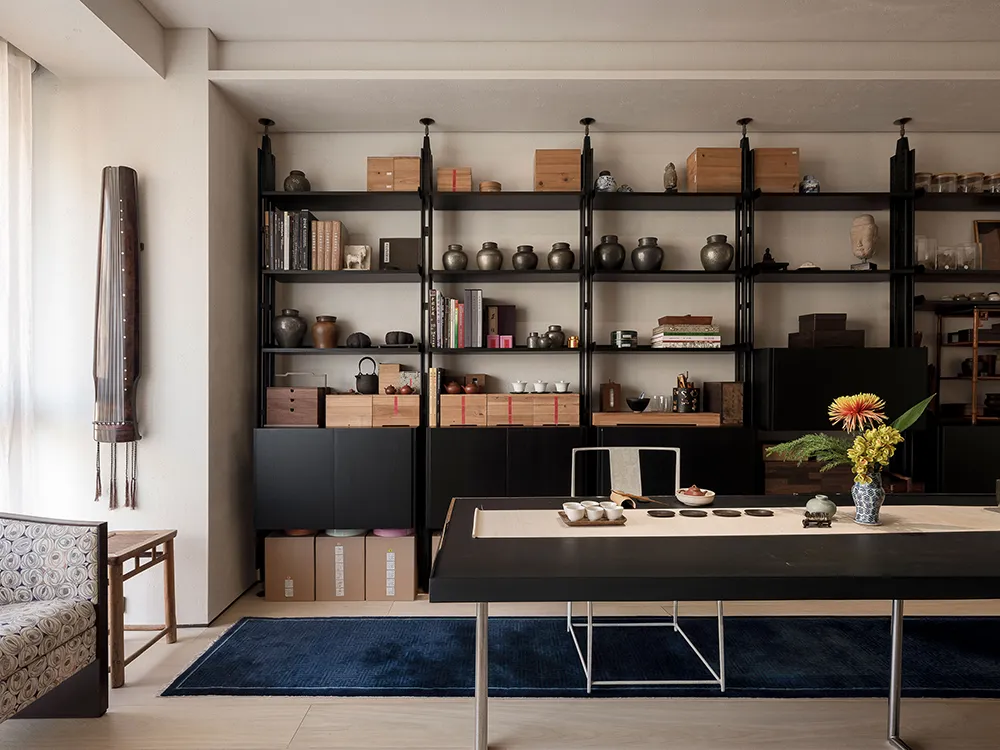
Qingtian Street’s history as a literati enclave gives the project a wider cultural frame. Lin does not rely on obvious decorative references. Instead, he builds atmosphere through spatial order, material restraint and objects with personal and historical weight. The home becomes a contemporary interpretation of Chinese domestic space, where collecting, ritual and inherited memory shape the interior.
Tea culture plays a central role. Responding to his parents’ way of living, Lin creates two distinct tea settings. One offers a quiet, minimal environment for floor-seated rituals. The other centers on a dark wood tea table and a wall of tea ware, supporting both solitary use and family gatherings. Chinese and Western kitchens are also separated, allowing different cooking habits to function without conflict.
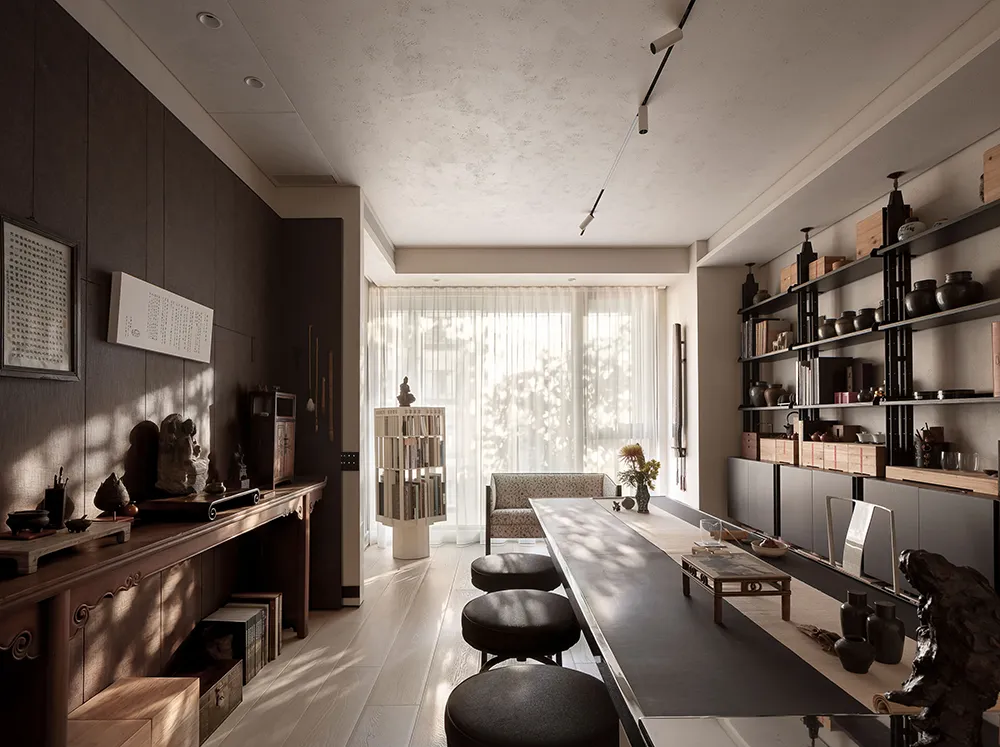
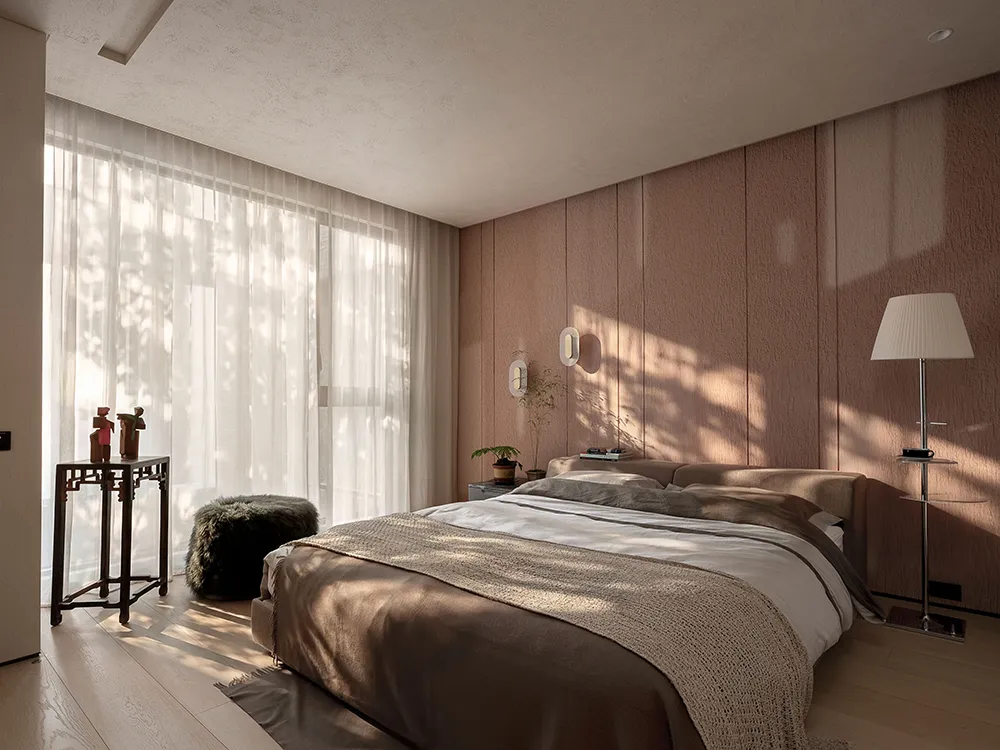
The material palette supports the home’s calm mood. Soft beige tones create a warm visual base, while textured wall finishes and gentle coatings diffuse light across the rooms. Grey-brown and natural oak surfaces add tactility, while Carrara marble and dark tiles introduce contrast without disrupting the overall restraint. Large windows and adjustable louvers bring changing light into the interior, creating subtle shifts in atmosphere throughout the day.
Art and furniture carry the strongest emotional charge. Contemporary pieces from HENGE, Cassina and Boffi sit alongside Han dynasty stone sculptures, Western Wei Buddhist figures, paintings by Sanyu and Ming dynasty huanghuali official’s hat chairs. These works are not isolated as display pieces. They enter the architecture as part of daily life. As Lin’s father notes, a Ming dynasty chair at home carries a material and historical value that exceeds luxury. In this project, such pieces become part of the spatial fabric.
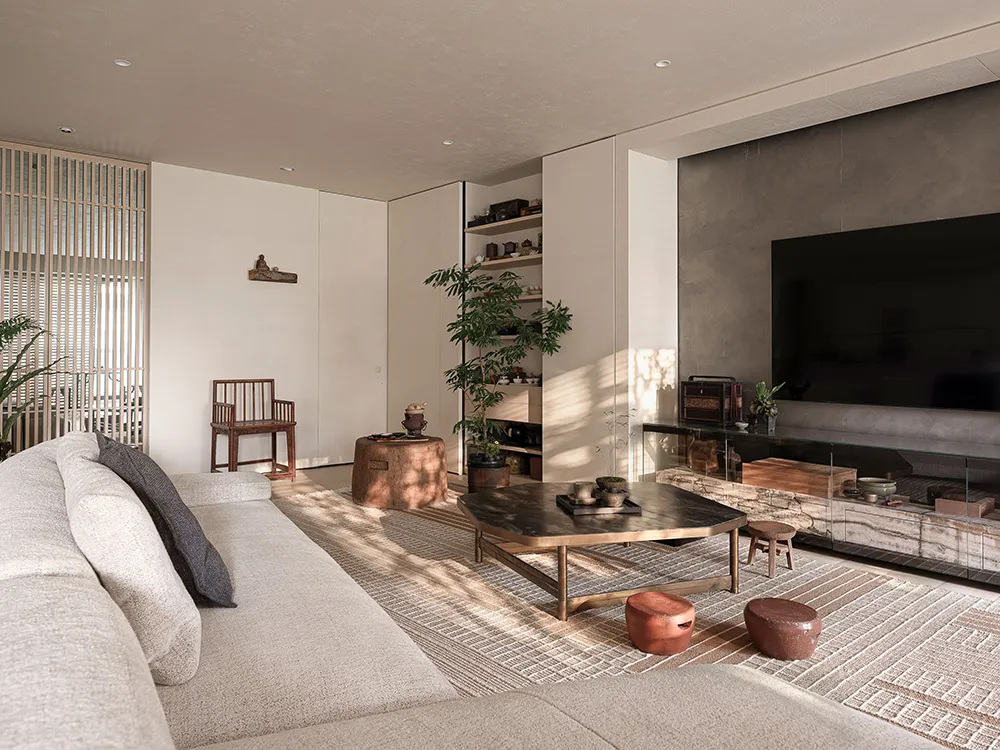
The mother’s tea room gives the home one of its most intimate cultural details. Sliding doors incorporate handcrafted Taiwanese latticework, referencing her childhood in Yilan. The pattern turns memory into light and shadow, linking family history to regional craft. Minnan-style antique furniture, Italian vintage pieces and Buddhist sculptures extend this dialogue between place, inheritance and inner calm.
Taipei Collector’s Home treats collecting as a way of living, not as possession. Lin creates a residence where architecture provides order, while art and objects bring warmth, depth and continuity. The result is a refined urban retreat that connects family heritage, cultural memory and contemporary life within one quiet, carefully composed interior.